
AI is changing what companies expect from CRM. What used to be a system of record is becoming a system for prioritization, recommendation, and commercial action.
Sales teams want better signals on where to focus. Service teams want faster, more contextual responses. Leadership teams want AI to improve revenue execution and customer experience, not add another disconnected layer of complexity.
In this article, we look at how AI is reshaping CRM, why China changes the execution model, where different architectures fit, and how leaders can choose a practical path before they choose a platform.
Executive Summary:
1. AI-powered CRM in China is not mainly a software-feature decision. It is an operating-model decision about workflows, governance, data quality, and local execution.
2. The strongest use cases are usually the ones closest to real commercial action: clienteling, prioritization, distributor follow-through, and service coordination.
3. For companies already using Salesforce globally or already operating on Salesforce on Alibaba Cloud, extending AI inside the same governed CRM environment is often cleaner than layering on disconnected tools.
4. That does not make Salesforce on Alibaba Cloud the default answer for every company in China. Some businesses are better served by a more local-first or lighter architecture.
5. Leaders should evaluate five practical dimensions—business model fit, governance complexity, ecosystem priorities, AI ambition, and scalability—before committing budget, timeline, and delivery resources.
Table of contents
- Why AI Is Changing CRM From System of Record to Commercial Engine
- Why China Changes the Operating Model
- Where Salesforce on Alibaba Cloud Fits—and Where It Does Not
- Where AI-Powered CRM in China Creates the Clearest Value
- The Five Practical Dimensions Leaders Should Test
- What Leaders Should Do Next
- Conclusion
Why AI Is Changing CRM From System of Record to Commercial Engine
Traditional CRM was built to capture activity, preserve customer history, and standardize workflows. That is no longer enough.
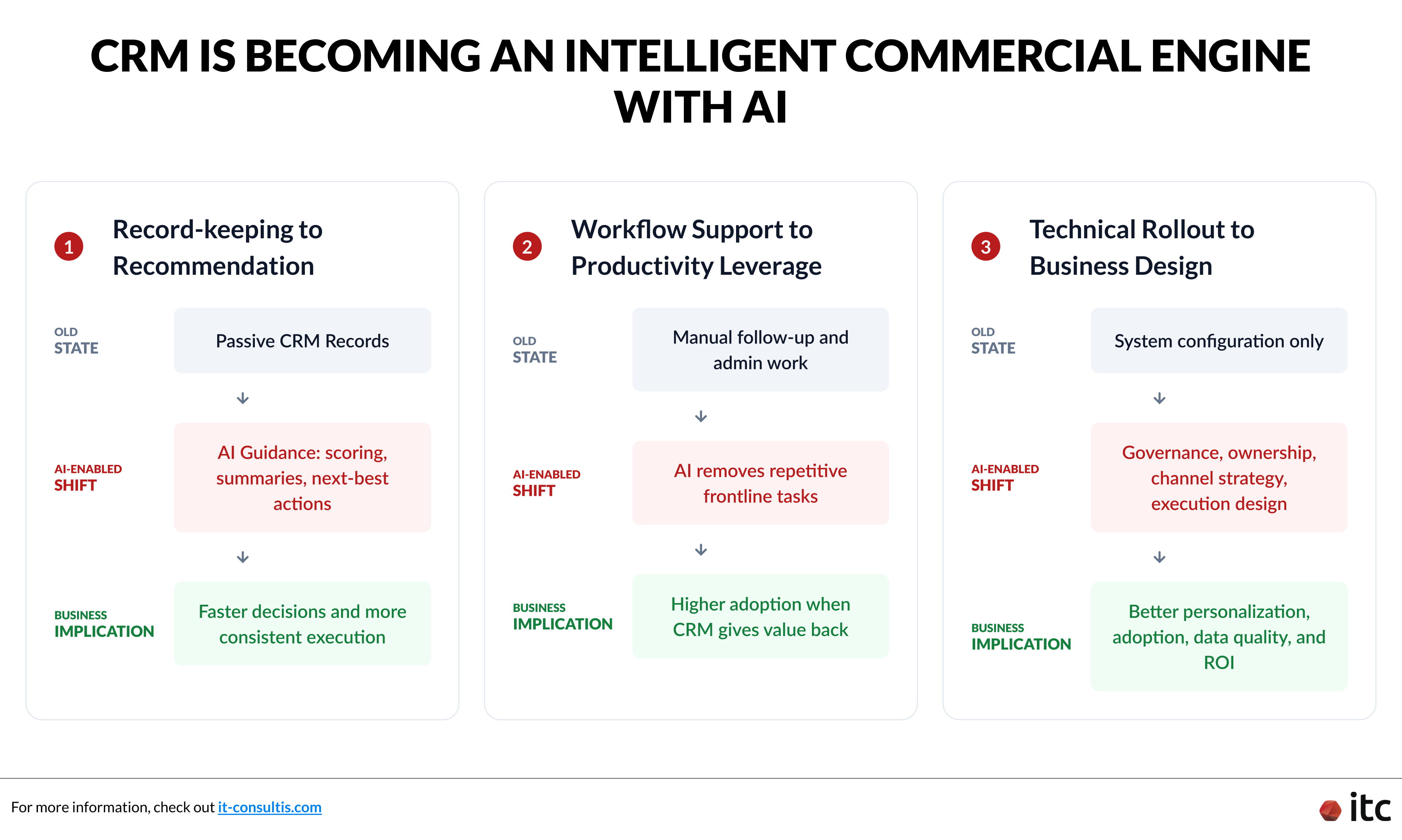
1. From Record-Keeping to Recommendation
CRM is moving from passive storage toward active guidance. Instead of only showing what happened, the system increasingly helps teams decide what to do next. That can include:
- Prioritizing leads based on likelihood to convert
- Generating summaries from fragmented sales or service activity
- Recommending next-best actions for sales, service, or clienteling teams
- Helping teams produce more relevant outreach at scale
The commercial value is direct: less time spent assembling context, faster decision cycles, and more consistent customer-facing execution.
2. From Workflow Support to Productivity Leverage
Generative and predictive capabilities are starting to remove low-value manual work from frontline teams. Drafting follow-up messages, summarizing account changes, preparing service responses, and highlighting pipeline risks no longer need to be fully manual tasks.
That matters because CRM adoption often breaks down when the system creates admin burden without returning enough value to the people expected to use it.
3. From Technical Rollout to Business Design
Once AI enters CRM, the conversation moves beyond software configuration. It becomes a question of execution design, ownership, governance, channel strategy, and commercial priorities.
That shift is especially important in China, where local platforms, compliance requirements, and organization design can reshape what a workable CRM model actually looks like.
Why China Changes the Operating Model
The global AI + CRM story is easy to understand: use AI to personalize at scale, improve productivity, and sharpen decisions.
The China reality is harder because the same ambition has to operate inside a different digital and organizational environment.
1. Local Platforms Shape Customer Engagement
In China, customer interaction often runs through local ecosystems such as WeChat and WeCom rather than the channel mix many global teams are used to.
That changes what data is available, how journeys are orchestrated, and where frontline teams actually work day to day.
The same applies to marketing tooling: Marketing Cloud is not offered as a China-hosted product, so see our guide to Salesforce Marketing Cloud China for the local options.
2. Governance Is Part of the Design, Not a Side Constraint
China CRM decisions quickly run into questions around data location, approval logic, integration boundaries, and operating control. These are not side issues. They influence:
- What can be activated
- How quickly it can scale
- How much confidence the wider organization has in the setup
3. Language and Local Context Determine Usefulness
AI only creates value when outputs are relevant to the teams using them and the customers receiving them.
In China, that means local language, local channel behavior, local customer expectations, and China-specific business context need to be reflected in the CRM model. Otherwise, AI remains technically available but commercially weak.
For more information, check out why brands need to fortify CRM in China.
Where Salesforce on Alibaba Cloud Fits—and Where It Does Not
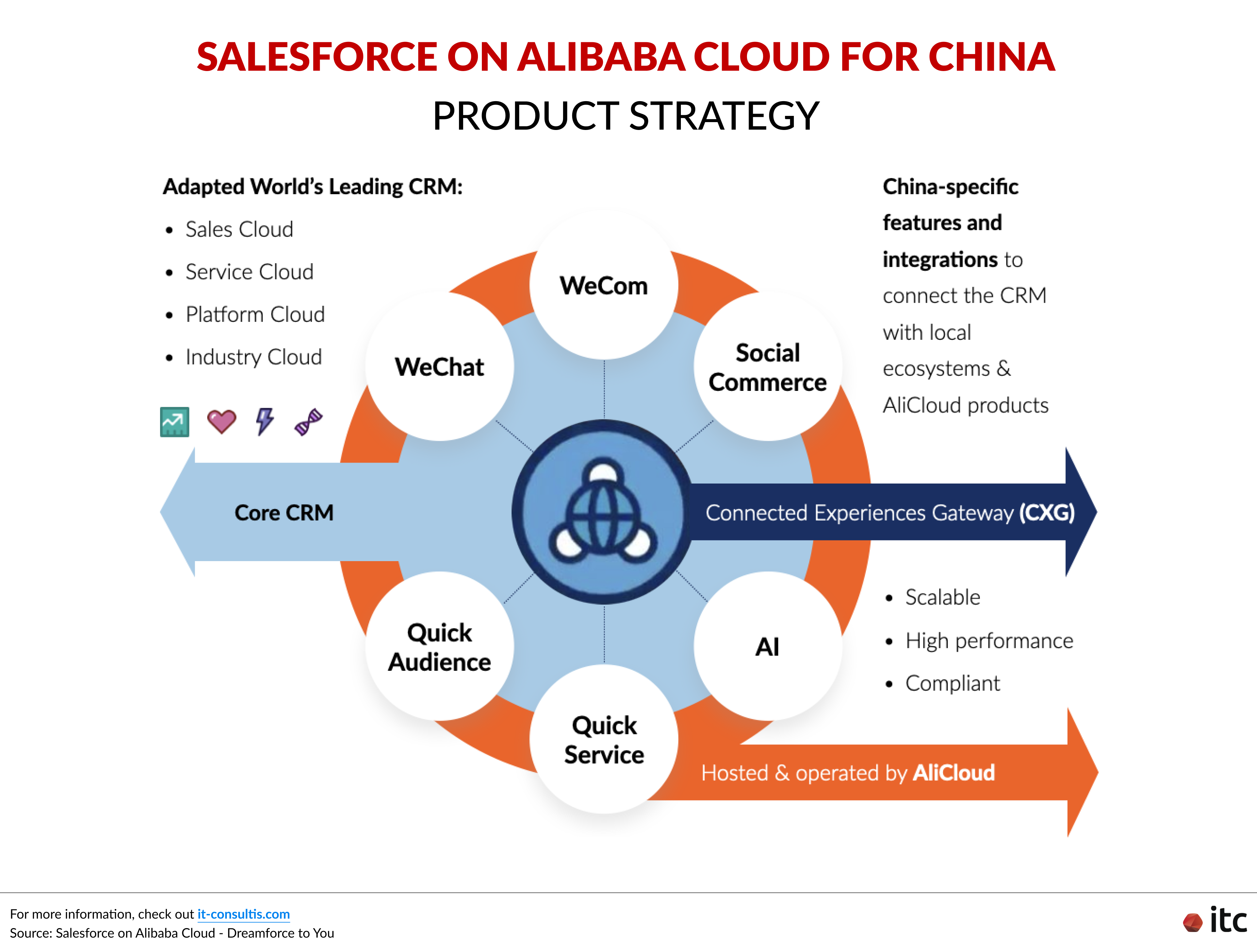
Salesforce on Alibaba Cloud is the stronger fit when a company wants AI inside a China-hosted, enterprise-governed CRM environment rather than through a disconnected third-party layer.
That is especially true for companies already using a global Salesforce instance or already operating on Salesforce on Alibaba Cloud.
In those situations, extending AI within the same environment is often the cleaner path because it stays closer to the existing CRM data model, workflow logic, and governance standards the business already relies on.
It is also relevant when leaders want China teams to work in locally viable workflows while maintaining continuity with broader Salesforce governance, implementation ownership, and reporting structure.
When It Is Not Automatically the Best Fit
A stronger recommendation should be earned, not assumed.
A more local-first or lighter CRM model may make more sense when:
- China operates with substantial autonomy and limited need for global CRM continuity
- The immediate goal is fast local execution rather than enterprise-wide governance alignment
- The use case is narrow enough that a full Salesforce-centered architecture would be excessive
- Data discipline, process maturity, or channel integration are still too weak for a larger platform decision to create near-term value
The key question is not which option sounds more strategic in theory. It is which architecture best supports the company’s real China operating model.
Where AI-Powered CRM in China Creates the Clearest Value
The more useful question is not whether AI belongs in CRM. It is where it can improve commercial execution in China without breaking the workflows local teams already use.
Luxury Retail and Premium Clienteling
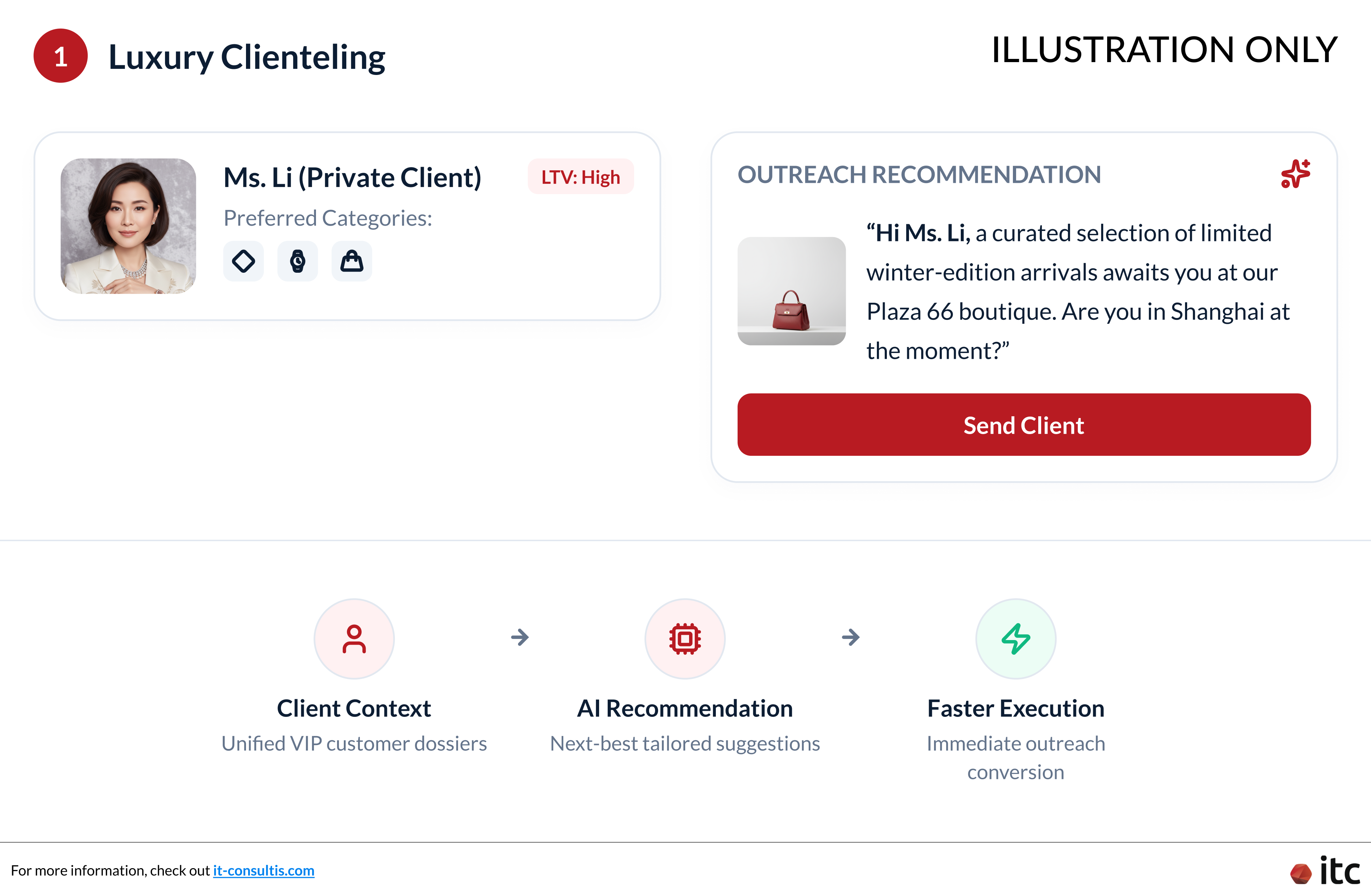
For luxury and premium brands in China, AI is most useful when it helps sales associates act on customer context faster and more consistently across boutiques, cities, and customer tiers.
AI can help by:
- Summarizing recent customer interactions and purchase signals
- Suggesting more tailored outreach based on profile, affinity, or engagement patterns
- Surfacing next-best actions for reactivation, follow-up, or service recovery
- Helping teams maintain more consistent service quality without making outreach feel scripted
In this model, Salesforce on Alibaba Cloud becomes relevant when AI-assisted execution stays close to CRM data and the local channels teams already use.
In practice, that often means connecting CRM context into a Connected Experiences Gateway (CXG) / WeCom Mini Program workflow rather than expecting sales associates to work inside a separate AI tool.
The goal is not to introduce another interface. It is to help frontline teams act faster inside the WeChat-connected workflow they already use.
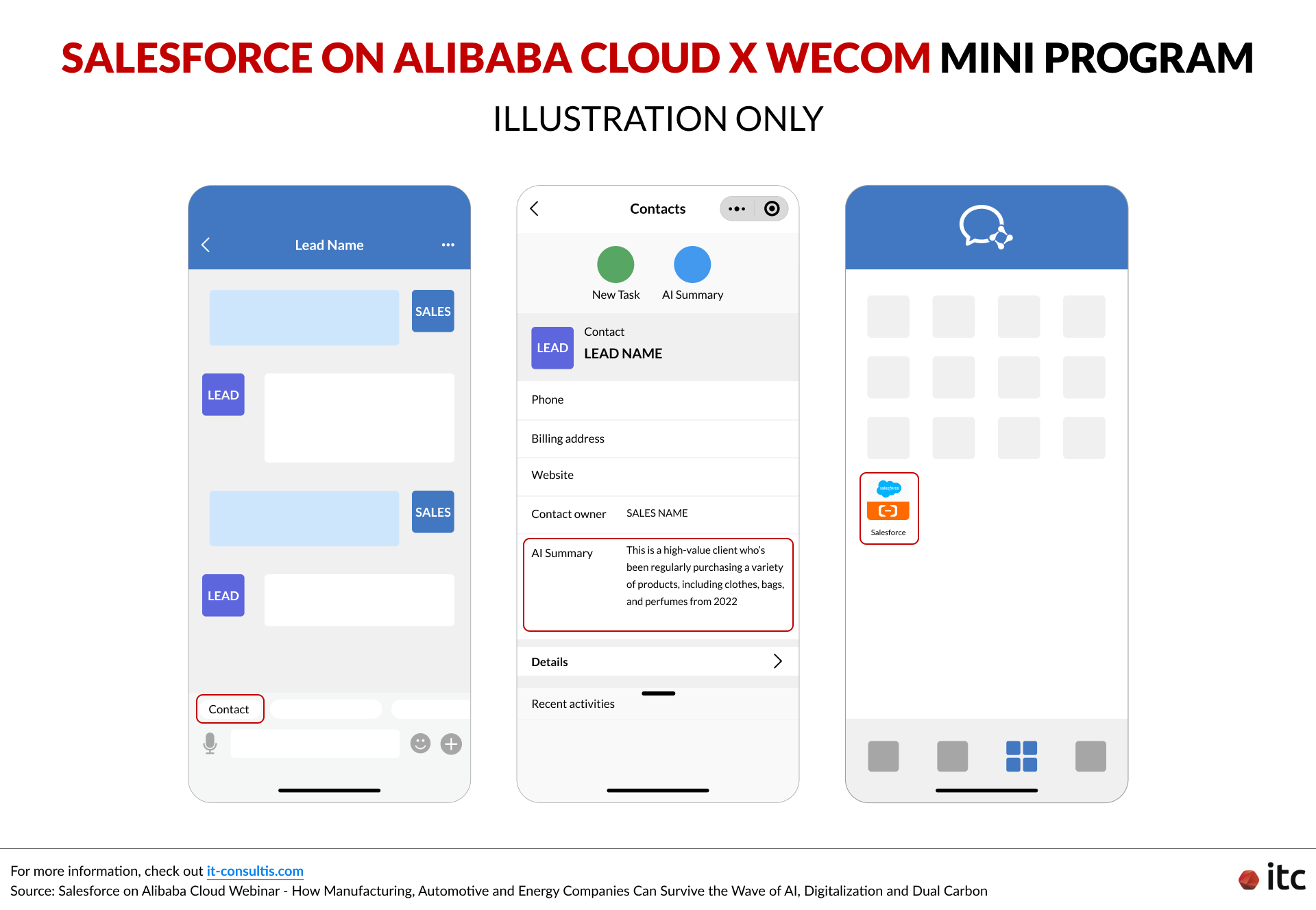
This should not be confused with WeCom’s native AI. The value here comes from connecting CRM context to the local engagement workflow, not from treating WeCom itself as the core AI layer.
An anonymized example from IT Consultis’s luxury CRM work in China:
One heritage luxury brand first had to stabilize migration readiness, data synchronization, and reporting support before localized clienteling enhancements could create real frontline value.
Only after that operational foundation was in place did successive clienteling-app upgrades and a localized personalization app become commercially useful.
The lesson is simple: in China luxury retail, AI value is usually unlocked after workflow stability, not before it.
B2B Sales Prioritization and Distributor Visibility
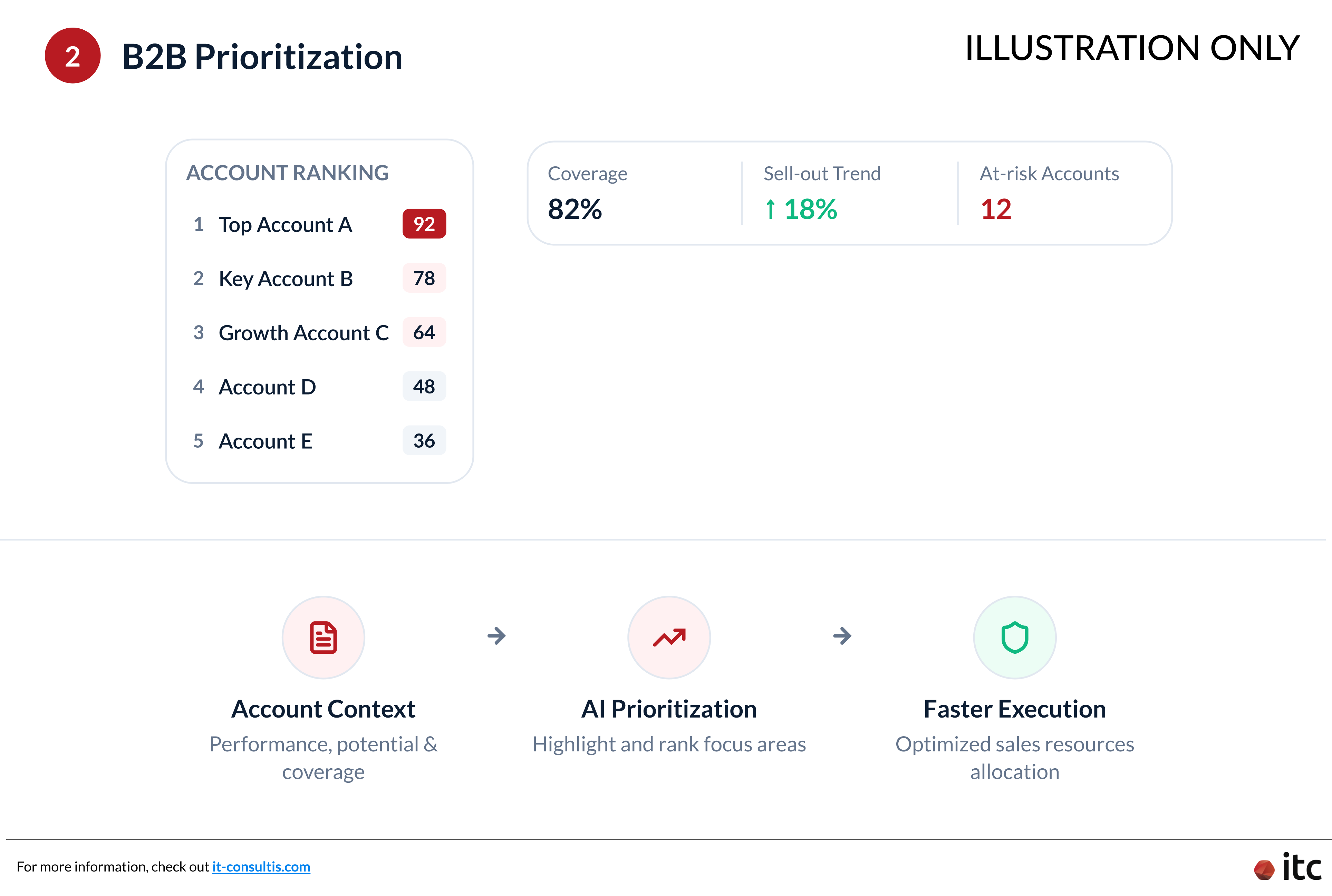
For B2B organizations in China, especially those managing local teams, distributors, or partner-influenced pipelines, AI creates value when it improves prioritization and follow-through rather than simply generating cleaner dashboards.
AI can help by:
- Generating account and opportunity summaries before meetings
- Highlighting stalled deals or inconsistent follow-up patterns
- Ranking leads or accounts based on commercial and behavioral signals
- Recommending next actions for teams managing long or multi-party sales cycles
For example, in sectors such as manufacturing, industrial equipment, or automotive, local teams often rely on a mix of direct-sales activity, distributor updates, and partner follow-through. If those signals do not enter CRM cleanly, AI scoring and recommendations quickly become cosmetic.
That is why the real value is not the model alone. It is the ability to capture China-relevant signals—field updates, distributor movement, follow-up activity, and account context—inside a governed structure local teams can actually maintain.
In that situation, the challenge is rarely a lack of AI. It is weak execution design underneath the AI layer.
For more information, explore how AI can be applied to specific sectors like life sciences and automotive through Salesforce on Alibaba Cloud’s industry cloud solutions tailored to their workflows, data needs, and customer engagement model.
The Five Practical Dimensions Leaders Should Test
Before leaders compare AI features, vendors, or platform roadmaps, they should test whether their CRM environment is actually ready to support useful AI in China.
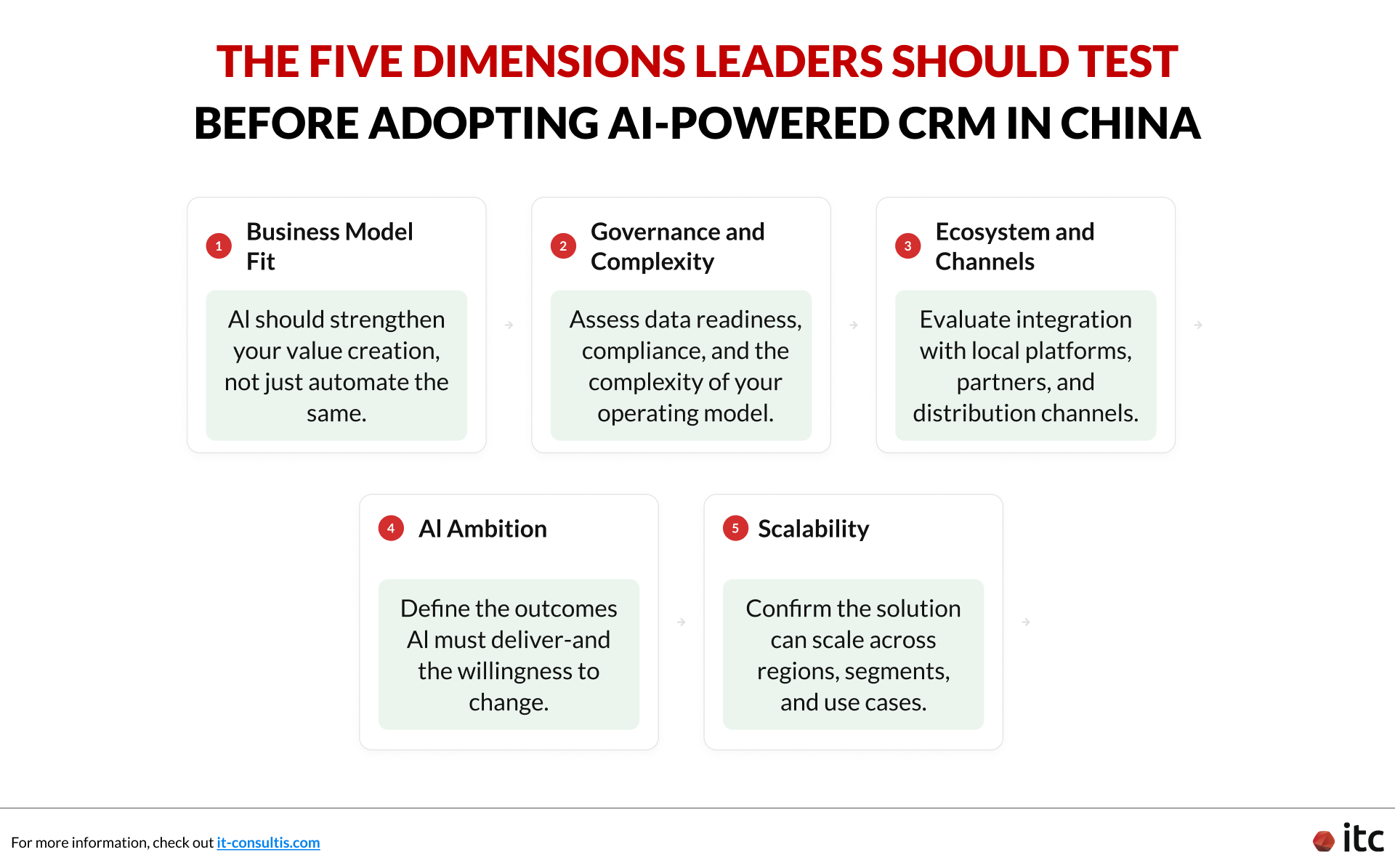
Leaders should test five practical dimensions:
- Business model fit: Is China operating largely as a self-contained commercial environment, or as part of a broader multi-market customer model? The answer affects how much CRM continuity matters.
- Governance and complexity: How much consistency does the organization need in reporting, workflows, permissions, and management visibility? The more important enterprise control becomes, the more costly fragmentation becomes.
- Ecosystem and channel priorities: How central are China-specific digital platforms and local engagement channels to daily commercial execution? CRM choices should reflect where customer interactions actually happen.
- AI ambition: Is the company aiming for limited automation, or for a more ambitious AI-enabled commercial model? The more strategic the AI agenda, the more important the CRM foundation becomes.
- Scalability over time: Will the chosen model still make sense as the business grows, adds use cases, or increases integration demands? A short-term fix may not support long-term commercial development.
If any of those dimensions are weak, AI will usually look stronger in demos than it performs in live operations.
What Leaders Should Do Next
1. Define the China workflows first
Clarify how China generates demand, manages relationships, runs sales or service motions, and coordinates with regional or global teams. If that picture is vague, the AI discussion will stay vague too.
2. Prioritize 2–3 high-value use cases:
Do not start with broad AI ambition. Start with the workflows that matter most commercially, such as clienteling productivity, distributor follow-through, B2B prioritization, or service coordination.
3. Run a practical assessment before a broad rollout:
In many enterprise environments, a realistic first phase is a 6–10 week architecture and use-case assessment covering data readiness, workflow fit, governance, and integration constraints. That is usually a better starting point than jumping straight into a large implementation program.
4. Plan a phased first release
A first production use case often needs another 8–16 weeks depending on channel integration complexity, data cleanup, and internal alignment. The goal should be one working commercial use case with measurable adoption—not a long wishlist of AI features.
5. Staff the right cross-functional team
A workable first phase usually needs business ownership, CRM architecture input, local operations participation, and technical integration support. AI-powered CRM fails most often when it is delegated to only one function.
6. Choose the platform after the model is clear
Once leaders know which workflows matter, which signals are trustworthy, and which governance model they need, they can assess whether Salesforce on Alibaba Cloud is the right fit—or whether a more local-first architecture makes more sense.
Conclusion
AI-powered CRM in China is not mainly a technology story. It is a business design story.
The companies that create the most value will not be the ones chasing the most features. They will be the ones that define how China needs to operate, identify the workflows where AI can improve execution, and choose a CRM architecture that balances local usefulness with enterprise control.
For some businesses, that path will point toward Salesforce on Alibaba Cloud. For others, it will point toward a lighter or more local-first model. The important thing is to make the choice in the context of the China operating model—not as a default product preference.
IT Consultis (ITC) helps enterprises assess localization, governance, channel integration, and platform-fit decisions so AI-powered CRM architecture supports both local execution and long-term growth in China.


