For many organizations in China, Salesforce on Alibaba Cloud can provide a compliant CRM foundation for sales, service, and operational workflows. But that foundation alone does not automatically make reporting, analysis, and decision-making easier.
This is where Quick BI adds value.
By adding a more flexible analytics and decision-support layer on top of Salesforce on Alibaba Cloud, organizations can give sales, service, finance, and leadership teams a clearer view of performance, faster access to relevant insights, and a more practical way to identify risks, track trends, and act sooner.
In this article, we look specifically at how the Quick BI x Salesforce on Alibaba Cloud integration strengthens CRM operations in China, how the solution works in practice, and when this approach makes sense.
Executive Summary:
1. Salesforce on Alibaba Cloud gives global and Chinese enterprises a compliant CRM backbone in mainland China, while Quick BI provides an AI‑driven analytics and visualization layer on top of that data.
2. Together, they turn fragmented CRM and sales data into a unified, self‑service view that different leaders, from sales to finance to general management, can explore in ways that match their decisions.
3. AI‑powered analysis, alerts, and narrative explanations significantly reduce the time spent on manual data preparation and review, so teams can focus on acting on insights rather than assembling reports.
4. For multinational brands and large Chinese organizations in China, this is a pragmatic way to evolve Salesforce from a system of record into a system of intelligence – without rebuilding the entire CRM stack from scratch.
Table of contents
- Why Quick BI Adds Value to Salesforce on Alibaba Cloud in China
- How Salesforce on Alibaba Cloud and Quick BI Work Together for Enhanced CRM Operations in China
- Business Impact of Salesforce on Alibaba Cloud x Quick BI for Sales, Finance, and Leadership Teams
- When This Approach Makes Sense for Your Organization
- How IT Consultis (ITC) Can Help
Why Quick BI Adds Value to Salesforce on Alibaba Cloud in China
Salesforce on Alibaba Cloud as a CRM Foundation in China
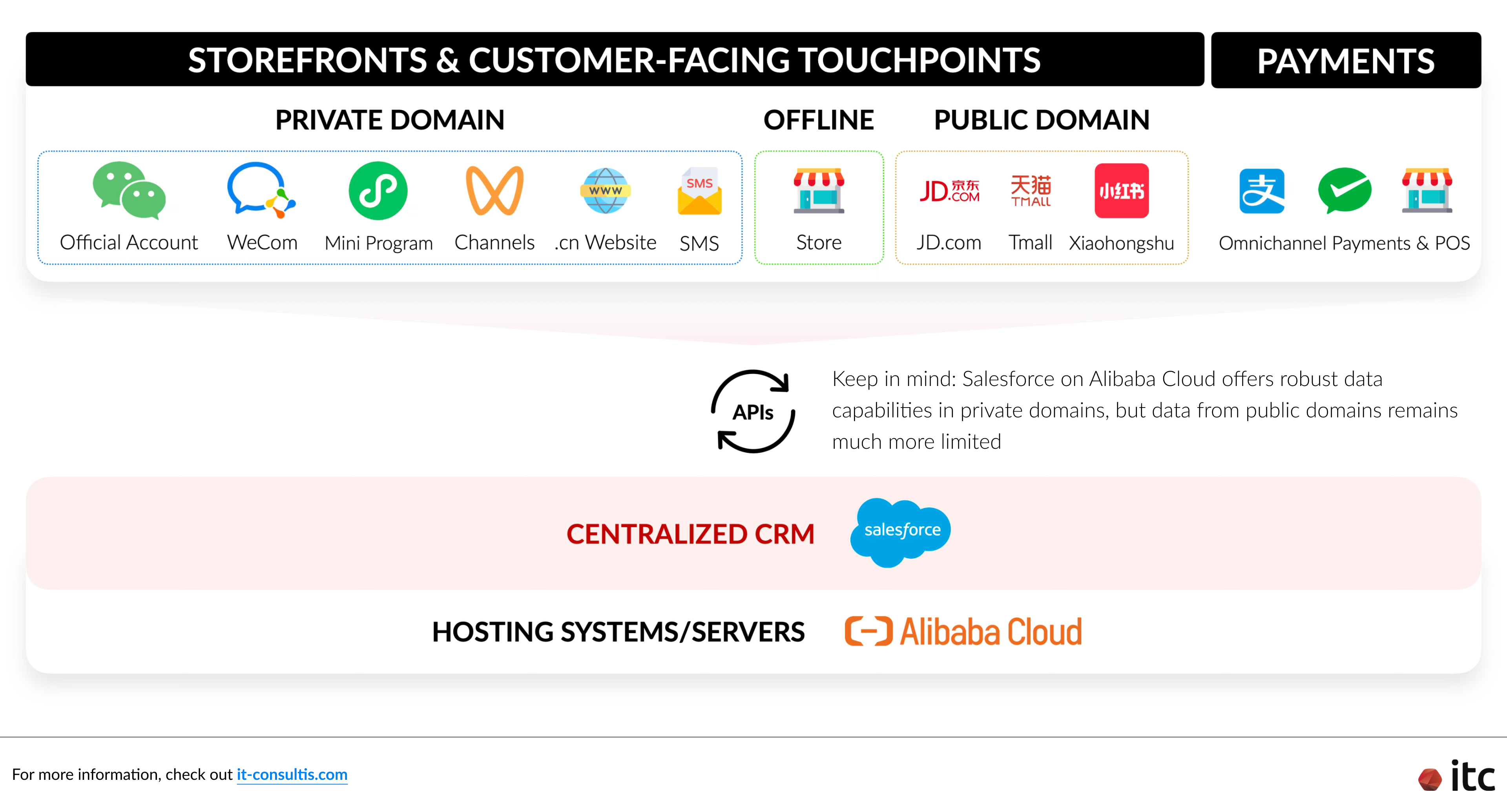
Salesforce on Alibaba Cloud gives organizations in China a localized CRM foundation for managing customer, sales, and operational data within the country’s infrastructure and compliance environment.
It can sit at the center of a broader Chinese digital ecosystem, including private-domain touch points such as WeChat Official Accounts, WeCom, WeChat Mini Programs, and brand websites.
This setup matters because it helps organizations centralize customer and operational data in a more structured way within China’s infrastructure and compliance environment.
Particularly, data from private-domain touch points is often richer and more actionable than data from public-domain platforms, because it can reveal stronger signals around customer behavior, engagement, and intent.
That makes the CRM foundation even more important for sales, service, and operational visibility, especially when organizations need a more structured way to centralize and interpret that data in China.
Where Analytics Challenges Still Remain
As CRM data volumes grow, many organizations in China still struggle to turn that data into timely, usable insight. Even with Salesforce on Alibaba Cloud as the operational foundation, reporting and decision-making often remain harder than they should be.
Common challenges include:
- Fragmented reporting across teams and data sources.
- Generic dashboards that do not match the needs of sales, finance, service, or leadership stakeholders.
- Heavy reliance on manual analysis, which slows down decisions and creates inconsistency.
- Limited visibility into performance trends makes it harder to spot risks and opportunities early.
- Difficulty turning operational CRM data into business-ready insight that supports action.
This is where Quick BI adds value, helping organizations add a more flexible analytics layer on top of Salesforce on Alibaba Cloud.
How Salesforce on Alibaba Cloud and Quick BI Work Together for Enhanced CRM Operations in China
Quick BI, developed by Lingyang under Alibaba Cloud, is an AI-driven business intelligence platform that helps users analyze data, build dashboards and explore insights through conversational and visual interfaces.
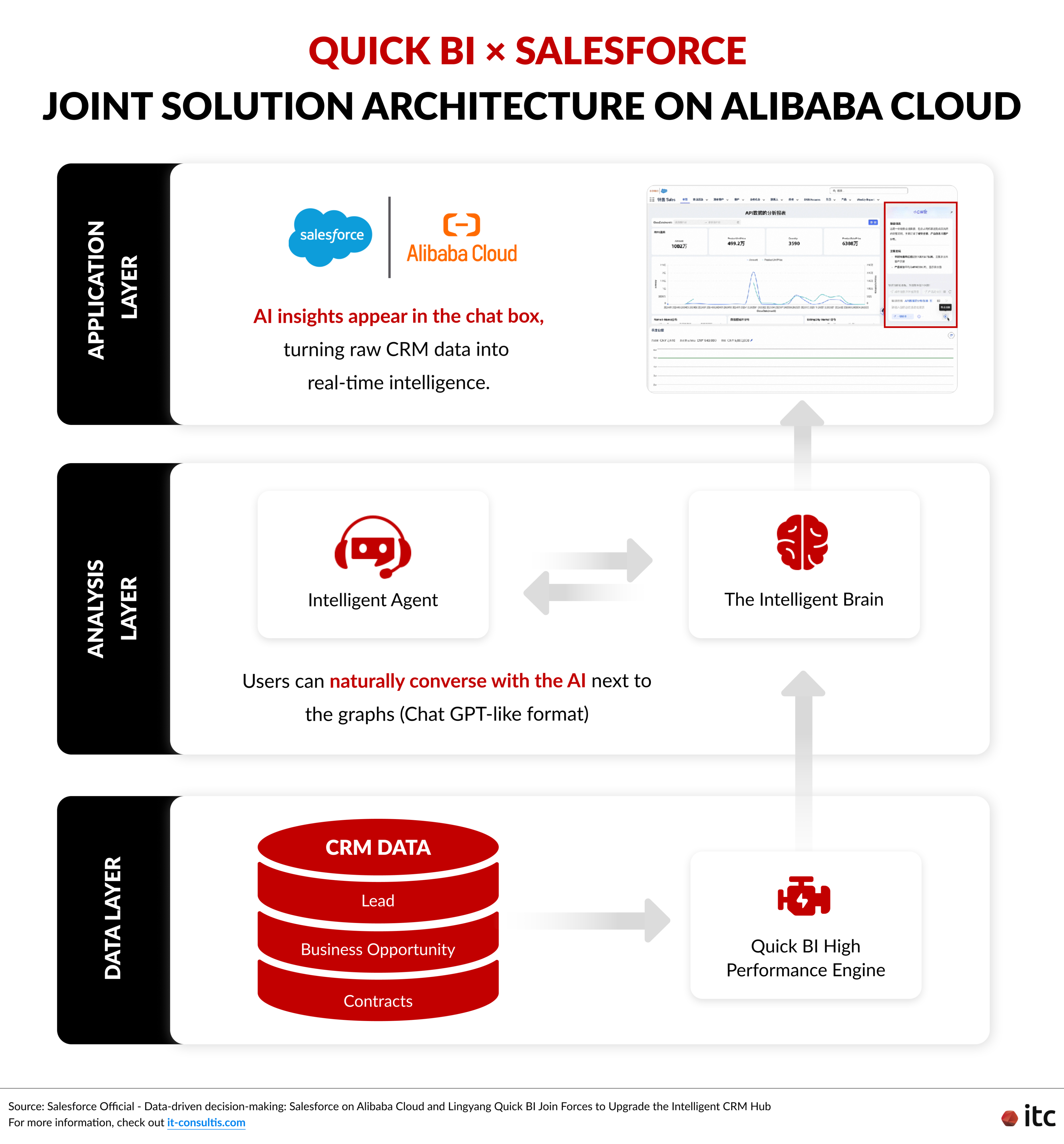
As the image suggests, the integration can be understood in three layers:
- Data layer: Salesforce on Alibaba Cloud holds the operational CRM data, including customer, sales, service, and business records.
- Analysis layer: Quick BI processes that data to identify patterns, support queries, and generate more usable analysis.
- Application layer: Business users interact with dashboards, AI-assisted prompts, alerts, and visualizations inside a more practical decision-support environment.
In practice, this means users can ask ChatGPT-like natural-language questions about their data, view the same information through different business lenses, and use automated explanations or drill-downs to move more quickly from raw data to usable insight.
Salesforce on Alibaba Cloud remains the system of record, while Quick BI acts as the analytics and decision-support layer on top of it.
Business Impact of Salesforce on Alibaba Cloud x Quick BI for Sales, Finance, and Leadership Teams
As mentioned above, in many organizations in China, the challenge is not only collecting CRM data, but making that data easier to interpret and use across daily operations.
Quick BI helps Sales, Finance, and leadership teams move beyond manual reporting toward faster, more practical decision-making.
1. Faster, Better-Informed Decisions Across Teams
Teams can move from static, monthly reporting to more continuous, conversational analysis. Instead of waiting for a slide deck or a manually prepared report, stakeholders can explore trends, ask follow-up questions, and get to relevant answers faster inside the analytics layer.
2. Stronger Visibility for Sales Teams
Sales leaders and frontline teams can get a clearer view of pipeline health, regional performance, account activity, and emerging risks. This makes it easier to spot gaps earlier, follow up on underperforming areas, and support faster action in the field.
3. Better Decision Support for Finance Teams
Finance teams can work with a more structured and timely view of commercial data, helping them monitor revenue trends, compare actual performance against targets, and identify anomalies or risks earlier. This supports stronger forecasting, planning, and cross-functional alignment with sales and leadership.
4. Role-Specific Views on the Same Data
Because Quick BI can interpret the same data through different lenses, a sales leader, finance director, service manager, and general manager can each focus on their own KPIs and questions while still working from a single, trusted data foundation.
5. More Scalable Analytics Operations
By automating a large part of data preparation and first-level analysis, enterprises can reduce reliance on manual reporting workflows and free up analysts to focus on higher-value work such as scenario modeling, exception analysis, and strategic support.
Closed-Loop Management Through Alerts and Warnings
Automated alerts and intelligent warnings help managers monitor critical KPIs more proactively and respond faster when risks or opportunities emerge. This creates a more closed-loop management model, where insights are not only visible but also easier to turn into timely action.
When This Approach Makes Sense for Your Organization
A joint Salesforce on Alibaba Cloud and Quick BI architecture is particularly relevant if:
- You use Salesforce on Alibaba Cloud as a core CRM in China, but still rely heavily on manual reporting to support decisions.
- CRM and sales data are technically available, but feel too fragmented or slow to support forecasting, risk detection, or performance steering.
In many cases, different executive stakeholders also keep asking for customized views and analysis that existing dashboards cannot easily deliver, and you want your CRM in China to feel more like a system of intelligence, without rebuilding the entire Salesforce stack or moving away from Alibaba Cloud.
A practical next step is to embed an AI-driven analytics layer, such as Quick BI, on top of Salesforce on Alibaba Cloud.
How IT Consultis (ITC) Can Help
IT Consultis (ITC) helps multinational and Chinese enterprises plan, deploy and optimize Salesforce on Alibaba Cloud for the realities of operating in China, from compliance and integration to day-to-day business use.
For organizations using or considering Salesforce on Alibaba Cloud in China, ITC can support you across the full journey:
- Advising on Salesforce on Alibaba Cloud strategy and architecture so your CRM foundation matches your business model, compliance requirements, and local operating needs in China.
- Migrating, deploying, and integrating Salesforce on Alibaba Cloud with local ecosystems, including business systems, customer touch points, data platforms, analytics tools such as Quick BI, and China-specific workflows involving platforms like WeCom.
- Defining analytics and decision-support use cases with business and IT stakeholders so that dashboards, alerts, and AI-assisted analysis support the needs of sales, finance, service, and leadership teams.
- Rolling out capabilities in phases, from CRM setup and integration to analytics enablement, user adoption, and ongoing optimization.