Salesforce Marketing Cloud in China is not offered as a China-hosted product. That does not mean brands have no localized Salesforce marketing options.
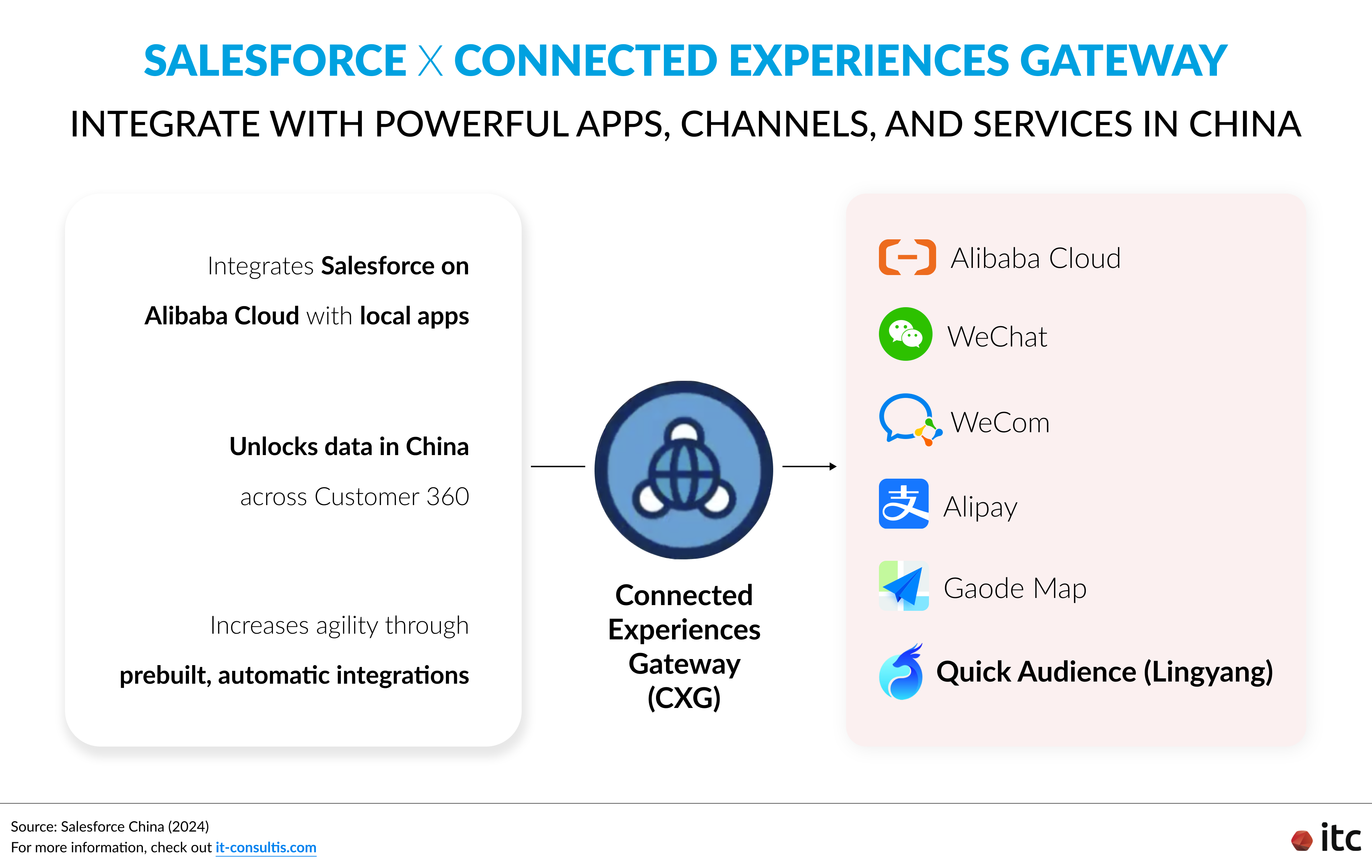
Salesforce on Alibaba Cloud combines a local CRM foundation with Connected Experiences Gateway (CXG).
Separate CXG customer data platform (CDP) and marketing automation (MA) offerings with Quick Audience support selected customer-data and campaign workflows. They are not a like-for-like replacement for Salesforce Marketing Cloud.
This article explains how the local Salesforce on Alibaba Cloud product set can address Marketing Cloud’s unavailability in China, where it can help your team connect customer journeys to sales and service workflows, and what to verify before committing to a setup.
Executive Summary:
1. Salesforce Marketing Cloud is not offered as a China-hosted product in Alibaba Cloud’s current Salesforce lineup.
2. Sales Cloud, Service Cloud, Salesforce Platform, and CXG provide a local operating foundation; CXG CDP and MA with Quick Audience add selected audience and campaign capabilities.
3. Brands can evaluate audience building, event-triggered follow-up, and activation through configured China-facing channels, without assuming feature parity with Marketing Cloud.
4. Confirm the intended customer and user locations, product editions, channel entitlements, integration direction, and data-governance requirements before committing to a design.
Table of contents
Is Salesforce Marketing Cloud Available in China?
Salesforce Marketing Cloud is not offered as a separate China-hosted product in Alibaba Cloud’s current Salesforce lineup.
The current Salesforce on Alibaba Cloud product overview lists:
- Sales Cloud
- Service Cloud
- Salesforce Platform
- China-specific Connected Experiences Gateway (CXG) capabilities
CXG extends the local CRM environment into China’s digital ecosystem and connects with Quick Audience for customer data platform (CDP) and marketing automation (MA) capabilities.
That distinction matters: the local portfolio can support selected marketing workflows, but it should not be presented as Marketing Cloud under another name.
Beyond understanding local product distinctions, brands also need to determine which teams are eligible to use each Salesforce environment.
Salesforce’s availability guidance sets out these location rules:
- Customers based in mainland China or Macau may not use Salesforce’s global services. Salesforce on Alibaba Cloud is the route identified for Salesforce use by those customers.
- Customers based elsewhere may not let users in mainland China or Macau access Salesforce’s global services. Those users can use Salesforce on Alibaba Cloud, while eligible users elsewhere can remain on the global service.
- Customers based in Hong Kong may purchase Salesforce’s global services from Alibaba, as a reseller, for use outside mainland China and Macau, or purchase Salesforce on Alibaba Cloud.
Companies should assess both customer location and individual user location before designing system access. This does not require every global Salesforce user or system to migrate.
Most teams searching for Salesforce Marketing Cloud in China are likely looking to support campaign orchestration, customer journeys, segmentation, lead nurturing, or cross-channel measurement.
Some of those outcomes may be achievable through a localized combination of Salesforce on Alibaba Cloud and Quick Audience.
How Brands Can Adapt with Salesforce on Alibaba Cloud
The practical question is not whether local products reproduce every Salesforce Marketing Cloud feature.
It is whether they can support the journeys the China team needs, with clear ownership of the data and follow-up.
Sales Cloud can give local teams a place to manage leads and sales follow-up.
Service Cloud can support case and service processes.
Salesforce Platform can support additional business workflows.
CXG connects Salesforce on Alibaba Cloud with supported local channels and ecosystem services. It has four product areas:
- Core CXG
- CXG RAG Knowledge Base
- CXG Voice
- CXG CDP/MA with Quick Audience
Core CXG includes Social Integration, Social Commerce, AI Connector, and Amap integration. Social Integration extends Salesforce CRM to local channels such as WeChat Official Accounts, Mini Programs, and SMS. Salesforce’s China localization guide also discusses possible integration with WeCom, email, and other local touchpoints.
Specific capabilities depend on the products, configuration, and entitlements in the setup.
CXG CDP/MA with Quick Audience adds separate audience and campaign capabilities in eligible setups.
Map the Marketing Job to the Local Capability
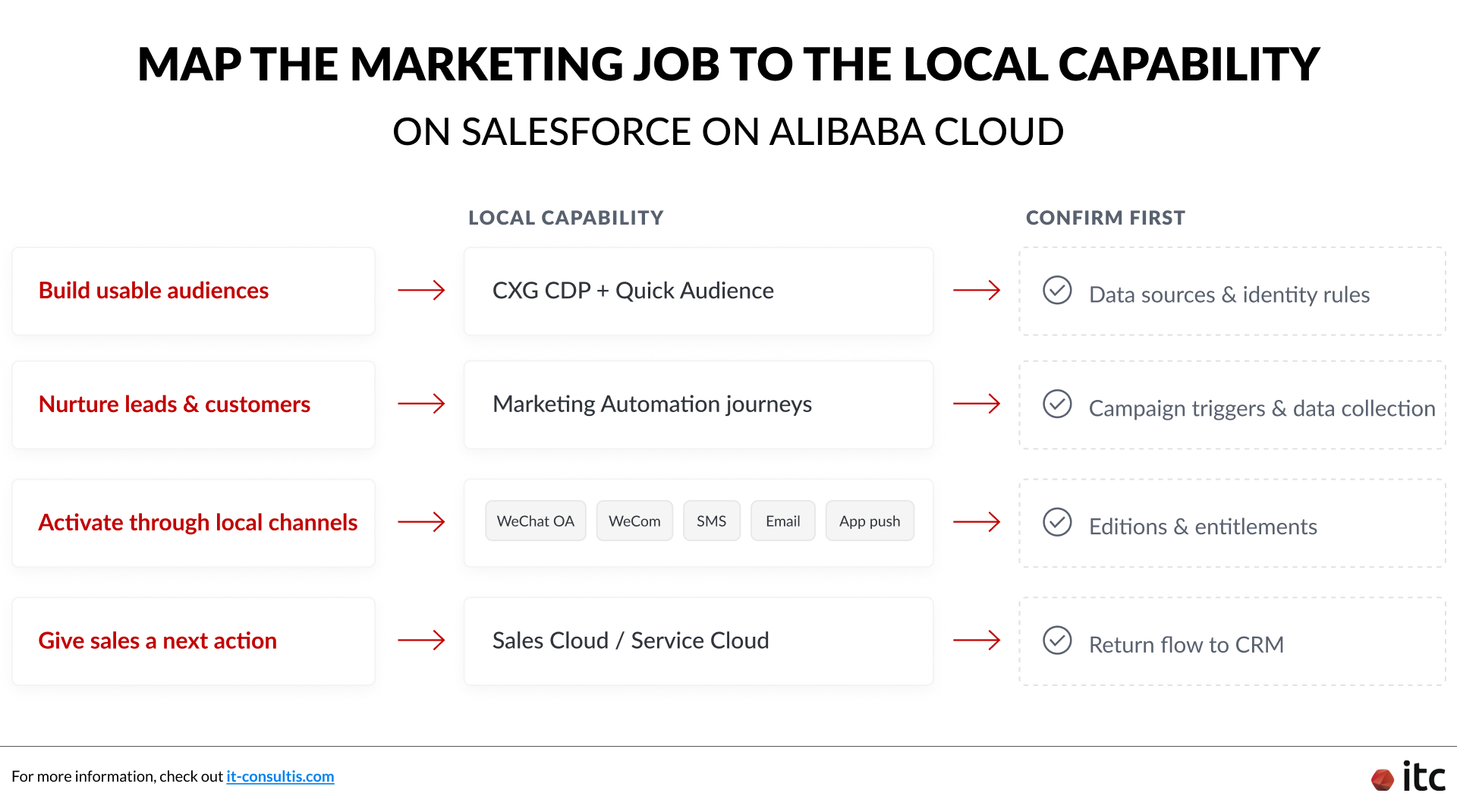
1. Build usable audiences:
CXG CDP with Quick Audience can bring together CRM attributes and eligible behavioral or interaction data to create customer profiles and rule-based segments.
Confirm the data sources and identity rules available for the selected setup.
2. Nurture leads and customers:
MA can support segmented follow-up and event-triggered journeys.
A QR-code scan or a WeChat Official Account follow, for example, can act as a journey trigger when the relevant event is captured and configured.
3. Activate through local channels:
Depending on the edition, configuration, and entitlements, teams can evaluate activation through channels such as WeChat Official Accounts, WeCom, SMS, email, or app push.
Do not assume every channel or campaign function is included in every setup.
4. Give sales or service teams a next action:
Sales Cloud can manage the lead and its follow-up. Service Cloud can support customer-service ownership.
If campaign responses or audience results need to update CRM records, see “Map the Data and System Handoffs” below for the documented return paths and what to validate.
Example: From a WeChat Interaction to Sales Follow-up
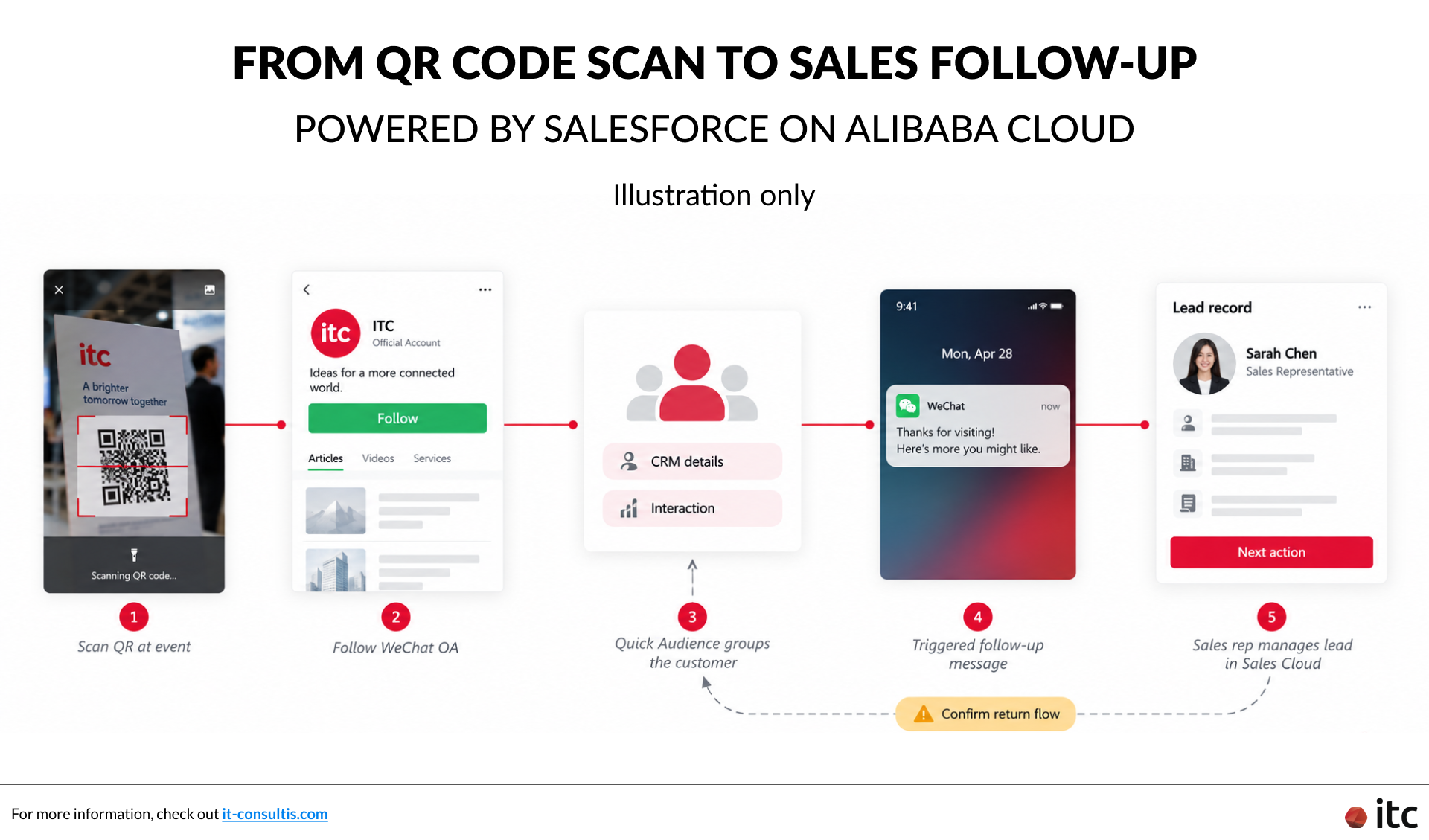
A customer scans a QR code at a brand event and follows the brand’s WeChat Official Account.
When the WeChat Official Account is connected and the interaction is captured, Quick Audience can:
- Use it as a journey trigger
- Combine it with customer data synced from Salesforce
- Add the customer to an audience
- Send a follow-up through a configured channel
The audience can then be pushed to Campaign Members for a Salesforce Campaign, so a sales rep can follow up on the matching Lead or Contact in Sales Cloud.
This push uses existing Lead, Contact, or Account IDs; a new follower without a matching Salesforce record must first be created or matched to one.
Product configuration and entitlements still apply.
Note: Alibaba Cloud’s CXG CDP/MA user guide documents selected data flows in both directions:
- Salesforce offline data and platform events can flow into Quick Audience
- Quick Audience can write tags to Salesforce Topics, display interaction records in Salesforce data objects, and push configured audiences to Salesforce.
These are defined integration paths, not a full two-way sync of every object or field. Confirm the supported objects, fields, configuration, timing, and entitlements for the intended setup before promising the handoff.
This is the practical shape of a local marketing journey while not necessarily reproducing every Salesforce Marketing Cloud feature.
For a deeper look at CXG, Quick Audience, and WeChat-related workflows, see our Salesforce China marketing automation overview.
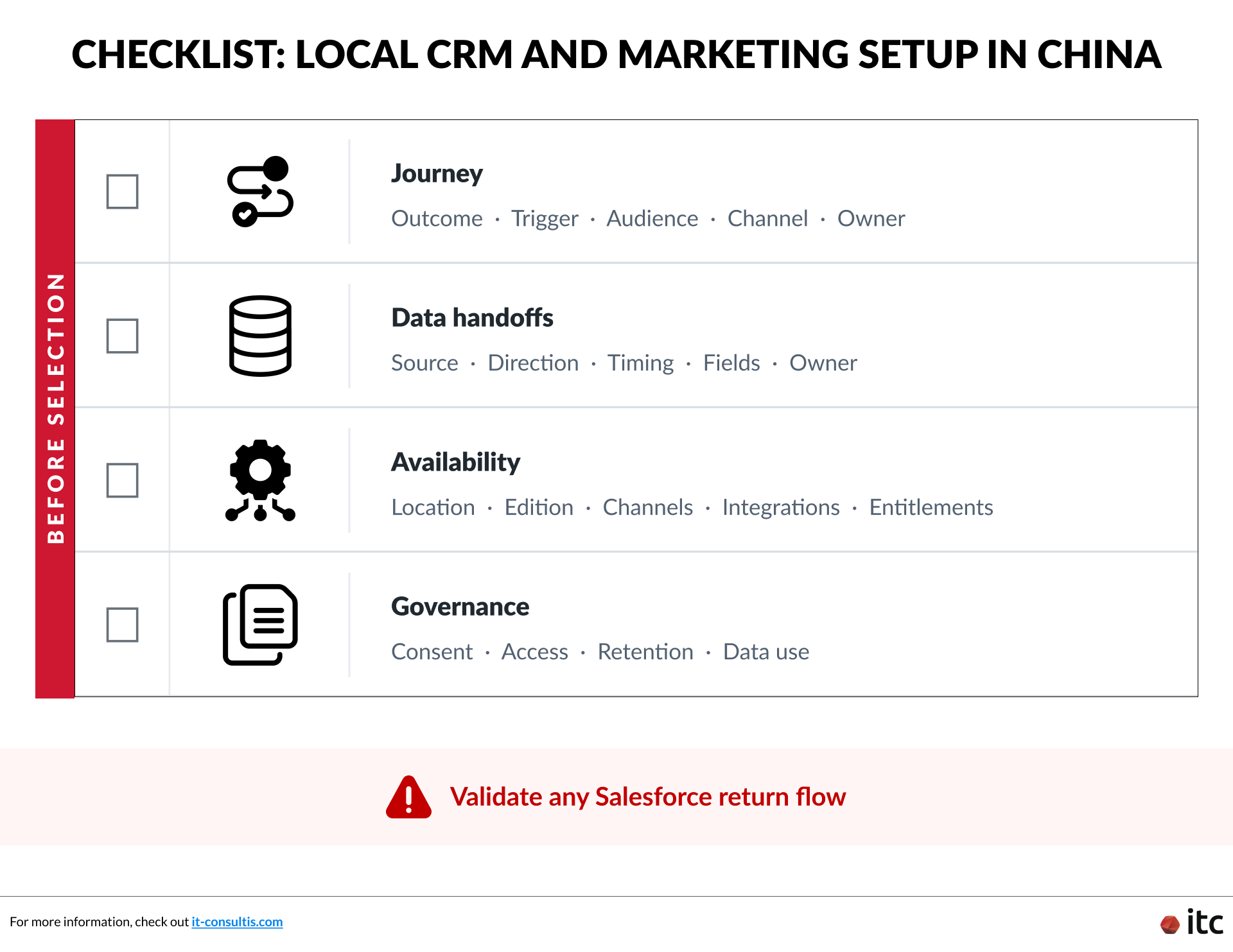
What to Decide Before Selecting a Local Setup
Start with One Customer Journey
Choose a business outcome, such as following up on a qualified inquiry or re-engaging an existing customer.
Define the trigger, the audience, the message, the channel, and the person or team responsible for the next action. This keeps product selection tied to a real need.
Map the Data and System Handoffs
Identify where the customer and lead records live, which system builds the audience, where the journey runs, and what sales or service teams need to see afterward.
Document the direction, timing, fields, and ownership of each required data flow.
Alibaba Cloud documents selected return flows to Salesforce: Quick Audience can write tags to Salesforce Topics, display interaction records on Salesforce data objects, and push configured audiences to Campaign Members. If campaign responses or other results need to update CRM records beyond these paths, validate the specific integration requirement.
For a practical framework for deciding what to standardize globally and what to localize in China, see Salesforce China Localization Framework for Global CRM Teams.
Confirm Location, Edition, Channels, and Entitlements
Check customer and user locations against Salesforce’s availability guidance.
Then confirm the CXG CDP or MA edition. MA is available as fully managed or semi-managed, with tiers based on maximum cumulative users and audience size per outreach. Also check the supported channels, integrations, and entitlements for the intended users and journey.
Product names alone do not prove that a particular workflow is available.
Set Governance Before Activation
Agree how the business will manage consent, access, retention, and the use of customer data across local and global teams.
Keep in mind that data in Salesforce on Alibaba Cloud is hosted in mainland China and is not replicated to Salesforce’s global data centers. Alibaba Cloud operates and supports the service in China without Salesforce accessing the data or tenants.
Therefore, companies running this alongside global Salesforce should evaluate any data exchanged between the China and global orgs against applicable cross-border requirements. Alibaba Cloud’s feature comparison outlines the data and access boundaries in detail.
In short, a local hosting model alone does not determine whether a specific data use complies with applicable requirements. Make sure to involve the relevant legal, security, and data owners early in the design process.
Conclusion: Design for the Journey, Not for Product Parity
Salesforce Marketing Cloud is not offered as a China-hosted product, but brands can assess other localized Salesforce capabilities for selected marketing work.
Sales Cloud, Service Cloud, Salesforce Platform, CXG, and Quick Audience can form parts of a local model for customer data, audience building, campaign follow-up, and sales or service ownership.
The right choice depends on the specific journey, location, product scope, and data handoffs. Define those requirements first, then validate the edition, channels, and integrations with the vendors.
That is a stronger basis for decision-making than trying to recreate Marketing Cloud feature for feature.
IT Consultis (ITC) is a certified partner helping global brands assess Salesforce on Alibaba Cloud, local marketing capabilities, integrations, and user-location requirements, so the architecture fits the business without assuming global product parity.