
For many companies launching or using Salesforce on Alibaba Cloud in China, the early focus is naturally on implementation: data migration, workflows, integrations, user adoption, and governance.
What often gets less attention is what happens after go-live if something goes wrong.
In this article, we outline a practical Salesforce on Alibaba Cloud data backup and recovery approach, helping enterprise teams define recovery targets, protect important data and files, and test whether their recovery model will hold up before an incident puts operations at risk.
A strong plan is not just about preventing worst-case scenarios. It is about reducing operational risk, protecting business continuity, and giving both China teams and global stakeholders more confidence in the resilience of the CRM environment.
Executive Summary:
1. Salesforce on Alibaba Cloud data backup and recovery should be part of the Day 1 operating model, not an afterthought after go-live.
2. The right approach starts with business recovery targets, especially recovery point objective (RPO) and recovery time objective (RTO), before teams evaluate backup solutions, restore methods, or retention rules.
3. Enterprises should protect more than customer records alone, including metadata, configuration, files, and the dependencies needed to restore business operations properly.
4. Recovery capability matters as much as backup frequency. A backup is only valuable if teams can restore the right data quickly enough and confirm that the recovered environment actually works.
5. For organizations operating in China, this discipline supports stronger governance, local continuity, and more reliable communication with global stakeholders.
Table of contents
- Why Salesforce on Alibaba Cloud Data Backup and Recovery Should Be Part of the Day 1 Plan
- Define CRM Data Recovery Targets in Business Language
- What to Include in the Salesforce on Alibaba Cloud Data Backup Scope
- Choose the Right Salesforce China Data Recovery Pattern
- Why Restore Testing Matters More Than Backup Status Alone
- A Salesforce on Alibaba Cloud Data Backup and Recovery Starter Checklist
- What This Means for China CRM Operations on Salesforce on Alibaba Cloud
- Conclusion
Why Salesforce on Alibaba Cloud Data Backup and Recovery Should Be Part of the Day 1 Plan
When Salesforce on Alibaba Cloud becomes part of daily operations in China, it often supports far more than a simple contact database.
It may hold lead and account records, service activity, pipeline inputs, customer interactions, internal workflows, and operational files that teams rely on every day.
That creates a simple but important question: if data is deleted, corrupted, overwritten, or becomes temporarily unavailable, how quickly can the business recover?
The answer matters because CRM disruption is rarely just a technical inconvenience. It can affect sales execution, service continuity, reporting confidence, compliance processes, and internal trust in the system.
This is not just a theoretical risk. Salesforce also highlights why data backup and recovery is important and details the cost of CRM data downtime for its global instance (these figures are best treated as illustrative signals of enterprise risk rather than direct proof points specific to Salesforce on Alibaba Cloud in China):
- The typical cost of downtime is $2.4 million per day.
- 35% of organizations report financial losses due to downtime or recovery costs.
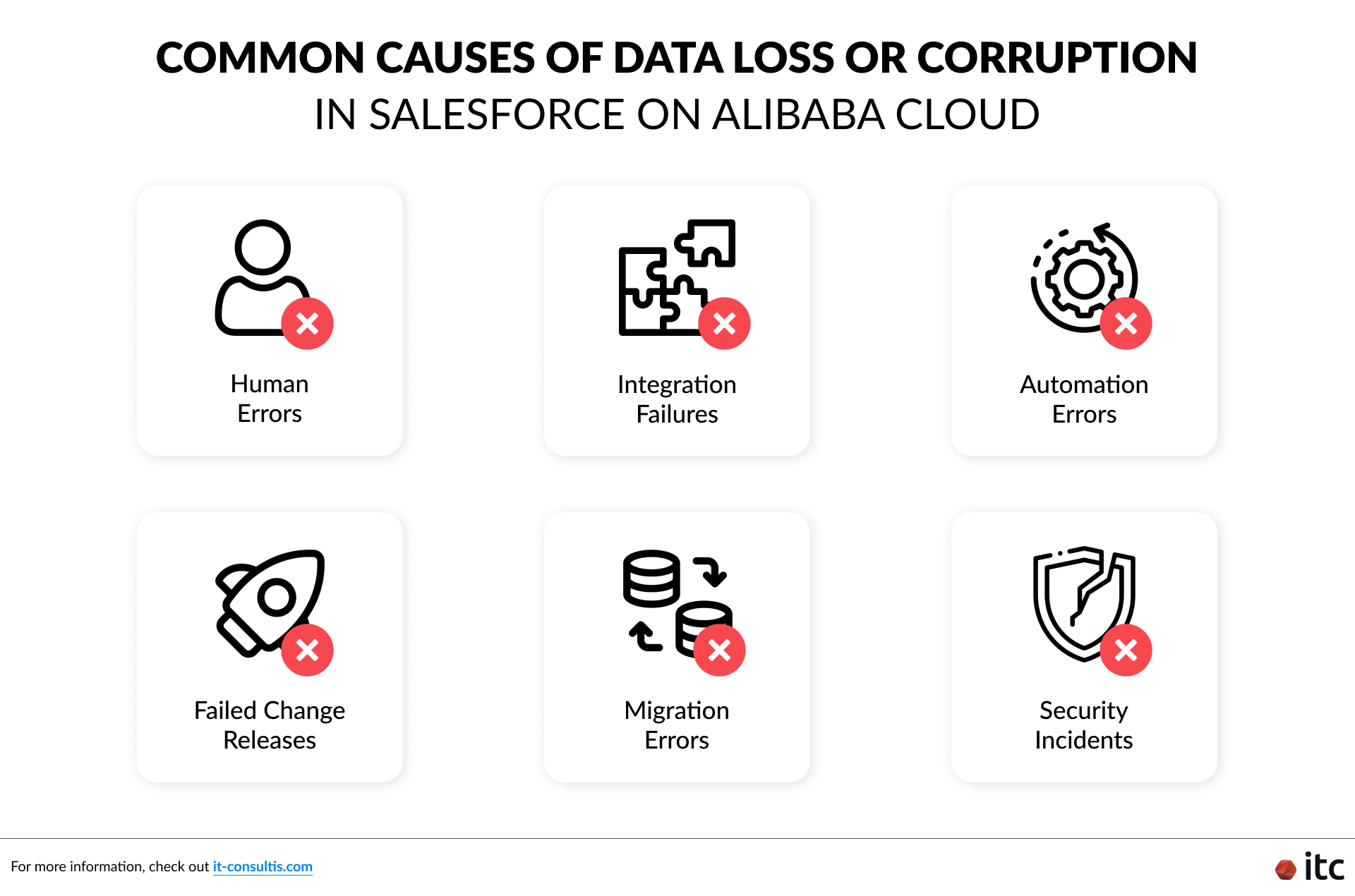
Even with strong permissions and sound implementation, data loss or corruption can still happen through:
- Human errors, such as accidental deletion or bulk update mistakes
- Integration failures
- Automation errors
- Failed change releases
- Migration errors
- Security incidents, including credential compromise
Salesforce on Alibaba Cloud is designed to serve as a strong enterprise CRM foundation for China operations.
A backup and restore plan strengthens that foundation further by giving the business clearer recovery controls, stronger continuity planning, and greater confidence in how the platform will perform when issues arise.
That is why backup and recovery should be considered alongside Salesforce on Alibaba Cloud migration planning, governance, and long-term resilience planning from the beginning.
Define CRM Data Recovery Targets in Business Language
Before teams discuss architecture patterns, retention windows, or Salesforce on Alibaba Cloud backup solutions, they should define recovery expectations in terms that the business can understand.
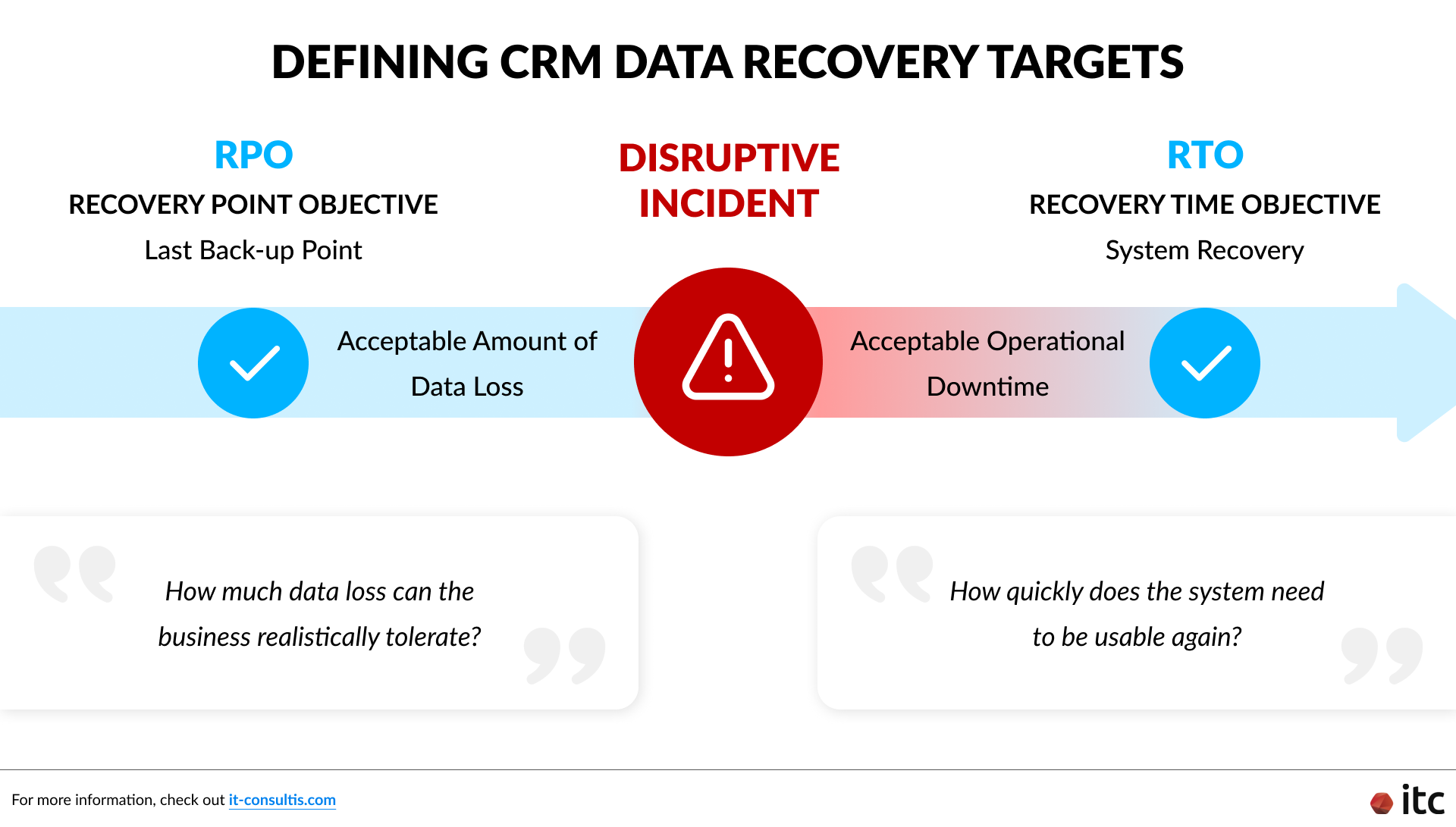
Recovery Point Objective (RPO)
RPO answers one question: how much data loss can the business realistically tolerate?
For some teams, losing several hours of CRM activity may be manageable.
For others, especially where records, service updates, or transaction-related documents change frequently, that may be unacceptable.
A tighter RPO usually means more frequent backups and a more disciplined Salesforce on Alibaba Cloud data backup and restore model.
Recovery Time Objective (RTO)
RTO answers a different question: how quickly does the system need to be usable again?
Some organizations can work temporarily in fallback mode if CRM access is disrupted.
Others depend so heavily on the system that even a short outage creates serious operational friction.
Defining RPO and RTO early helps enterprises make better decisions about frequency, retention, restore methods, ownership, and escalation paths.
Just as importantly, it gives leadership a clearer basis for evaluating whether the proposed recovery model matches the operational and governance risk of the platform.
What to Include in the Salesforce on Alibaba Cloud Data Backup Scope
A common mistake is to think only about records.
In practice, a resilient Salesforce on Alibaba Cloud data backup and recovery strategy should cover the broader operating environment.
That usually includes:
- Core CRM data, such as leads, contacts, accounts, opportunities, cases, tasks, activities, and business-critical custom objects.
- Configuration and metadata, including fields, layouts, rules, approvals, automations, permissions, reports, and dashboards.
- Files and attachments, such as contracts, quotations, screenshots, invoices, training materials, service evidence, or other documents tied to business processes.
- Operational dependencies, including integration points, access assumptions, restore procedures, and the sequence required to bring critical workflows back online.
Files deserve special attention. In many enterprise environments, some of the most sensitive or operationally important materials live in attached documents rather than in CRM fields.
If backup planning covers records but treats files as an afterthought, the restored environment may still leave the business exposed.
The same is true for metadata. Restoring data without restoring how the system works can leave teams with a technically recovered but operationally unusable CRM.
For more information, see Salesforce’s best practices to back up CRM data. It also offers useful principles that can inform backup planning for Salesforce on Alibaba Cloud.
Choose the Right Salesforce China Data Recovery Pattern
Not every business needs the same Salesforce on Alibaba Cloud disaster recovery model.
A practical enterprise design usually starts by separating three related but different needs so buyers can decide how much resilience, retention, and recovery control the business actually requires.
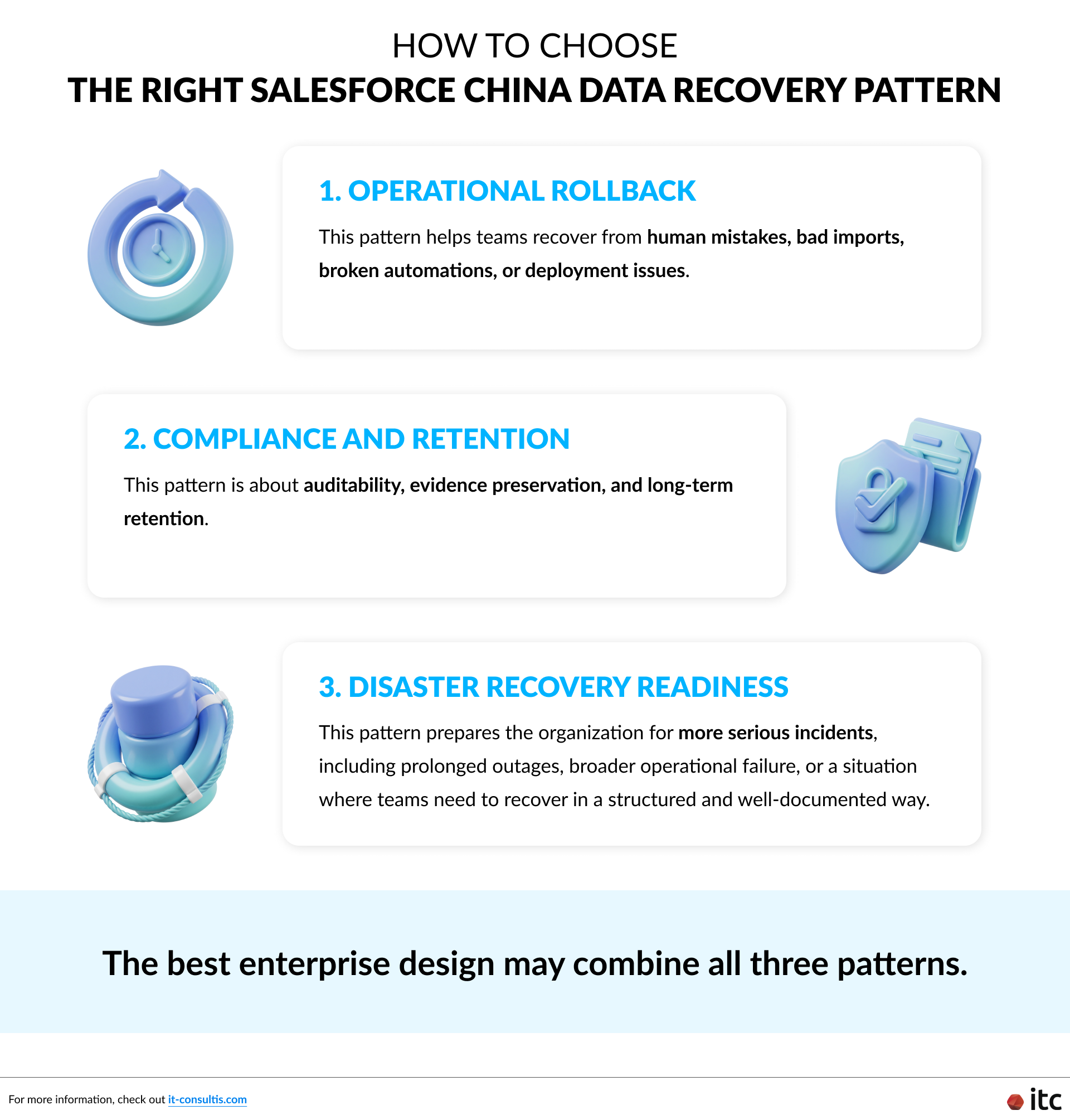
1. Operational Rollback
This pattern helps teams recover from human mistakes, bad imports, broken automations, or deployment issues.
The focus is on restoring granularity, speed, and the ability to recover specific records or objects without unnecessary disruption.
2. Compliance and Retention
This pattern is about auditability, evidence preservation, and long-term retention.
The design should reflect how long important records and files need to be kept, how they can be retrieved, and how access is controlled.
3. Disaster Recovery Readiness
This pattern prepares the organization for more serious incidents, including prolonged outages, broader operational failure, or a situation where teams need to recover in a structured and well-documented way.
Here, the most important assets are often not just backups themselves, but also the runbook, ownership model, dependency mapping, and validation process.
The best enterprise design may combine all three patterns rather than treating Salesforce on Alibaba Cloud data backup and recovery as a single checkbox activity.
This helps decision-makers evaluate recovery design as a business-control choice, not just a technical backup task.
Why Restore Testing Matters More Than Backup Status Alone
Many teams feel reassured once Salesforce on Alibaba Cloud backups are scheduled and storage policies are in place.
But backup success does not automatically mean recovery success.
A more useful question is whether the organization can restore the right data, in the right order, within the expected recovery window, and confirm that business-critical workflows still function afterward.
That is why realistic restore testing matters.
Instead of only checking whether a backup job completed, teams should validate recovery against scenarios that mirror real operational risk.
For example, can they recover from an incorrect bulk update, a deleted set of files, a broken release, or a data corruption incident without creating wider disruption?
This kind of testing turns Salesforce on Alibaba Cloud backup and restore from a theoretical control into an operational capability.
It also gives leadership more confidence that the CRM environment can recover in practice, not just on paper.
A Salesforce on Alibaba Cloud Data Backup and Recovery Starter Checklist
If you are early in planning, a simple checklist can help enterprise stakeholders structure the right conversations before selecting tools, approving ownership, or committing to a recovery model.
- Define the target RPO and RTO for the most business-critical Salesforce on Alibaba Cloud processes.
- List the records, files, metadata, and workflows that would materially affect operations if lost or corrupted.
- Confirm whether the backup scope covers both data and the configuration needed to make the system usable after restore.
- Decide which needs are primarily about rollback, which are about retention, and which are about full disaster recovery readiness.
- Document who owns Salesforce China data recovery decisions, who approves recovery actions, and how communication should work during an incident.
- Test realistic recovery scenarios and record the gaps that appear during validation.
This checklist is intentionally practical. The goal is not to over-engineer the environment from the start, but to make sure resilience planning keeps pace with business dependency.
Whether teams rely on native exports, external backup tools, or broader Salesforce on Alibaba Cloud backup solutions, the same principle applies: the recovery model should match the business risk.
What This Means for China CRM Operations on Salesforce on Alibaba Cloud
For enterprises operating in China, data backup and disaster recovery planning often carries added strategic weight.
Salesforce on Alibaba Cloud gives enterprises a strong, localized CRM foundation for China operations, balancing local infrastructure, China data residency and compliance expectations, and global visibility.
For many brands, this is also part of a broader effort to fortify CRM operations in China.
That means resilience planning should support both local continuity and management confidence.
- China teams need a system they can trust operationally.
- Global stakeholders need confidence that recovery expectations, governance rules, and reporting reliability are clearly defined.
This is why CRM recovery planning should not be separated from the broader operating model behind the platform.
It should be considered alongside architecture, localization, oversight, migration planning, and compliance responsibilities from the beginning.
When handled well, backup and disaster recovery do not merely protect against disruption. They help reinforce Salesforce on Alibaba Cloud as a dependable platform for China operations.
Conclusion
Salesforce on Alibaba Cloud data backup and recovery is ultimately about reducing business risk.
It already provides a strong CRM foundation for enterprises operating in China.
The strongest approach is to reinforce that foundation early by defining recovery expectations in business language, protecting more than just records, and validating recovery through realistic scenarios.
That discipline helps create a CRM environment that is not only compliant and localized, but also more resilient and easier for stakeholders to manage with confidence.
In practice, the real objective is simple: if an incident happens, the business should know what can be recovered, how fast recovery should happen, who is responsible for making it happen, and whether the operating model can withstand governance scrutiny.
That clarity turns backup from a background IT task into a concrete business safeguard.
IT Consultis (ITC) is a certified Salesforce on Alibaba Cloud partner helping enterprises build compliant, China-ready CRM operations.
Beyond supporting end-to-end migration to Salesforce on Alibaba Cloud and shaping tailored CRM strategies, we help enterprises strengthen the platform further with recovery planning, continuity design, and custom data backup and disaster recovery solutions.


