Many global brands entering or expanding in China eventually ask the same question: Can we connect WeChat to Salesforce, or integrate WeChat with Salesforce, without redesigning our CRM architecture for China from the ground up?
The short answer is yes, but the real issue is not only whether the integration is technically possible.
WeChat – Salesforce integration for China is not just a technical integration topic. It is also a question of data governance, compliance, customer engagement design, and long-term operating fit.
What may look like a straightforward systems connection on paper becomes much more complex once China’s customer data, cross-border transfer considerations, and local operating realities enter the picture.
In this article, we explore what WeChat – Salesforce integration can realistically look like in China, where a global Salesforce instance may be enough, and when a localized CRM foundation like Salesforce on Alibaba Cloud becomes the better long-term choice.
Executive Summary:
1. WeChat – Salesforce integration is possible, but in China, the real question is not only technical feasibility — it is also data scope, compliance, and long-term operating fit.
2. Global Salesforce can be connected to WeChat, WeChat Mini Programs, and, in some cases, WeCom workflows through APIs and custom integration layers, but that does not mean all customer data should or can flow freely into a global CRM instance.
3. For brands with many Chinese customers, B2C operations, or stricter data security requirements, a localized CRM foundation often becomes the more sustainable route.
4. Salesforce on Alibaba Cloud is usually the stronger long-term option when brands need compliant China CRM operations rather than a narrow integration use case.
5. The best decision depends on business ambition, customer scale, data sensitivity, and the role WeChat and WeCom play in the brand’s China customer journey.
Table of Contents
- Why Brands Look for WeChat Integration with Salesforce
- Route 1: Connecting the Global Salesforce Instance with WeChat and WeCom
- Route 2: Localizing CRM for China with Salesforce on Alibaba Cloud
- A Practical Decision Framework for WeChat – Salesforce Integration
- 1. How Strategic Is China to the Business?
- 2. How Much Customer Data Needs to be Handled Locally?
- 3. What Is the Role of WeChat and WeCom in the Customer Journey?
- 4. How Sensitive Are the Compliance and Data Security Requirements?
- 5. Is the Brand Solving for Short-term Access or Long-term Operating Fit?
- Conclusion
Why Brands Look for WeChat Integration with Salesforce
For many organizations, the need is straightforward: they want to connect customer engagement in China with the CRM workflows they already use globally.
That often includes goals such as:
- Building a more unified customer view across China and global operations.
- Capturing leads or engagement signals from WeChat into Salesforce.
- Triggering follow-up tasks, service actions, or sales workflows in Salesforce.
- Connecting customer-facing China channels with internal teams more efficiently.
In practice, brands are usually not looking for a connector for its own sake. They are trying to link customer engagement in China with sales, service, reporting, or CRM visibility in a way that is commercially useful and operationally sustainable.
That is why the right architecture decision depends not only on whether Salesforce can connect to WeChat, but also on how the business operates in China and what role customer data, messaging, and local workflows play in that model.
Route 1: Connecting the Global Salesforce Instance with WeChat and WeCom
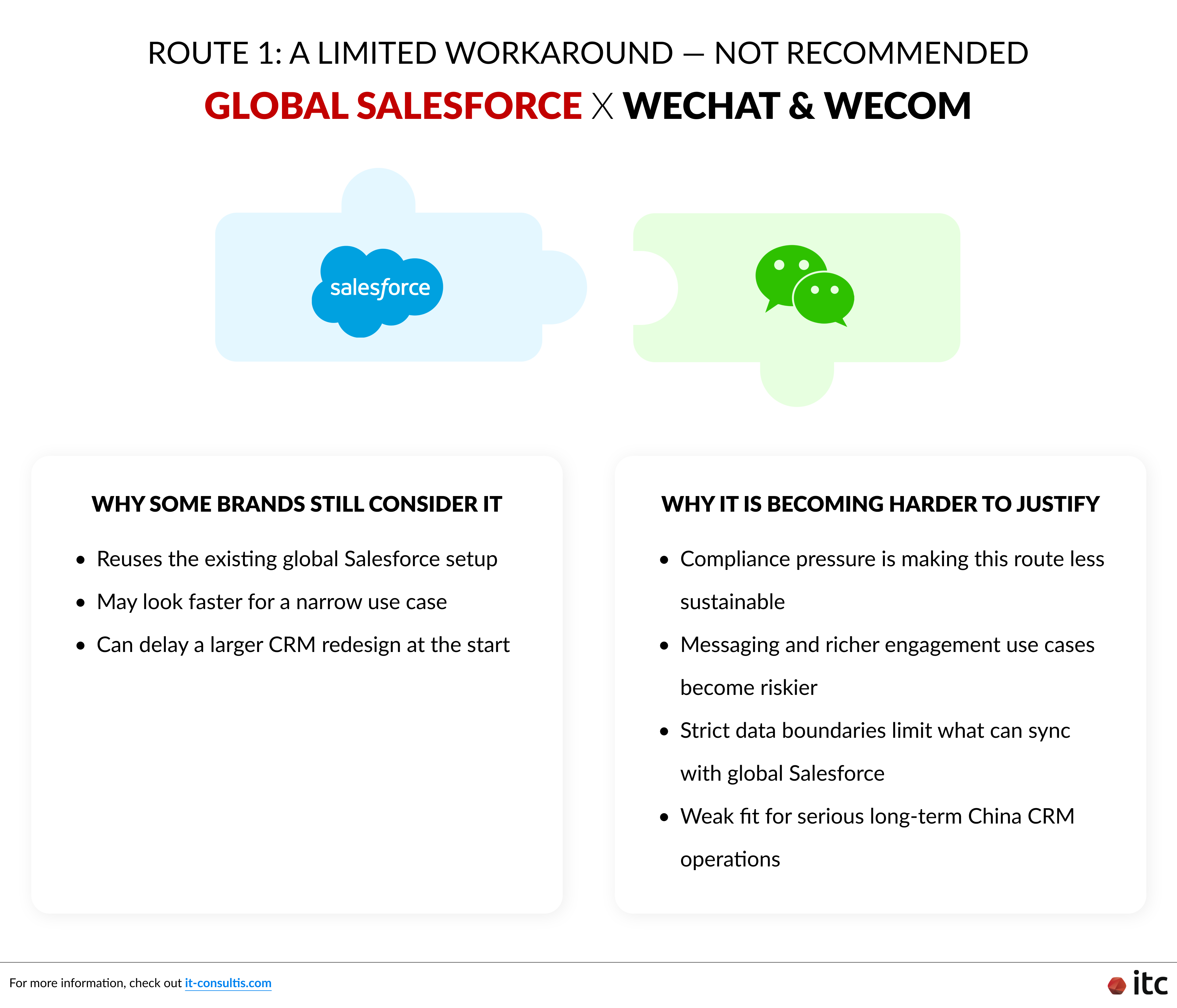
While some brands may still consider connecting a global Salesforce instance with WeChat and WeCom (Tencent’s enterprise communication and collaboration platform) as a temporary workaround, it is no longer a route we would recommend for serious China CRM operations.
In this model, the brand keeps its existing global Salesforce environment as the CRM core and builds integration layers between Salesforce and China touchpoints.
This can involve custom APIs, middleware, or a local application layer, such as a WeChat or WeCom Mini Program or related interface that can push and pull selected data between systems.
A setup like this may support selected workflows such as lead capture, task creation, order-related data exchange, selected engagement triggers, or limited customer profile synchronization.
Why Route 1 May Still Appeal at First
- Reuses the existing global Salesforce environment.
- May appear faster to launch for a narrow use case.
- May delay a larger CRM redesign at the start.
Why Route 1 Is Becoming Harder to Justify for Serving the Chinese Market
The challenge is that China CRM is rarely just about moving data between two systems.
Once a WeChat–Salesforce integration touches customer identity, chat interactions, or other sensitive information, the question shifts from technical feasibility to cross-border transfer risk, compliance with the Personal Information Protection Law (PIPL), and the broader sustainability of the operating model.
Some brands also explore Salesforce WeChat integration for messaging, especially when they want customer conversations, service workflows, or sales follow-up to connect more closely with CRM operations.
In China, however, messaging-related use cases demand especially careful control over data scope, customer information handling, and local compliance requirements.
This is where Route 1 starts to break down. A connection may be technically possible, but that does not automatically make it viable as a long-term China CRM strategy.
In practice, brands need to define a strict boundary around what can stay local, what can be synchronized, and what should not move into a global Salesforce instance at all.
The more the business depends on personal customer data, richer messaging context, and ongoing local engagement, the harder it becomes to justify Route 1 as anything more than a limited workaround.
For brands with serious China ambitions, compliance is increasingly becoming a non-negotiable design constraint, which makes a localized CRM foundation the more resilient long-term direction.
Route 2: Localizing CRM for China with Salesforce on Alibaba Cloud
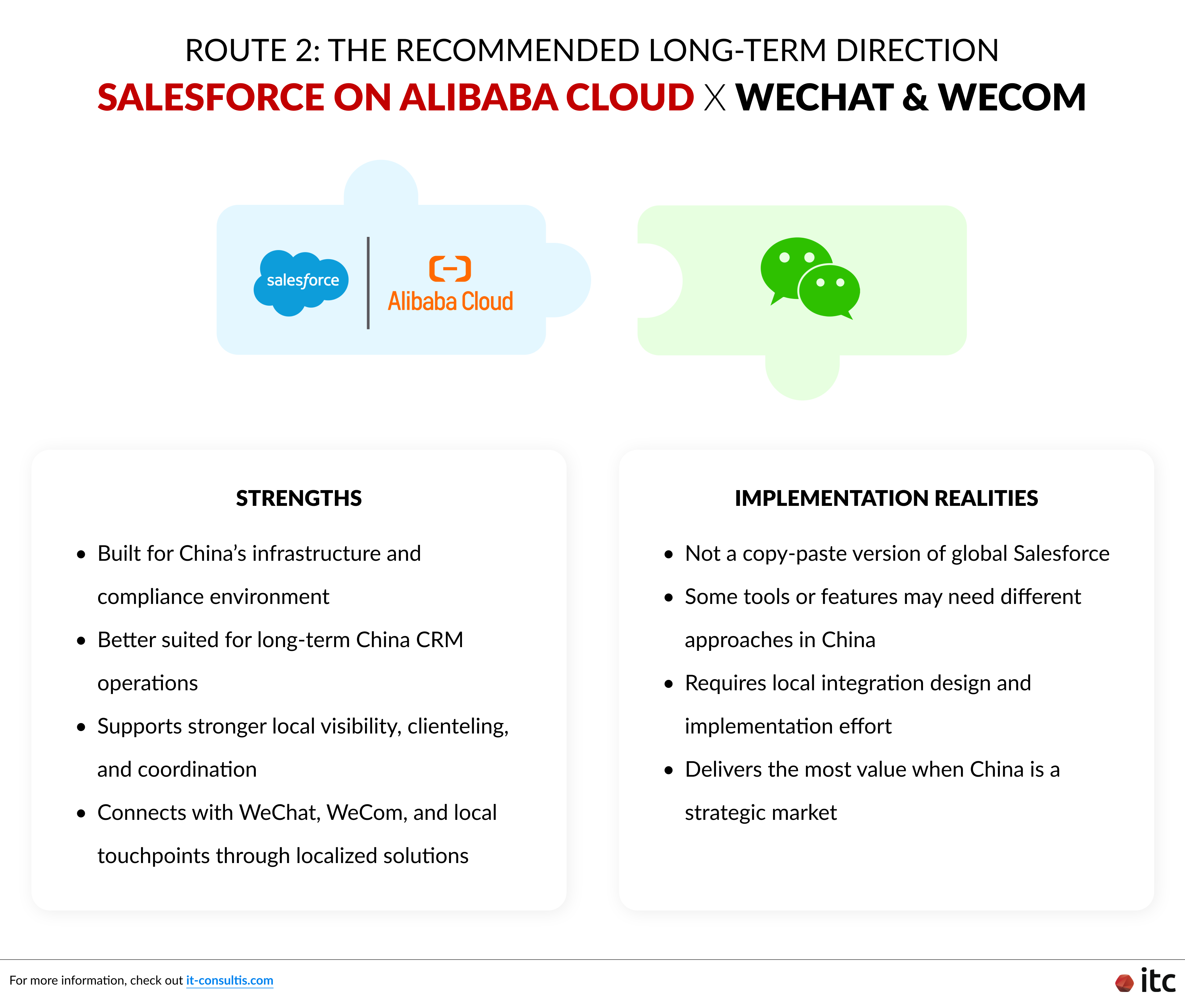
For brands building serious CRM operations in China, the recommended route is to localize the CRM foundation rather than rely on a global Salesforce-to-WeChat architecture.
This is where Salesforce on Alibaba Cloud becomes the more relevant architecture. Rather than asking a global Salesforce environment to absorb China-specific compliance, data, and operating requirements, brands can use a CRM foundation designed for China’s infrastructure and regulatory environment.
In this model, the brand uses Salesforce on Alibaba Cloud as the China CRM foundation and then connects it to WeChat, WeCom, and other local touchpoints.
For more information, see related approaches to:
- Connecting WeChat with Salesforce on Alibaba Cloud through Connected Experiences Gateway (CXG)
- Integrating Salesforce on Alibaba Cloud and WeCom for stronger clienteling and operational workflows in China
Why China CRM Localization Is Becoming the Recommended Long-term Direction
A localized CRM model provides a more resilient base for China operations because it aligns the CRM environment more closely with local data, systems, compliance expectations, and day-to-day operating realities.
This matters when brands need to move beyond narrow sync logic and support more mature China CRM use cases, such as:
- Better local customer visibility
- More structured clienteling and follow-up
- Stronger coordination between China-facing teams and systems
- A more durable foundation for growth across WeChat, WeCom, and related touchpoints
In other words, the shift is not only architectural. It is strategic. The brand is choosing a CRM model that is better suited to where China operations are heading, rather than trying to preserve a global setup that may become increasingly difficult to sustain.
Salesforce on Alibaba Cloud Still Requires the Right Implementation Approach
Salesforce on Alibaba Cloud can provide a stronger long-term CRM foundation for China, but it is not a copy-paste version of a global Salesforce environment.
Brands still need to plan for local integration design, implementation scope, and the reality that some tools, packages, or product combinations available in global Salesforce may require different approaches in China.
In some cases, this means rethinking parts of the architecture rather than simply replicating the global setup feature for feature.
The goal is not to recreate the global environment at any cost, but to build a CRM foundation that is compliant, practical, and aligned with how the business actually operates in China.
For organizations evaluating that transition, our guide to migrating from a global Salesforce instance to Salesforce on Alibaba Cloud explores the process in more detail.
When Route 2 Makes the Most Sense
Nonetheless, a localized CRM route is especially compelling when:
- The brand has a large or growing China customer base.
- China is strategically important rather than experimental.
- The organization handles more sensitive customer data.
- The business needs stronger alignment with local compliance and operating requirements.
- The brand wants CRM to support more than isolated workflows, such as broader sales, service, clienteling, or customer lifecycle management.
This can apply to both B2C and B2B contexts.
B2C brands, especially in sectors such as retail and luxury, often reach this threshold faster because they typically handle larger volumes of customer interactions and personal data.
But B2B brands with stricter governance needs may face similar pressure to localize their CRM setup.
A Practical Decision Framework for WeChat – Salesforce Integration
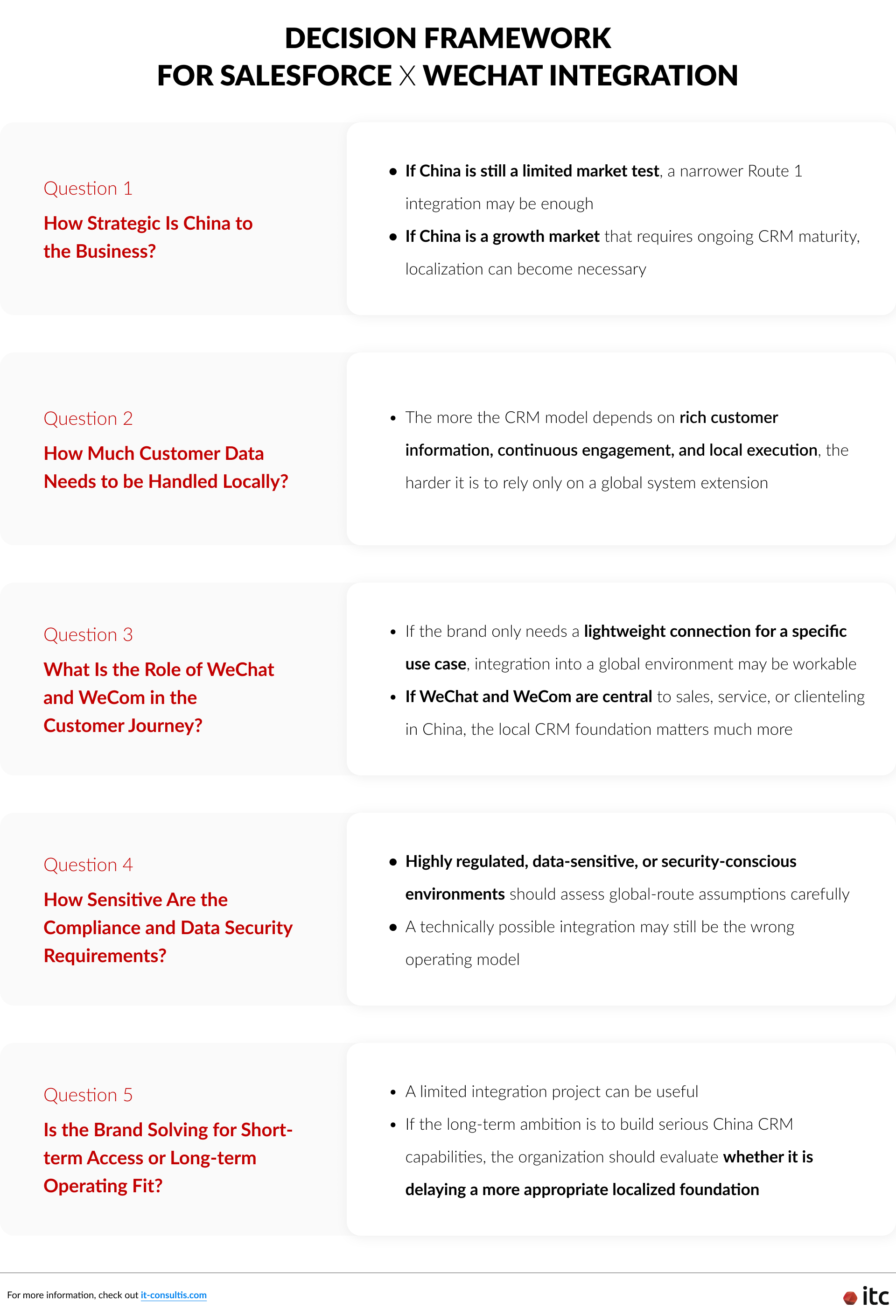
For most decision-makers, the best question is not whether Salesforce can connect to WeChat. It is which architecture best fits the business goal.
A useful decision framework starts with five questions.
1. How Strategic Is China to the Business?
If China is still a limited market test, a narrower Route 1 integration may be enough. If China is a growth market that requires ongoing CRM maturity, localization can become necessary.
2. How Much Customer Data Needs to be Handled Locally?
The more the CRM model depends on rich customer information, continuous engagement, and local execution, the harder it is to rely only on a global system extension.
3. What Is the Role of WeChat and WeCom in the Customer Journey?
If the brand only needs a lightweight connection for a specific use case, integration into a global environment may be workable.
If WeChat and WeCom are central to sales, service, or clienteling in China, the CRM foundation matters much more.
4. How Sensitive Are the Compliance and Data Security Requirements?
Highly regulated, data-sensitive, or security-conscious environments should assess global-route assumptions very carefully. A technically possible integration may still be the wrong operating model.
5. Is the Brand Solving for Short-term Access or Long-term Operating Fit?
A limited integration project can be useful. But if the long-term ambition is to build serious China CRM capabilities, the organization should evaluate whether it is delaying a more appropriate localized foundation.
Conclusion
Salesforce – WeChat integration in China should not be approached as a simple plug-and-play connection between systems.
Although a global Salesforce-to-WeChat setup may still be technically feasible in limited cases, it is no longer the route we would recommend for brands building serious CRM operations in China.
As compliance requirements tighten and China operations demand more control over customer data, messaging, and local workflows, Route 1 becomes increasingly hard to defend as a sustainable model.
The issue is not only whether the integration works, but whether the architecture is appropriate for where China CRM is heading.
For that reason, brands with meaningful China ambitions should treat localized CRM architecture as the recommended path. In practice, that means moving beyond a global-extension mindset and building on a China-ready CRM foundation such as Salesforce on Alibaba Cloud.
IT Consultis (ITC) is a certified Salesforce on Alibaba Cloud and global Salesforce partner, guiding multinational and Chinese enterprises to build CRM architectures that are compliant, scalable, and connected to key Chinese touchpoints such as WeChat and WeCom.