For multinational companies migrating to Salesforce on Alibaba Cloud, CRM localization is rarely a simple configuration exercise. Even when a company already has a mature global Salesforce setup, the China environment often requires more than replication.
In this article, we share a practical Salesforce China localization framework to help global and local teams decide what should stay standardized and what should be adapted for China, so the system supports governance, reporting consistency, local usability, and long-term adoption.
The core challenge is not whether China should be aligned with the global CRM. It is how to create the right kind of alignment without forcing China teams into processes, definitions, and workflows that do not fit local reality.
Executive Summary:
1. Salesforce China localization is not just about hosting or compliance. It is about designing a CRM model that works for both global governance and China execution.
2. The most effective approach is to standardize what protects control and reporting consistency, while localizing what improves usability, adoption, and operational fit for Salesforce on Alibaba Cloud in China.
3. A practical Salesforce China localization framework should be applied across lead management, approvals, reporting, dashboards, and supporting tools.
4. Teams can simplify decisions by classifying each area as something to lightly customize, replace, or rebuild for China.
5. Clear localization decisions early in the project reduce rework, improve adoption, and help global and China teams stay aligned after go-live
Table of Contents
- Salesforce China Localization is a Design Exercise, Not a Technical Transfer
- What Global Teams Should Usually Standardize in Salesforce on Alibaba Cloud
- What Often Needs Adaptation for the Salesforce China Instance
- A Practical Way to Evaluate Salesforce China Localization Decisions
- How to Review Global Salesforce Plugins, Packages, and Tools for China
- A Five-Step Salesforce China Localization & Migration Framework
- Conclusion
Salesforce China Localization is a Design Exercise, Not a Technical Transfer
A global CRM model is usually designed around enterprise-wide visibility, governance, and shared reporting standards. Those priorities still matter in China. But China teams also operate in a different digital, regulatory, and commercial environment.
That means Salesforce China localization should not be treated as a binary choice between copying the global org and rebuilding everything from scratch, especially when the China environment differs from the global Salesforce environment in ways that affect design decisions.
Instead, it should be treated as a design exercise that evaluates each major process area based on business purpose, local fit, and China CRM governance impact.
Before discussing objects, workflows, or migration scope, global and China teams should first align on two practical questions:
- Who will use Salesforce on Alibaba Cloud every day?
- What does leadership expect from CRM reporting?
These questions matter because the right localization design depends on how the system will actually be used in China.
For example, a CRM used mainly for pipeline visibility may need different priorities from one designed to support lead follow-up discipline, local approvals, and day-to-day sales execution.
Without this alignment, companies often fall into two common traps:
- They preserve too much of the global design, which weakens usability and local adoption, or
- They localize too much without clear rules, which weakens consistency and cross-market visibility.
A practical Salesforce China localization framework helps teams define where global consistency is essential and where local adaptation creates business value, reducing rework while improving adoption after launch.
What Global Teams Should Usually Standardize in Salesforce on Alibaba Cloud
A strong Salesforce China localization framework starts by protecting the elements that support enterprise-wide governance.
These usually include core reporting logic, shared business definitions, leadership-facing metrics, governance principles, and the controls needed to maintain visibility across regions.
When these areas stay consistent, headquarters can compare performance, manage risk, and maintain confidence in the China operation without requiring the local system to be identical to the global org.
In practice, standardization often makes sense for:
- Common reporting structures and KPI logic used by leadership
- High-level sales, service, or pipeline definitions that support cross-market comparison
- Governance rules around ownership, approvals, and auditability
- Core data structures that need to remain stable across markets
- Decision-making principles that protect transparency and control
This kind of standardization is important because it creates a common management language. It helps global teams understand what is happening in China without over-prescribing every local workflow.
What Often Needs Adaptation for the Salesforce China Instance
While governance should remain strong, the day-to-day operating layer often needs localization.
Salesforce China localization usually becomes most important in the parts of the CRM that users interact with constantly: local lead handling, operational workflows, approval routing, execution dashboards, and the supporting logic that reflects how teams actually work in China.
For example, the global business objective behind lead qualification may remain fully valid.
But the operational path to qualify, hand off, and follow up on leads may need to be adapted for local sources (e.g., WeChat Official Account instead of website, WeCom instead of WhatsApp, WeChat Mini Program instead of APP), local ownership models, and local team structures.
The same is true for approvals, where global oversight may remain necessary, but the routing logic and approver roles may need to reflect the pace and structure of local operations.
Reporting can also require localization at the execution layer. Global leadership may need stable roll-up metrics, while China teams need dashboards that reflect local priorities, daily task management, and market-specific workflows.
This is why CRM localization for China should focus less on surface-level translation and more on operational fit.
A Practical Way to Evaluate Salesforce China Localization Decisions
One useful way to apply a Salesforce China localization framework is to review each major workflow or operating area through three options: lightly customize, replace, or rebuild.
Lightly Customize
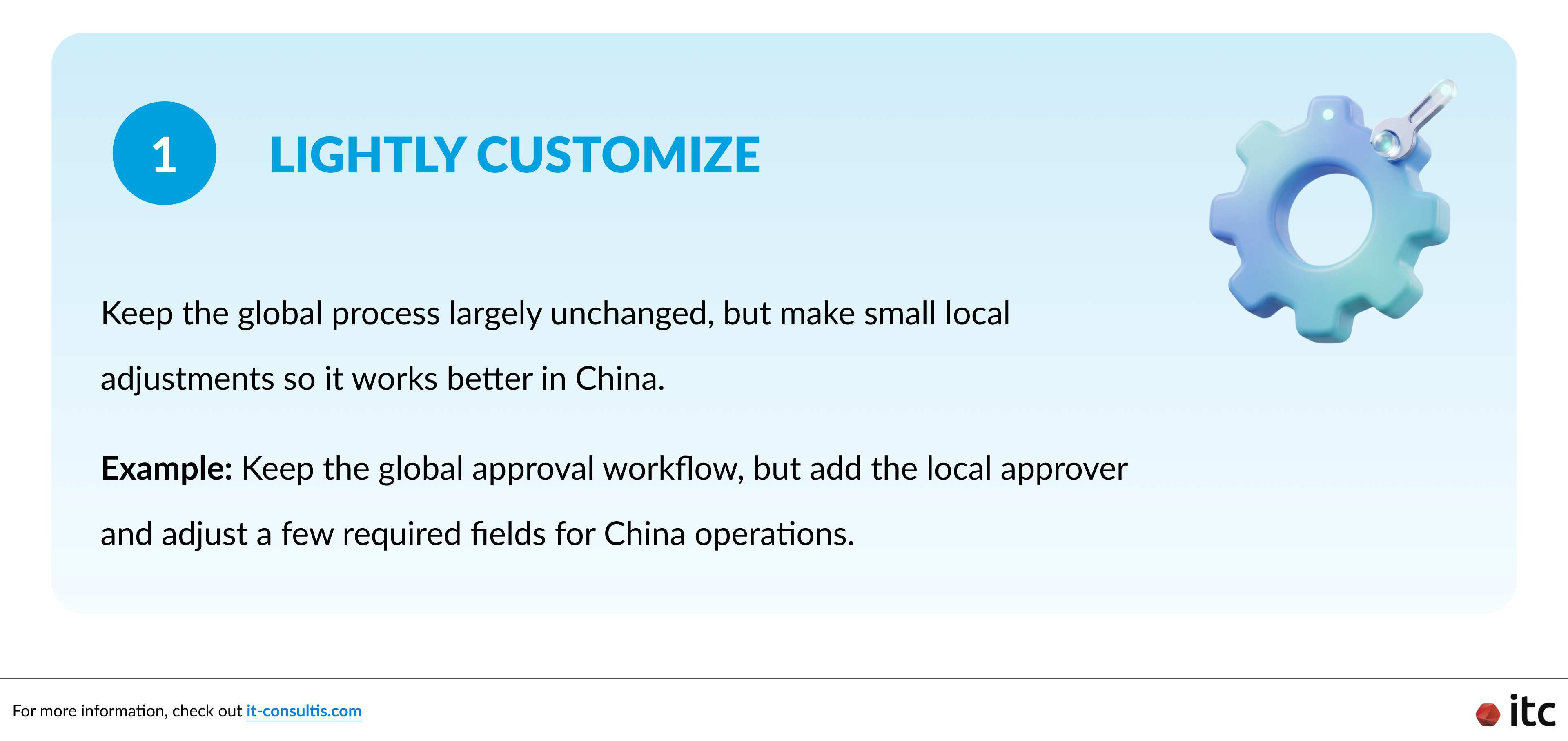
This approach works when the global process is largely sound and only needs targeted adjustments for China. The business logic stays mostly intact, but a few elements are adapted so the process works better locally.
For example, keep the global approval workflow, but add the local approver and adjust a few required fields, ownership rules, or refine definitions for China operations.
This option is often the most efficient when the existing global model already fits China reasonably well.
Replace
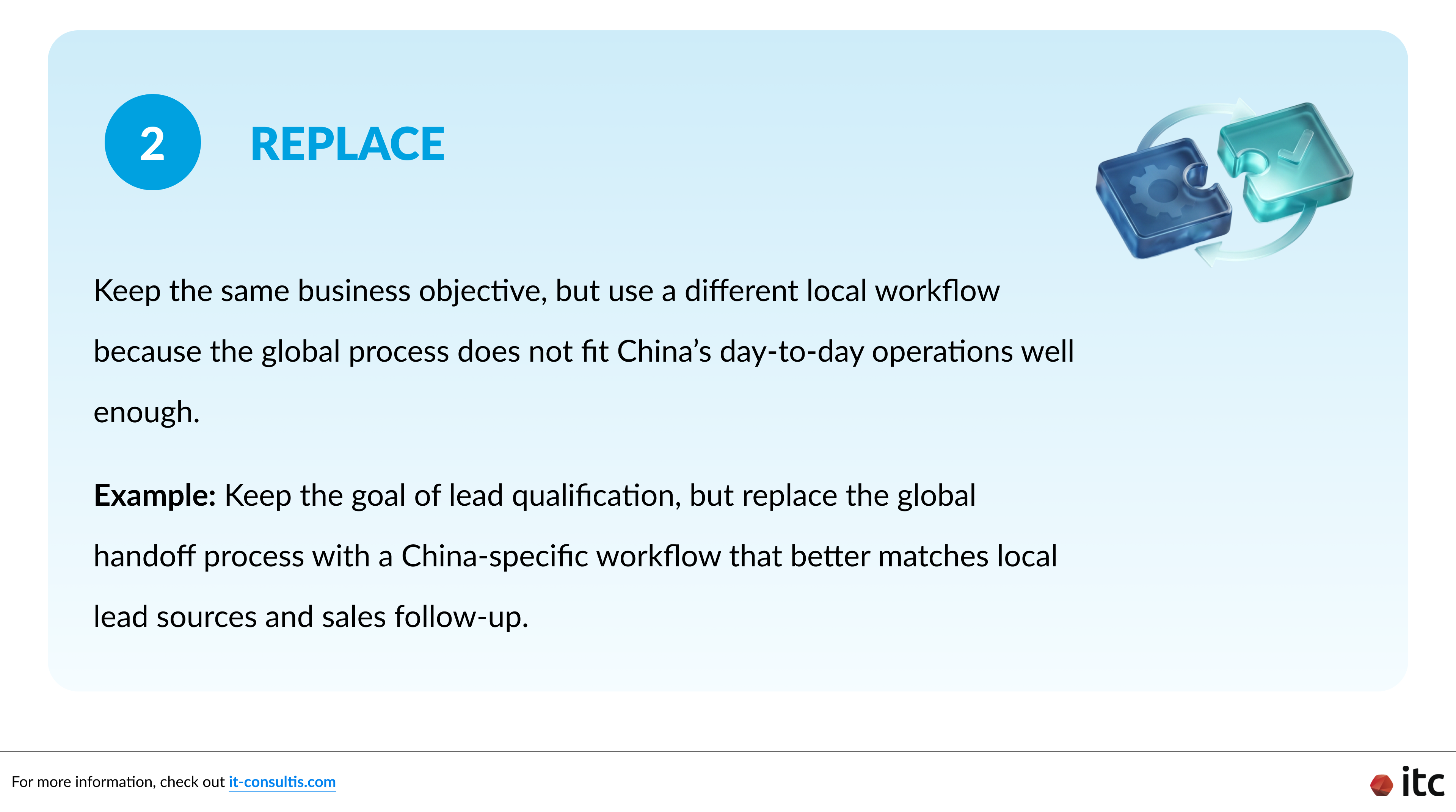
Replacement is appropriate when the business objective should stay the same, but the actual workflow should change.
For example, a company may want to preserve the same goal for lead qualification or approval governance, while replacing the detailed global process with a China-specific version that better supports local execution.
This allows teams to maintain strategic alignment without forcing local users to work inside a process that does not match local reality.
Rebuild
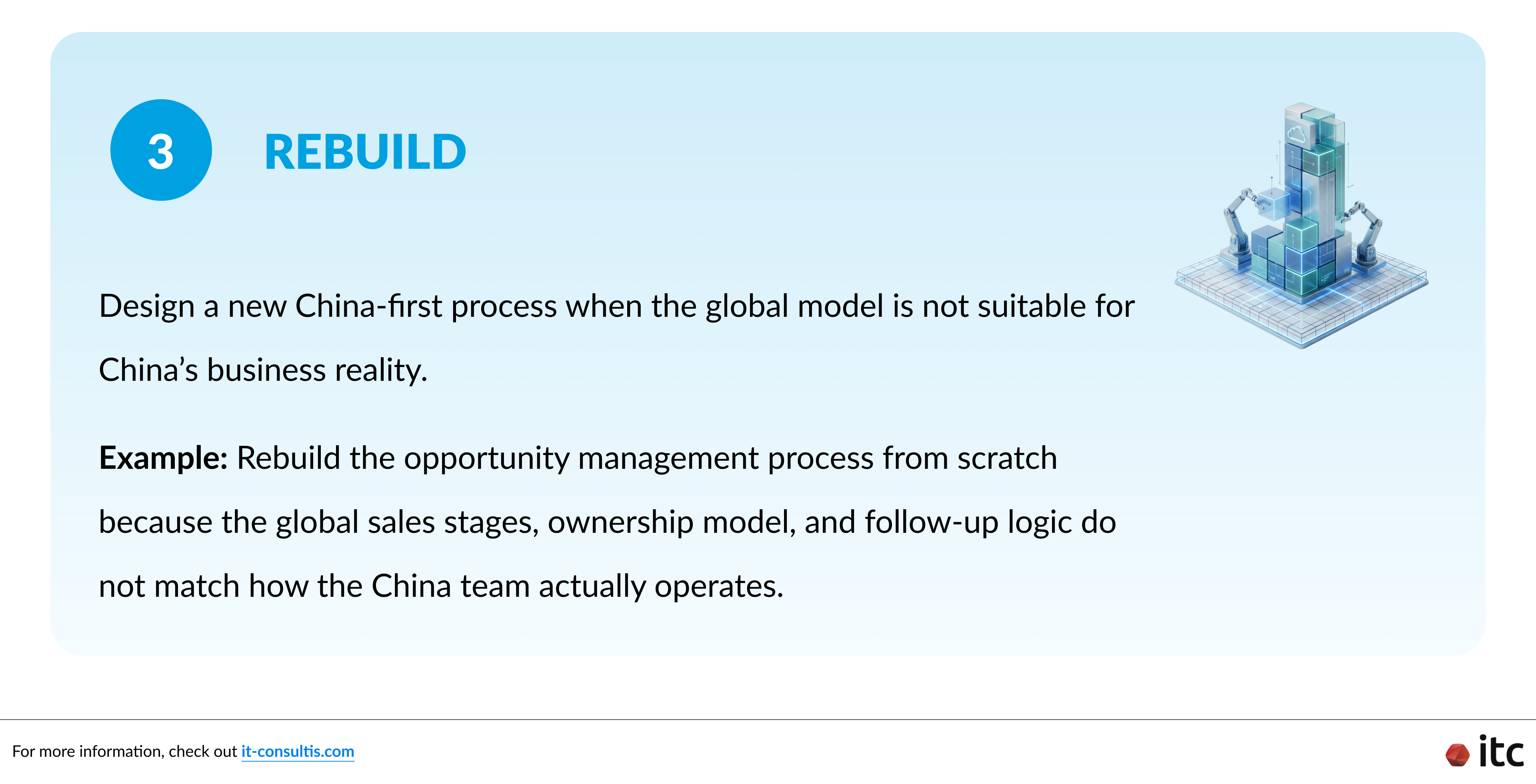
Rebuilding is necessary when the global Salesforce model does not reflect how the Chinese business actually operates.
This can happen when the global workflow assumes a different ownership structure, sales motion, operating cadence, or internal coordination model. In that case, patching the process may create more complexity than value.
For example, brands should rebuild the opportunity management process from scratch because the global sales stages, ownership model, and follow-up logic do not match how the China team actually works.
A rebuild does not mean abandoning governance. It means designing a China-first process that still supports enterprise visibility, but does so through a more appropriate local operating model.
How to Review Global Salesforce Plugins, Packages, and Tools for China
Salesforce China localization should also include a separate review of plugins, packages, and supporting tools.
A common mistake is to assume that if a tool supports the global Salesforce environment today, it should automatically remain part of the China design.
But a better question is whether the business logic behind that tool still makes sense in the localized Salesforce on Alibaba Cloud operating model.
Teams should review each tool by asking:
1. Is it compliant with China’s regulatory environment (i.e., China Personal Information Protection Law) and accessible?
2. What business problem does this solve today?
3. Does that problem exist in the same form in China?
4. Should the tool be retained, adapted, replaced, or excluded?
This review is especially important for tools connected to approvals, workflow logic, reporting, integrations, and local execution. Some tools may still fit the Chinese environment with minor changes. Others may need a local alternative or a redesigned process.
A business-first review helps keep Salesforce on Alibaba Cloud localization focused on outcomes rather than on copying components for their own sake.
A Five-Step Salesforce China Localization & Migration Framework
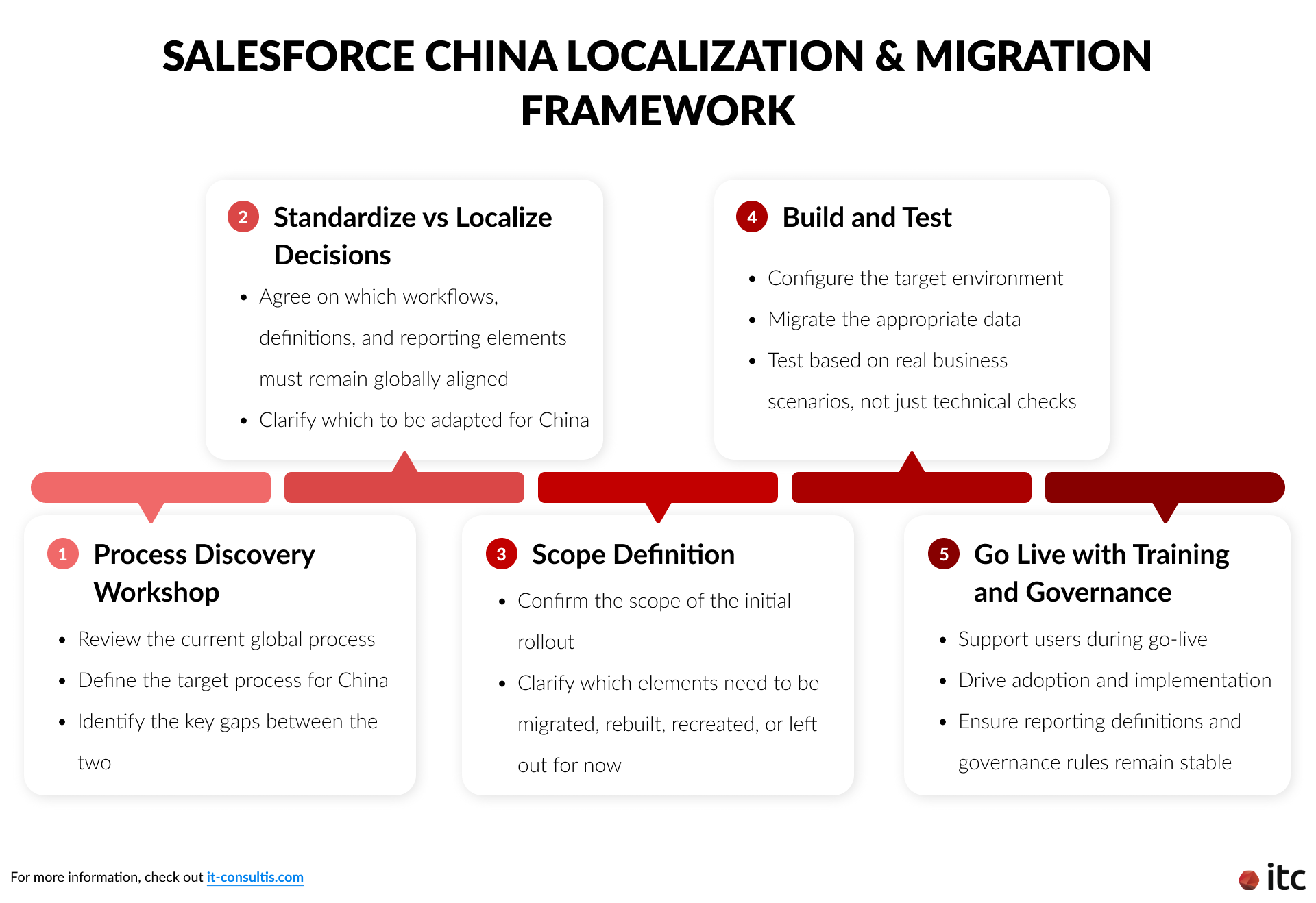
1. Process Discovery Workshop
Review the current global process, define the target process for China, and identify the most important gaps between the two.
This step should focus on how the system is actually used today, what China teams need from it in practice, and where global workflows may not fit local operations.
2. Standardize vs Localize CRM Decisions
Agree on which workflows, definitions, governance rules, and reporting elements must remain globally aligned, and which should be adapted for China.
The goal is to preserve global visibility and control while making the system workable for local users.
3. Scope Definition
Confirm what should be migrated, rebuilt, recreated, or excluded from the initial rollout.
This step helps teams set realistic priorities, avoid unnecessary complexity, and define a rollout scope that balances business value, timeline, and risk.
4. Build and Test
Configure the target environment, migrate the right data, and validate the setup using realistic business scenarios rather than only technical checks.
Testing should reflect how China teams will actually use the system day to day, including workflows, approvals, reporting, and local operational needs.
5. Go Live with Training and Governance
Support users during launch, reinforce adoption, and make sure reporting definitions and governance rules remain stable after rollout.
Go-live is not just about deployment. It also depends on user confidence, clear ownership, and a governance model that keeps the localized CRM aligned over time.
Successful Salesforce on Alibaba Cloud localization starts with process design, not replication.
By separating what should be standardized from what should be localized, teams can reduce rework, improve adoption, and keep the China org aligned with global goals without forcing it to be identical.
For more information, check out our guide to Salesforce on Alibaba Cloud migration and the official technical migration guide.
Conclusion
The strongest Salesforce China localization strategies are built on deliberate choices, not assumptions.
When global and China teams use a clear framework to decide what should be standardized and what should be adapted, they reduce rework, protect governance, and create a CRM environment that is more likely to be adopted in practice.
For companies moving from a global CRM to a China-ready model, the real advantage comes from designing the right balance. That is what turns localization from a technical necessity into a business enabler.
IT Consultis (ITC) is a certified Salesforce on Alibaba Cloud partner helping enterprises and global system integrators deliver Salesforce in China with a locally compliant, fully operational CRM environment tailored to the Chinese market.