Notifications look like a small workflow detail until they fail.
In China, a delayed delivery alert, a missing refund update, or a mistimed promotional message quickly becomes a customer-service issue, an operational issue, and a compliance issue at the same time.
In this article, we explain what Salesforce on Alibaba Cloud can realistically support for notifications and marketing-related messaging in China, where connected local tools still matter.
We also look at how decision-makers in China and regional APAC hubs such as Singapore and Hong Kong should define the boundary between CRM orchestration, local channel connectivity, and campaign execution.
Executive Summary:
1. Salesforce on Alibaba Cloud is strongest as the China CRM backbone and orchestration layer, not as a standalone marketing automation engine.
2. Transactional notifications are achievable, but reliability depends on local channel integration, template governance, event quality, fallback rules, and exception handling.
3. Connected Experiences Gateway (CXG) helps bridge Salesforce on Alibaba Cloud with local channels and systems, while campaign-scale segmentation and orchestration typically sit in Quick Audience or another local activation layer.
4. The hard part is rarely composing the message. It is managing fragmented upstream events, duplicate-trigger risk, failed delivery retries, consent status, and operational ownership.
5. Teams should define event inventory, channel roles, escalation rules, and monitoring requirements early instead of treating notifications as a late-stage implementation detail.
Table of Contents
- Why Notifications Matter More in China Than Many Global Teams Expect
- What Salesforce on Alibaba Cloud Can Handle Directly
- How Notification Types Map to Salesforce on Alibaba Cloud
- Why Notification Architecture Becomes Complex in Salesforce on Alibaba Cloud Environments in China
- Why Marketing Messaging Needs a Different Operating Layer
- The Mistakes Decision-makers Should Avoid
- What This Means for Teams Designing China Notification Operations
- Conclusion
Why Notifications Matter More in China Than Many Global Teams Expect
For brands operating in China, notifications are not just system outputs. They are frontline customer-experience touchpoints and operational control points.
That matters because China’s customer journey is structurally different from the web-and-email journeys many global teams still assume.
This operating reality affects not only mainland China teams, but also regional teams in Singapore, Hong Kong, and across APAC that oversee China CRM, service, or digital operations.
According to Salesforce’s September 2025 guide to localized execution in China, customer journeys in China increasingly run through QR codes, WeChat Official Accounts, WeCom conversations, WeChat Mini Programs, and local service loops rather than traditional email-led funnels.
The same guide also notes that Chinese users check email materially less often than users globally, which changes how brands should think about urgency, reach, and fallback channels.
In practical terms, strong notification workflows support four high-value outcomes:
- Lower customer-service workload by reducing avoidable “where is my order?” inquiries
- Better customer experience through timely order, delivery, refund, and exception updates
- Faster internal approvals and fewer operational bottlenecks
- Stronger lifecycle engagement when transactional data is correctly connected to local marketing tools
For that reason, notification design belongs close to CRM strategy, service design, and operating-model decisions rather than being left to a narrow implementation workstream.
What Salesforce on Alibaba Cloud Can Handle Directly
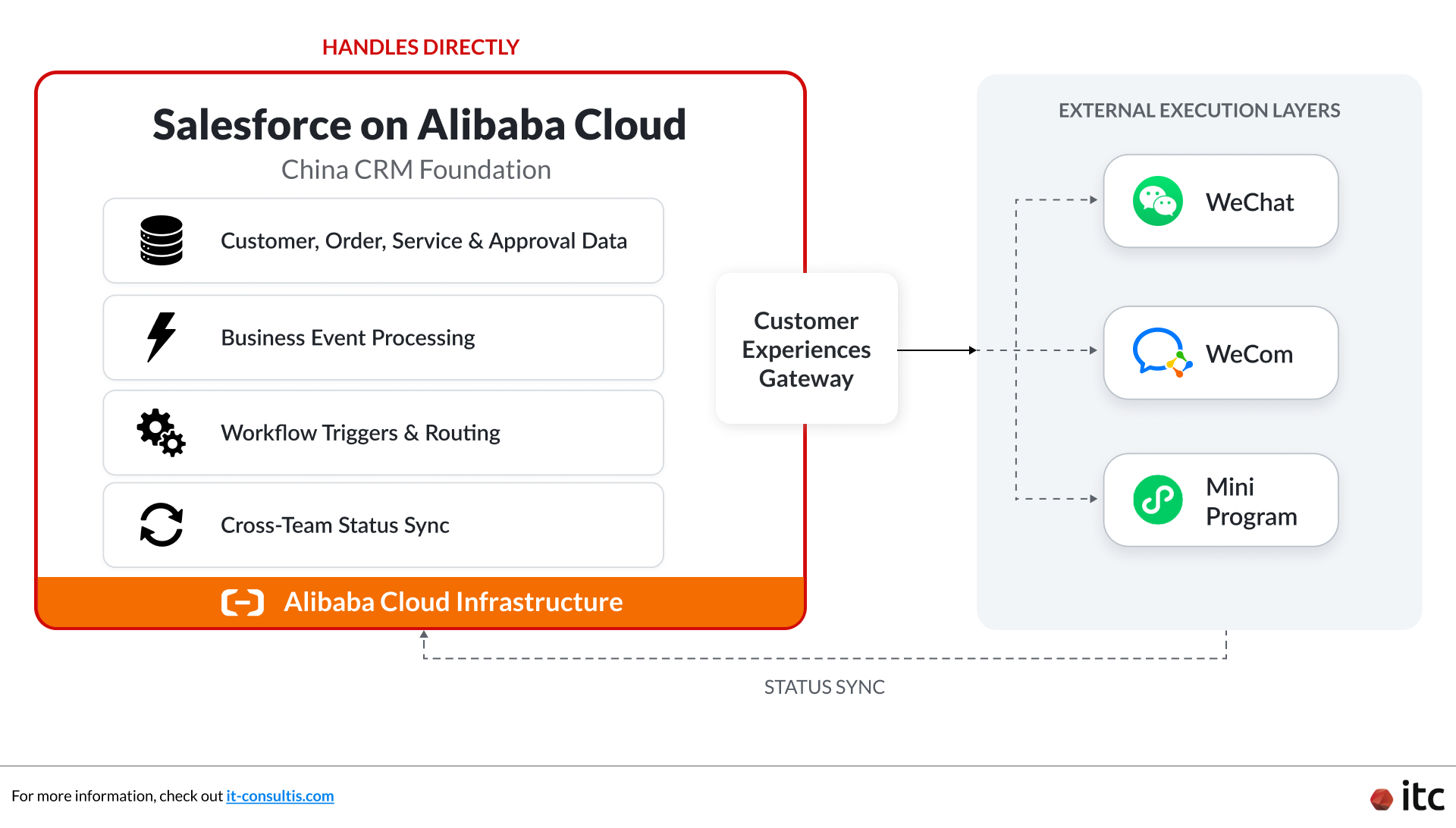
Salesforce on Alibaba Cloud should first be understood as a localized CRM foundation for China rather than as a single all-in-one messaging engine.
That matters because it helps teams separate what it can manage directly from what still depends on local activation and delivery layers.
At a high level, Salesforce on Alibaba Cloud is well suited to:
- Holding customer, order, service, and approval data in a China-ready CRM environment
- Receiving or processing business events tied to orders, refunds, service cases, approvals, and other operational workflows
- Triggering workflow logic, internal notifications, and process routing inside CRM and service operations
- Synchronizing status visibility for sales, service, and operational teams
- Coordinating with Connected Experiences Gateway and other local integrations to pass events or data into downstream China execution layers
This means Salesforce on Alibaba Cloud can play a central role in notification architecture, but not as the sole execution layer for every message a brand wants to send.
Its strongest direct role is in workflow control, data orchestration, internal coordination, and event handling. Customer-facing delivery in China still depends on localized channels and external execution layers connected to the CRM foundation.
How Notification Types Map to Salesforce on Alibaba Cloud
A more useful way to distinguish notification types is by purpose rather than by technology alone. In China, the key question is which communications Salesforce on Alibaba Cloud can support directly and where localized delivery still needs to be connected.
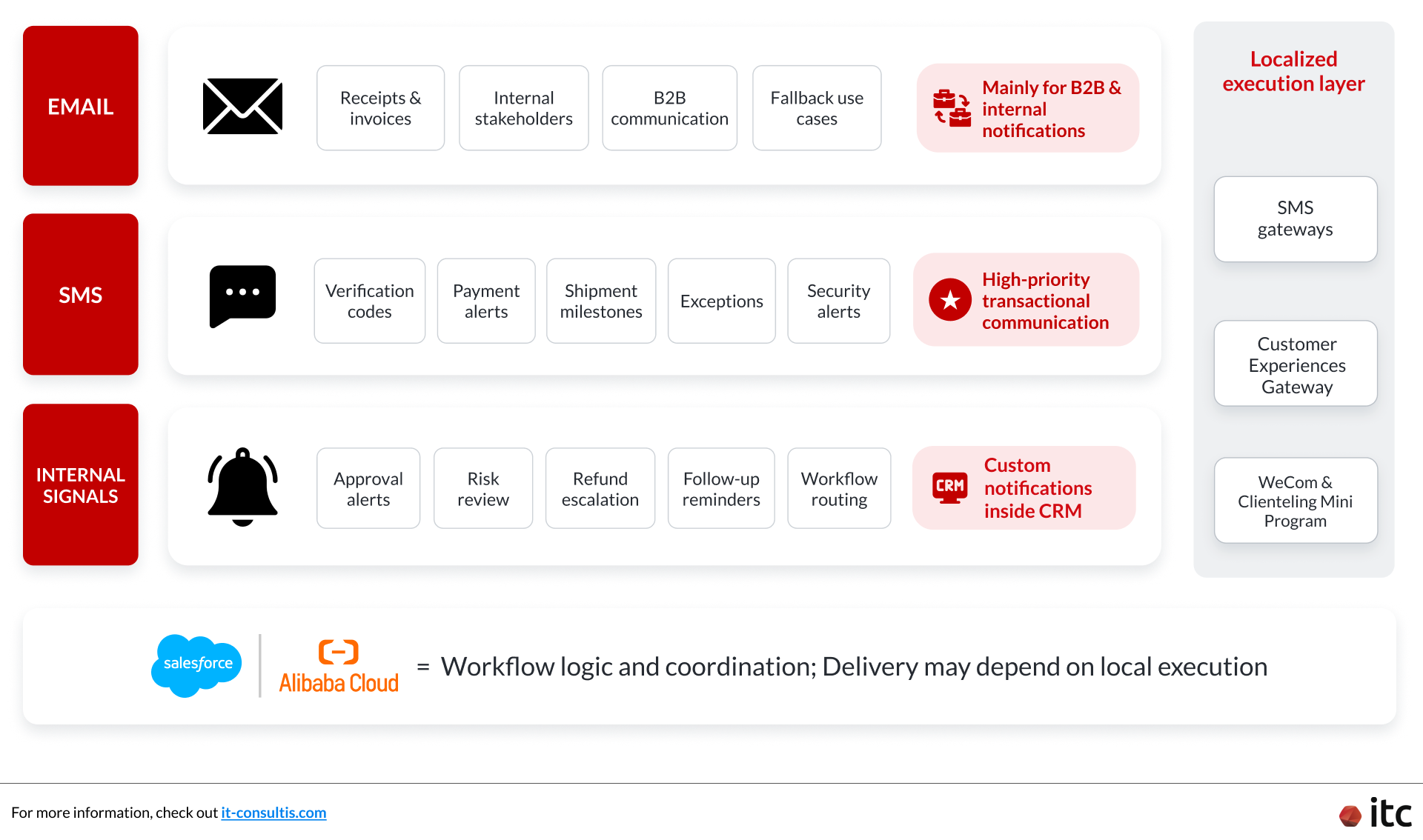
Salesforce on Alibaba Cloud can support email-related workflows, but email is not the default consumer channel many global teams expect in China.
In most cases, email is better reserved for:
- Formal documents such as receipts and invoices
- Internal stakeholder communications
- Selected B2B scenarios
- Fallback use cases where email remains operationally useful
For consumer-facing B2C communications, email should rarely be treated as the primary urgent-notification layer.
SMS
SMS remains one of the most important channels for high-priority transactional communication in China.
It is commonly used for:
- Verification codes
- Payment success or failure alerts
- Shipment and delivery milestones
- Exception notifications such as delays, cancellations, or address issues
- Security or account-related alerts
Within a Salesforce on Alibaba Cloud environment, SMS can sit inside broader workflow and orchestration logic, but effective delivery still depends on localized execution.
That usually means integrating local gateway providers, working within approved signatures and templates, and applying tight sending discipline to reduce spam-control and deliverability risks.
Internal Notifications and Workflow Signals
Custom notifications inside Salesforce on Alibaba Cloud are important, but their role should be understood correctly. They are primarily internal workflow signals, not direct consumer communications.
They are especially useful for:
- Approval alerts
- Risk-control review triggers
- High-value refund escalation
- Sales or service follow-up reminders
- Internal workflow routing between teams
This is one of the clearest examples of what Salesforce on Alibaba Cloud supports directly inside CRM and service workflows.
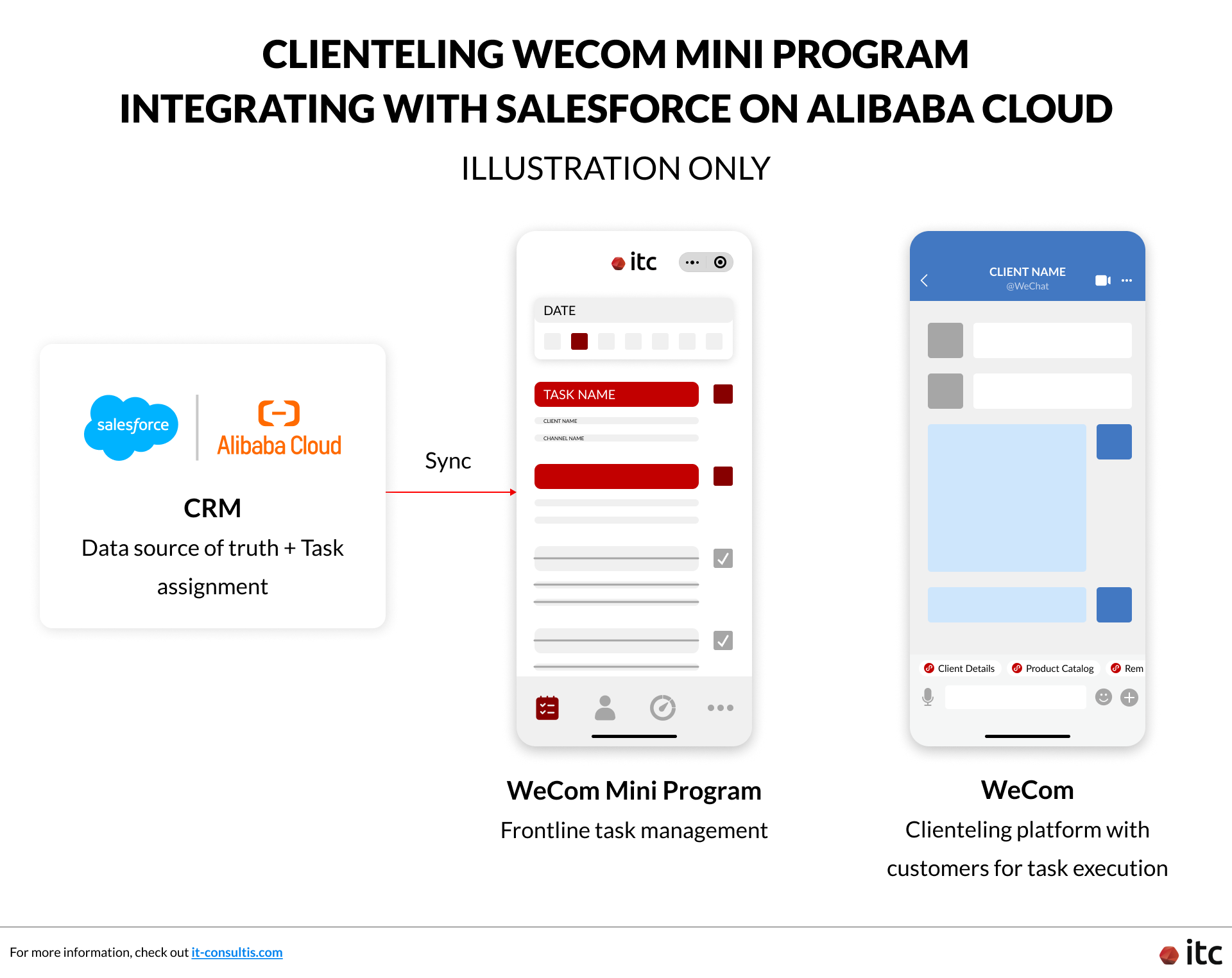
In more advanced architectures, those internal signals can also trigger downstream logic connected to Connected Experiences Gateway, SMS providers, or local execution layers such as a clienteling WeCom Mini Program integrated with Salesforce on Alibaba Cloud and WeCom.
That means Salesforce on Alibaba Cloud can manage core workflow logic and internal coordination, while customer-facing delivery and frontline activation in China often depend on a broader localized execution layer.
Why Notification Architecture Becomes Complex in Salesforce on Alibaba Cloud Environments in China
The challenge is not whether to send a message. It is whether the right event is recognized, routed through the right local path, and governed by the right fallback and compliance rules.
In a Salesforce on Alibaba Cloud environment, that complexity increases because notification workflows rarely live inside one platform alone.
It often needs to coordinate with local business systems, local delivery channels, Connected Experiences Gateway, and China-specific compliance requirements.
Four issues usually create most of that complexity.
1. Event Sources are Fragmented
In many China deployments, the most important notification triggers do not originate inside Salesforce on Alibaba Cloud alone.
Order and service signals may come from:
- Local OMS platforms
- eCommerce marketplaces
- ERP systems
- Third-party logistics providers
- Payment and refund systems
- Customer service tools
That means Salesforce on Alibaba Cloud is often only one system in the workflow, not the sole event origin. An “order shipped” notification may depend on OMS confirmation, logistics webhook write-back, parcel-split logic, and status synchronization back into Salesforce CRM.
If those inputs arrive late, map incorrectly, or conflict across systems, the notification logic may still fire while the customer experience is wrong.
2. One Business Event Often Needs Multiple Delivery Paths
In a Salesforce on Alibaba Cloud operating environment, a single event such as “order shipped” may require:
- A primary customer-facing message
- A fallback if the preferred channel is unavailable
- An internal alert if delivery status becomes abnormal
- Synchronized status visibility inside CRM
A practical example is a customer whose mobile number becomes invalid. Teams then need a defined fallback path, a delivery-failure status, and a rule for whether service teams should be alerted inside the Salesforce on Alibaba Cloud workflow.
Without that orchestration logic, the architecture may look sound on paper but break in real operations.
3. Exception Flows Matter as much as Happy-path Flows
Brands usually design the clean scenarios first: order confirmed, payment successful, or parcel shipped.
But in Salesforce on Alibaba Cloud environments, service cost and customer frustration usually come from exception scenarios such as payment failure, split shipments, delay notifications, delivery failure, cancellation, refund progress, risk holds, and after-sales review outcomes.
Multi-parcel orders are a good example. One order can split into several shipments, each with different milestones.
Without parcel-aware status logic and deduplication rules around Salesforce on Alibaba Cloud workflows, teams either push duplicate alerts or miss partial-shipment updates altogether.
4. Logging, Retries, Monitoring, and Compliance Are Part of the Architecture
In China, notification workflows built around Salesforce on Alibaba Cloud need more than trigger logic. They also need operational controls across Connected Experiences Gateway, local providers, and upstream systems.
If a logistics callback is delayed, an SMS provider times out, or a downstream gateway rejects a payload, teams need enough logging to know whether the trigger fired, whether delivery failed, whether a retry occurred, and whether another system retriggered the same message.
Compliance and localization make those controls even more important. Alibaba Cloud’s guidance on Salesforce on Alibaba Cloud highlights the relevance of China’s Cybersecurity Law, Data Security Law, Personal Information Protection Law, and cross-border data transfer governance.
In practice, that affects notification design in concrete ways:
- Customer data storage and transfer boundaries matter
- Consent, subscription status, and opt-out handling matter for the relevant message types
- Local template approval processes matter
- Channel choice matters
- Content review and operational governance matter
In China, notification design is not just about sending messages timely. It is about making multiple systems, channels, and governance rules work together reliably and compliantly.
Why Marketing Messaging Needs a Different Operating Layer
Transactional messaging and marketing messaging should not be designed the same way, even when both draw on the same CRM data foundation.
Transactional messaging is event-driven, service-sensitive, and operationally constrained. It typically prioritizes:
- Timeliness
- Accuracy
- Reach
- Compliance
- Exception handling
Examples include:
- Order submission confirmation
- Payment success or failure
- Shipment updates
- Refund status updates
- Approval reminders
- Service ticket progress
Marketing messaging, by contrast, is audience-driven and campaign-driven. It typically prioritizes:
- Segmentation quality
- Consent, subscription status, and opt-out handling where applicable
- Content relevance
- Channel fit
- Journey logic
- Re-engagement measurement
Examples include:
- Post-purchase re-engagement
- Membership reminders
- Coupon journeys
- Nurture sequences
- Content distribution
- Behavior-triggered lifecycle messages
In practice, Salesforce on Alibaba Cloud may provide the customer data, event context, and workflow foundation for both categories.
But campaign execution usually belongs in a separate activation layer designed for segmentation, scheduling, journey logic, and channel orchestration at scale.
The Mistakes Decision-makers Should Avoid
The most common mistakes are not obscure technical edge cases. They are flawed assumptions made too early.
Mistake 1: Treating notifications as a minor implementation detail
Notifications influence customer experience, complaint volume, support load, approval speed, and brand credibility. They deserve leadership attention early.
Mistake 2: Copying a global email-first architecture into China
China’s engagement model is channel-local, mobile-first, and messaging-centric. Reusing global assumptions without redesigning for China usually produces weak reach and weak user response.
Mistake 3: Assuming core CRM alone equals marketing automation
Salesforce on Alibaba Cloud is a strong CRM foundation, but serious marketing execution in China still requires connected local tooling, audience logic, and channel orchestration.
Explore how to integrate WeChat with Salesforce for centralized data collection and streamlined marketing automation and service workflows.
Mistake 4: Designing only the happy path
Delayed logistics callbacks, split shipments, invalid mobile numbers, expired consent, and duplicate triggers are normal operating realities. Teams that treat them as edge cases usually end up with higher service costs and weaker trust.
Mistake 5: Postponing governance until late in the project
Template approvals, opt-out logic, retry policy, message ownership, escalation rules, and logging requirements should be defined before launch design is finalized.
Mistake 6: Underestimating approval workflow complexity
Internal notifications can fail operationally even when the customer side works. A high-value refund or risk-blocked order may need approval timeout escalation, role-based routing, and context-rich alerts. If approvers receive only a generic message with no escalation logic, backlogs build quickly.
What This Means for Teams Designing China Notification Operations
For decision-makers in China and regional APAC hubs such as Singapore and Hong Kong, the more useful question is not “Can Salesforce on Alibaba Cloud send this message?” It is “What role should Salesforce on Alibaba Cloud play inside our China notification architecture?”
For most brands, the practical answer is:
- Use Salesforce on Alibaba Cloud as the China CRM and notification orchestration backbone
- Define a clear event inventory across order, service, approval, and lifecycle scenarios
- Assign channel roles instead of treating every channel as interchangeable
- Connect local delivery tools where high-volume or channel-specific notification delivery is required
- Build exception logic, fallback logic, retry controls, and delivery monitoring into the design from the beginning
The strongest architecture is rarely the one with the most channels. It is the one with the clearest event logic, the most disciplined governance, and the fewest blind spots when notification exceptions appear in real operations.
IT Consultis (ITC) supports this kind of China-local notification design around Salesforce on Alibaba Cloud: aligning the platform, local delivery layers, and governance model so notification workflows are reliable, compliant, and operationally useful.
Conclusion
Salesforce on Alibaba Cloud can be a strong notification foundation in China, but only when teams define its role clearly. It should anchor customer data, workflow logic, and notification orchestration, not be mistaken for a complete local delivery stack.
The brands that perform best define event ownership, channel roles, exception handling, and consent governance before implementation begins. That is what turns a compliant local CRM deployment into a reliable notification architecture for China.