Salesforce Life Sciences Cloud became generally available globally in October 2025 and has been made available in China on Salesforce on Alibaba Cloud since July 2026.
For multinational pharma companies already using the global Life Sciences Cloud instance, this is not just a product update.
If China’s healthcare professional, organization, inquiry, and interaction data are part of local execution, those companies have to localize their Life Sciences Cloud on Salesforce on Alibaba Cloud for China.
Keeping those data and workflows on the global instance is not a credible long-term model for China.
More broadly, pharma companies should assess whether it is the right platform for commercial, medical, and service execution in China.
In this article, we examine why Salesforce Life Sciences Cloud in China matters now, where pharma CRM models usually break in practice, and what leaders should evaluate before treating it as a serious platform option for China.
Executive Summary:
1. Salesforce Life Sciences Cloud in China matters because pharma teams need a stronger operating model, not just local infrastructure.
2. The most immediate value is practical: better healthcare professional/organization context, more disciplined field and medical workflows, cleaner inquiry capture, and more reliable follow-up.
3. China changes adoption economics. Local channels, mobile-first execution, content governance, and workflow fit shape whether CRM becomes useful or stays administrative.
4. AI only becomes commercially relevant when CRM data and workflows are already structured. Weak foundations produce weak AI outcomes.
5. The right evaluation lens is operational. Pharma leaders should assess workflow fit, channel fit, data governance, compliance design, and delivery capability before they assess feature lists.
Table of Contents
- Why Salesforce Life Sciences Cloud in China Matters Now
- Why Pharma Companies Using the Global Salesforce Instance Have to Localize Life Sciences Cloud on Alibaba Cloud for China
- Where Pharma CRM Models in China Usually Break
- What Salesforce Life Sciences Cloud in China Could Improve in Practice
- Why Local Workflows and Channels Change Adoption in China
- Conclusion
Why Salesforce Life Sciences Cloud in China Matters Now
The pressure on pharmaceutical organizations in China is now operational, not theoretical.
Commercial teams need better visibility into account potential, territory priorities, and past engagement.
Medical teams need cleaner inquiry capture, stronger traceability, and more coordinated follow-up.
Leadership teams want frontline execution to improve while also building a CRM foundation that can support useful AI, stronger reporting, and more consistent governance.
That raises the bar for CRM.
A modern life sciences CRM in China has to do more than store contacts and activity logs. It has to support:
- Healthcare professional (HCP) and healthcare organization (HCO) hierarchy management
- Affiliation and account context
- Sales representative/pharma field rep and medical science liaison (MSL) coordination
- Medical inquiry capture and compliant follow-up
- Territory planning and execution visibility
- Approved-content distribution through locally relevant channels
- Mobile workflows that teams will actually use
That is why Salesforce on Alibaba Cloud and its latest Life Sciences Cloud for Customer Engagement have strategic relevance for life sciences organizations operating in China.
Why Pharma Companies Using the Global Salesforce Instance Have to Localize Life Sciences Cloud on Alibaba Cloud for China
Salesforce Life Sciences Cloud for Customer Engagement first became generally available globally in October 2025. It was later launched on Salesforce on Alibaba Cloud at the July 2026 Annual Summit in Shanghai.
That release sequence matters because it signals more than another product update. It shows that the life sciences engagement model is now being localized for China within the Alibaba Cloud operating environment.
In Greater China, Salesforce products are operated, maintained, and sold by Alibaba Cloud, with integrations for local social and messaging platforms, payment services, SMS services, and map services.
For life sciences organizations, that matters because effective local customer engagement depends not only on system access, but on workable channels, compliant workflows, and data handling that fits within China’s operating environment.
That local operating model matters for more than convenience or performance.
In life sciences, customer engagement activity often involves sensitive HCP, HCO, interaction, and inquiry-related data.
Under China’s Personal Information Protection Law (PIPL), relying on a global instance to store or process data tied to these activities can create serious regulatory exposure for companies with an establishment in China.
For multinational pharma companies already using Salesforce globally, the implication is straightforward: once China HCP, HCO, inquiry, and interaction data are part of local execution, they have to localize their Life Sciences Cloud on Salesforce on Alibaba Cloud for China.
That requirement is not only about where data sits. It is also about how compliant workflows are executed, how approved content is distributed, how customer context is preserved, and how frontline teams work in China.
Leaders, therefore, need to assess not only whether the product is available in China, but whether it supports a China-localized life sciences operating model that keeps data handling, compliance discipline, workflow execution, and frontline engagement aligned with how teams actually work in China.
Where Pharma CRM Models in China Usually Break
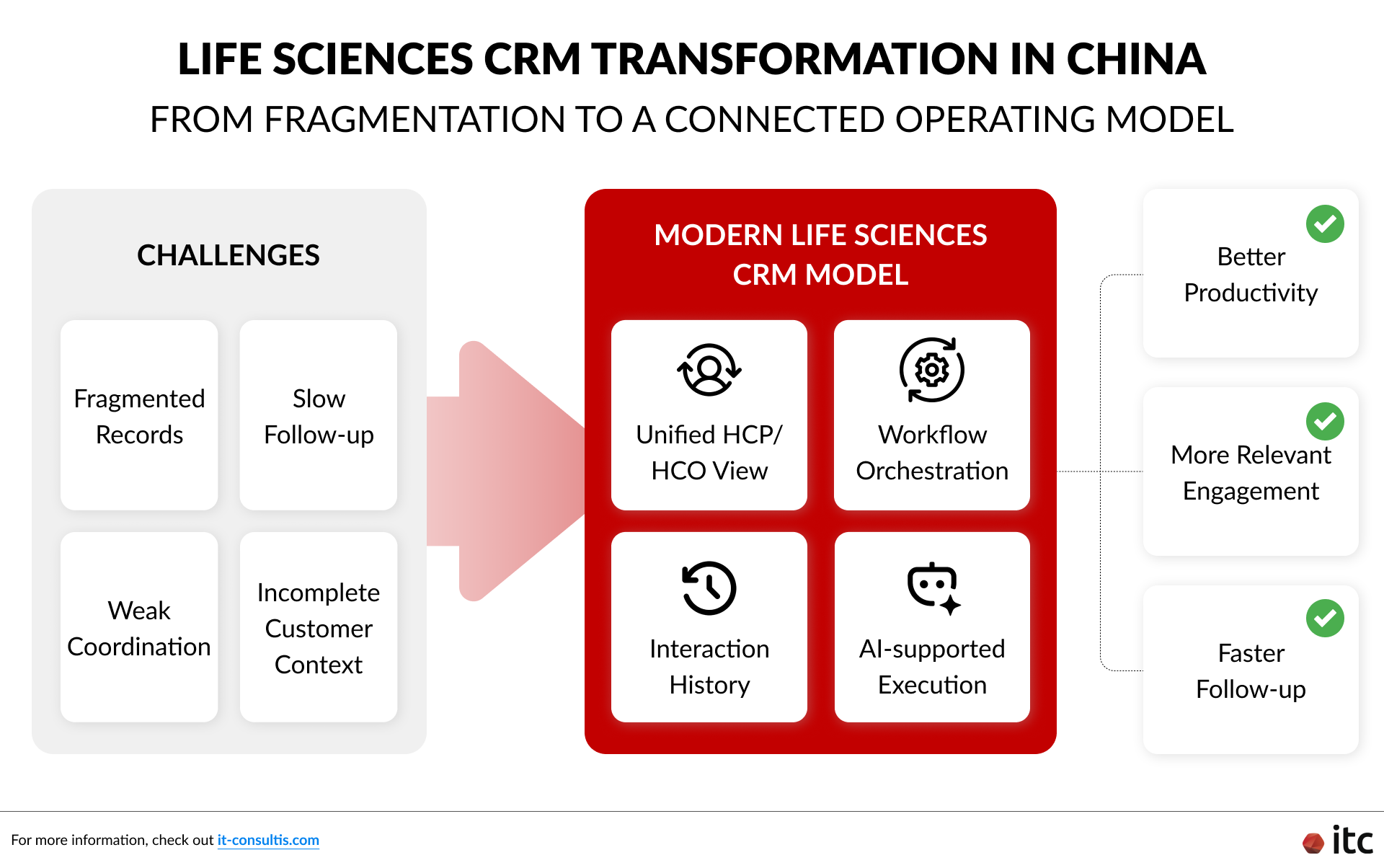
Many CRM programs in life sciences do not fail because the software is weak. They fail because the operating model remains fragmented.
1. HCP and HCO Context Remains Incomplete
Teams often work with fragmented customer records, weak affiliation logic, and inconsistent interaction history. That makes targeting, follow-up, and account planning less precise than they should be.
In practice, that means a field rep, an MSL, and a manager may all look at the same account with different levels of context and different assumptions about what happened last.
2. Medical and Commercial Workflows Do Not Stay Connected
Medical inquiry handling, field activity capture, and post-meeting follow-up are often managed across separate tools or manual processes. The result is slower coordination, weaker traceability, and more administrative friction.
This is especially visible when teams need to move from an interaction to an inquiry, from an inquiry to approved content, or from a visit to a documented next step that can be tracked and reviewed.
3. Territory and Execution Planning Becomes Reactive
When CRM data is incomplete or stale, territory planning turns into a reporting exercise rather than an execution tool.
Managers lose a reliable basis for prioritizing HCPs, coordinating activities, and identifying where frontline effort is actually creating value.
4. Local Execution Habits Sit Outside the System
If CRM design assumes that teams will work mainly inside formal desktop workflows, adoption usually weakens.
In China, workflow fit depends heavily on:
- Mobile usability
- Local communication habits
- Whether the CRM model connects cleanly to the channels teams already rely on
5. AI Gets Layered onto Weak Foundations
According to Forrester’s study on “Applications Of AI In Health And Life Sciences” in 2024, 76% of healthcare decision-makers see AI as a key driver for creating more personalized patient interactions.
Many organizations now want AI-supported workflows such as pre-call preparation, summarization, next-best-action guidance, or interaction support.
However, those use cases only work well when account context, engagement data, and workflow discipline are already strong.
Without that foundation, AI adds noise faster than it adds value.
What Salesforce Life Sciences Cloud in China Could Improve in Practice
The strongest case for Salesforce Life Sciences Cloud in China is not that it adds one more layer of functionality. It is that it could help pharma organizations build a more coherent execution model.
A Stronger HCP/HCO Engagement Foundation
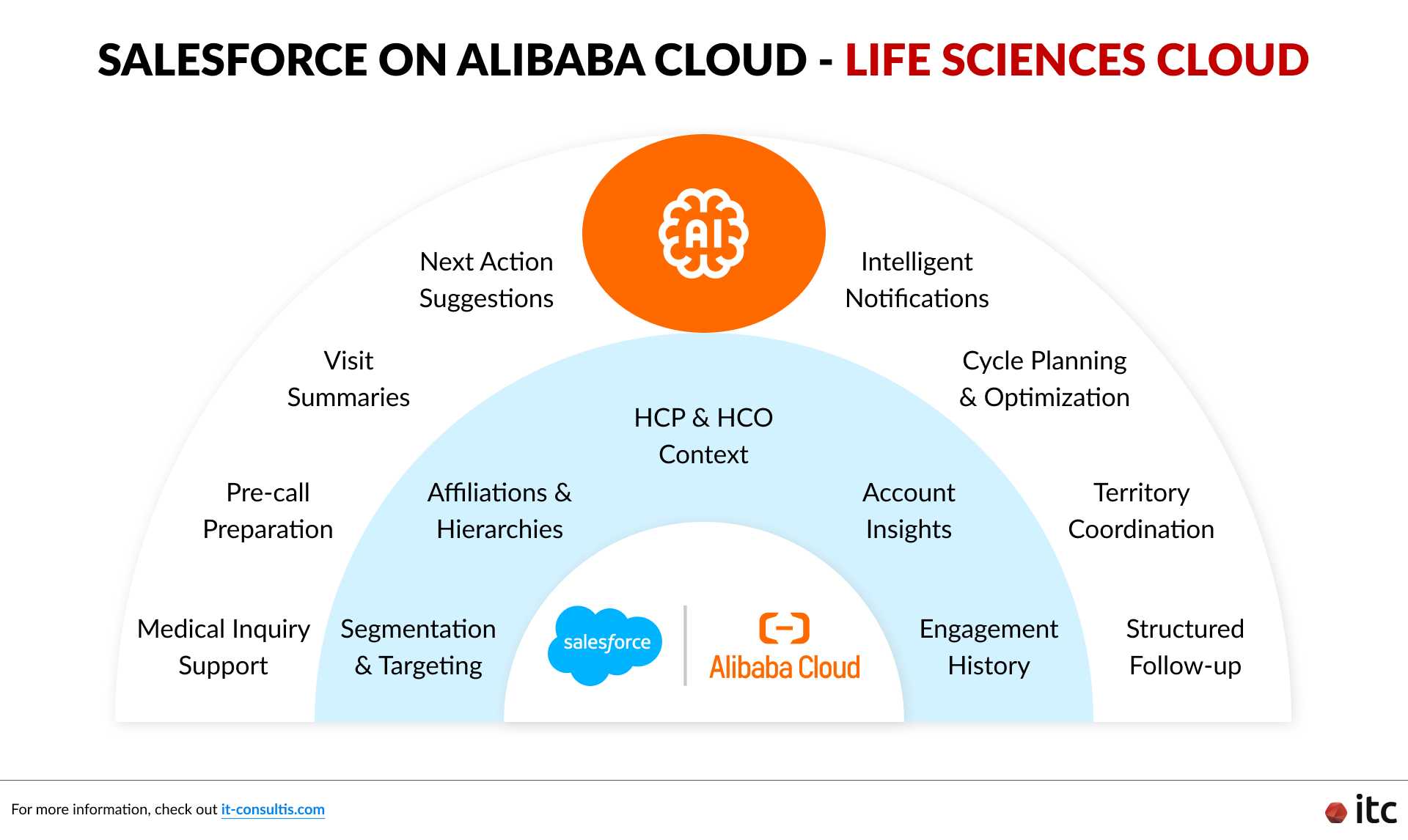
A better life sciences CRM should make HCP and HCO relationships, affiliations, account context, and engagement history easier to understand and use.
Relevant engagement depends on more than a contact record. It depends on seeing:
- Who the stakeholder is
- How they relate to the broader organization
- What has already happened
- What should happen next
For pharma teams using Salesforce on Alibaba Cloud in China, this creates a better basis for segmentation, prioritization, and account planning.
More Disciplined Field and Medical Workflows
The most commercially useful improvements are often the least glamorous. Better workflow discipline can reduce administrative drag and improve consistency in activities such as:
- Pre-call preparation
- Interaction capture
- Structured follow-up
- Territory coordination
- Medical inquiry documentation
- Compliant next-step management
Frontline productivity is rarely lost in one major breakdown. It is lost in repeated small frictions across preparation, coordination, documentation, and follow-up.
Better Inquiry Capture and Compliant Content Flow
One of the more important life sciences use cases is the link between medical inquiry capture, reviewability, and approved-content distribution. If those workflows are fragmented, teams respond more slowly, and compliance risk rises.
A better CRM operating model should help teams capture inquiries in a more structured way, route them correctly, preserve traceability, and support compliant follow-up using approved materials.
AI That Supports Execution Rather than Theory
The most credible AI use cases here are practical ones: visit summarization, pre-call context, workflow prompts, content retrieval, and more structured next-step support.
That does not mean every AI-driven workflow is already mature or broadly deployed in the Chinese life sciences context. It means the commercial logic is clear: a stronger CRM structure creates a more realistic base for AI to improve frontline execution.
Why Local Workflows and Channels Change Adoption in China
This is where many global CRM assumptions break.
A life sciences CRM in China does not succeed just because the core platform is available locally. It succeeds when local workflow design, communication habits, and governance requirements are built into the operating model from the start.
For example, field and medical teams may depend heavily on mobile coordination and locally familiar channels. That affects how follow-up happens, how approved content is distributed, how context is preserved, and how quickly a team can move from one interaction to the next.
This is also why WeCom matters in the broader discussion. Its value is not as a superficial messaging add-on. Its value is as part of a local execution layer that can help keep CRM workflows closer to how teams actually work in China.
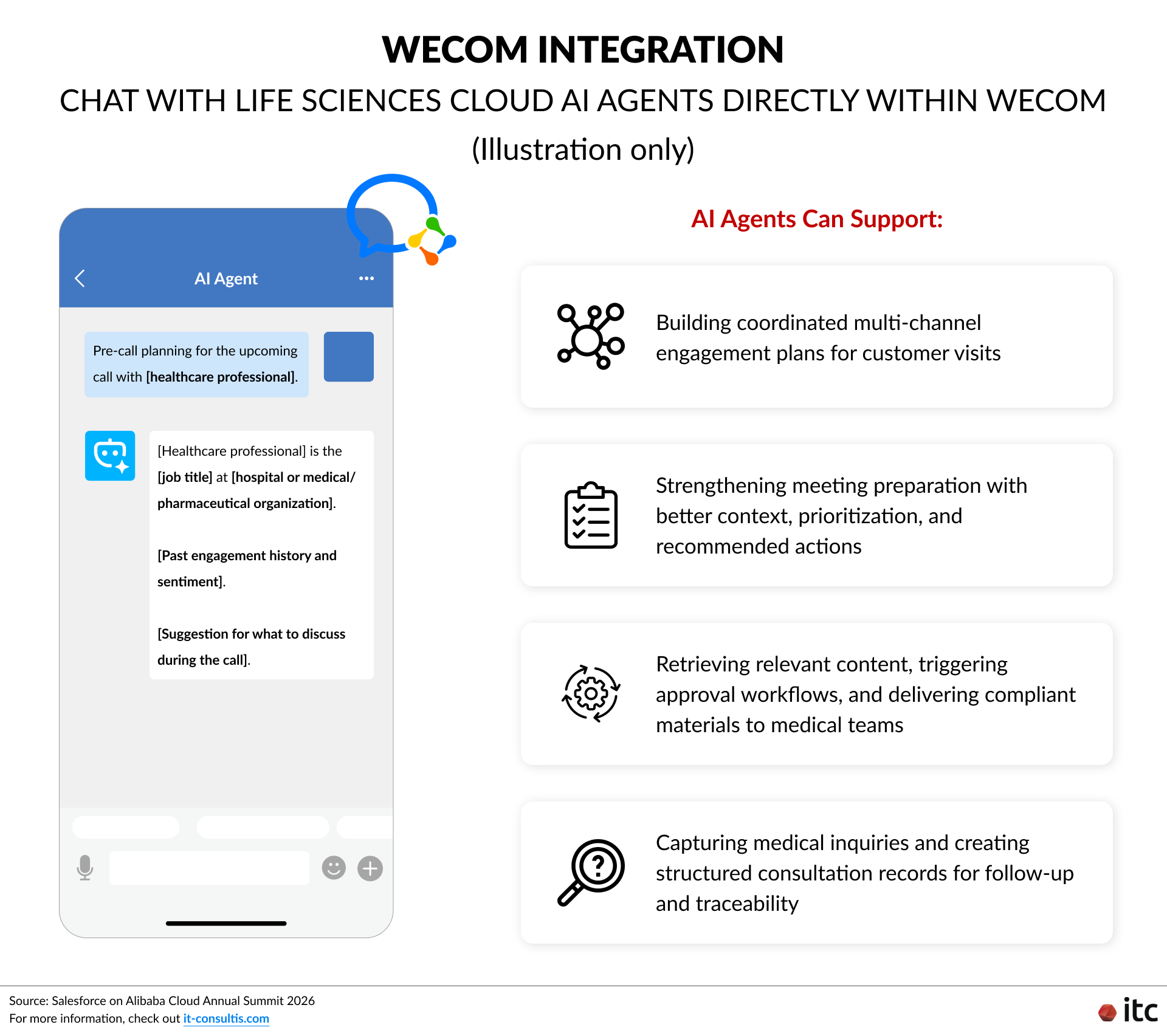
WeCom is positioned not as a simple messaging add-on, but as part of the execution layer through which frontline roles such as field reps, medical science liaisons (MSLs), and District Sales Manager / Regional Sales Manager (DSM/RSMs) interact with AI agents connected to Life Sciences Cloud.
They can support practical workflows such as pre-call planning, conversation insights, medical inquiry handling, and next best action, while keeping those activities tied to a single source of truth.
What matters is not channel novelty. It is whether CRM stays connected to how teams actually prepare, follow up, and coordinate in China.
A WeCom-oriented model helps close that gap by:
- Supporting frontline execution in a locally familiar environment;
- Keeping engagement activity tied more closely to the underlying CRM record.
When local communication habits and CRM workflows are better connected, teams are more likely to preserve context, respond faster, support compliance, and sustain stronger execution over time.
For more information, see our guide to integrating WeChat and WeCom with Salesforce on Alibaba Cloud.
Conclusion
Salesforce Life Sciences Cloud in China matters because it gives pharmaceutical organizations a more workable way to localize CRM for the China market while staying aligned with broader global Salesforce priorities.
For many companies, the real question is not whether it is superior to the global Salesforce environment in absolute terms. It is whether it creates a more workable model for compliant local engagement, stronger workflow execution, and better customer context in China.
Its value will still depend on workflow design, data quality, compliance discipline, local channel fit, and execution maturity.
But for organizations already using Salesforce globally, the key implication is clearer than that: once China HCP, HCO, inquiry, and interaction data are part of local execution, the China engagement layer needs to be localized on Salesforce on Alibaba Cloud.
The real question is how to do that well, not whether China can continue to sit on the global setup.
If your organization is evaluating how Salesforce should work for life sciences engagement in China, start by defining the operating model that will make local execution compliant, practical, and scalable.
Talk to IT Consultis (ITC) about building a more China-fit Salesforce on Alibaba Cloud strategy for pharmaceutical engagement.