
For enterprises operating in China, the real question is rarely whether WeCom has security features in the abstract.
The real question is whether WeCom can support a communication environment that is controlled, governable, and appropriate for the data, users, and oversight requirements involved.
In this article, we explain what “safe” should mean when evaluating WeCom for enterprise use in China, from access controls and communication governance to message archiving, cross-border data considerations, and sector-specific risk exposure.
For CIOs, compliance leaders, China-market executives, and digital operations teams, WeCom should be assessed as part of an operating model, not as a standalone app feature checklist.
Executive Summary:
1. WeCom can be a safe enterprise platform, but not safe by default. The outcome depends on how the environment is configured, governed, and monitored.
2. The strongest safety advantage comes from enterprise control. Permissions, trusted-device rules, archiving, watermarking, offboarding continuity, and admin visibility matter more than generic app security claims.
3. For regulated businesses, the main issue is not encryption alone. It is whether the platform fits the company’s retention, oversight, and compliance obligations.
4. Cross-border data handling is a key decision point. Some transfer scenarios may benefit from 2024 regulatory exemptions, but many companies still need rigorous classification, documentation, and governance.
5. The sectors that should review WeCom most carefully include finance, healthcare, legal, manufacturing, and customer-intensive brands. Each faces a different risk profile, so “safe” must be defined in operational terms.
Table of contents
Why Enterprises Ask Whether WeCom is Safe
WeCom sits at an unusual intersection. It is not just a collaboration tool.
It can also function as a communications layer, a customer engagement channel, a community-building platform for attracting and nurturing prospect groups through network effects, a lightweight workflow environment, and, in some cases, a regulated communications environment.
That is why the safety question matters.
When business leaders ask whether WeCom is safe, they are usually not asking only about encryption. They are asking whether the platform can:
- Support secure internal and external communication
- Protect sensitive files and records
- Provide meaningful administrative control
- Preserve audit trails and communication history
- Support message archiving, monitoring, and follow-up optimization where needed
- Reduce continuity risk when employees change roles or leave
- Fit into China’s evolving compliance environment
In practice, this question usually comes from four business concerns:
1. Reducing fragmented communication risk
Companies want to move away from informal, disconnected, or employee-owned communication practices that weaken visibility and control.
2. Improving control over business information
They need clearer rules for access, external sharing, download behavior, and customer ownership.
3. Aligning communication practices with regulatory expectations
Some sectors need stronger retention, supervision, and auditability around messages, files, and approvals.
4. Balancing usability with governance
Teams need a platform that works effectively inside China’s digital environment without creating unnecessary control gaps.
This is why WeCom is often assessed seriously by financial institutions, insurers, healthcare and pharma companies, legal and professional services firms, manufacturers with sensitive IP, and brands running high-value customer communications in China.
The Short Answer
Yes, WeCom can be a safe enterprise platform in China, especially when compared with informal business communication on personal consumer accounts.
But the more accurate answer is this: WeCom can support a safer enterprise communication model when the company sets the right governance model around it.
That means defining:
- Which users need access
- What data can move through the platform
- What should be archived
- How customer conversations are managed
- Which devices are trusted
- Whether any data may be reviewed or transferred outside China
For many organizations, that makes WeCom materially safer than relying on personal-account workflows for business communication.
The platform is designed for company-level oversight, continuity, and operational control.
What Actually Makes WeCom Safer for Enterprise Use
Tencent positions WeCom around enterprise-grade governance and security controls, and highlights recognized assurance standards around the broader platform environment, including SOC and ISO-related certifications.
More recently, WeCom’s AI capabilities have also been framed around ISO/IEC 42001, the international standard for AI management systems, reinforcing the platform’s broader positioning around responsible enterprise AI use.
That does not make every implementation automatically compliant, but it does show that WeCom is built for more structured enterprise use than consumer messaging tools.
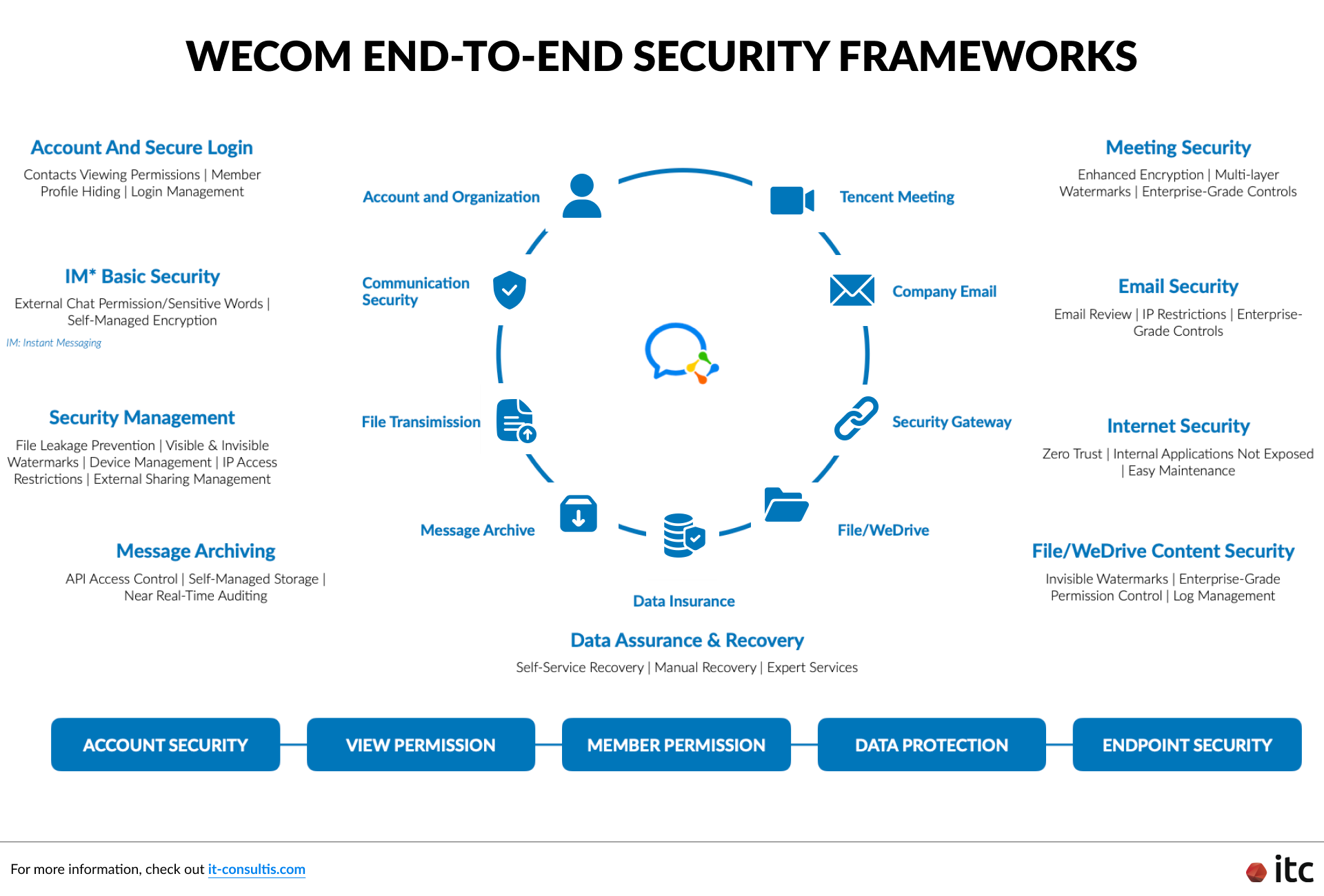
1. Access and Identity Control
A safer deployment starts with who can enter the environment and what they can see.
WeCom supports controls such as login management, profile visibility restrictions, permission structures, and, in more advanced setups, measures such as two-factor authentication, trusted-device management, and IP-based access rules.
These controls matter because many enterprise communication failures come from weak access discipline rather than a dramatic platform compromise.
2. Communication Governance
WeCom gives companies more control over internal and external communication than personal messaging tools.
This can include external-chat permissions, sensitive-word controls, supervision features, and message archiving where retention and traceability matter.
For some companies, message archiving is not only about evidentiary retention. It can also support communication monitoring, follow-up visibility, and ongoing process optimization in customer-facing teams.
WeCom’s ecosystem can also extend into Tencent Meeting / VooV Meeting, where host controls, meeting passwords, waiting rooms, watermarking, and recording permissions support tighter real-time communication management.
3. File and Content Control
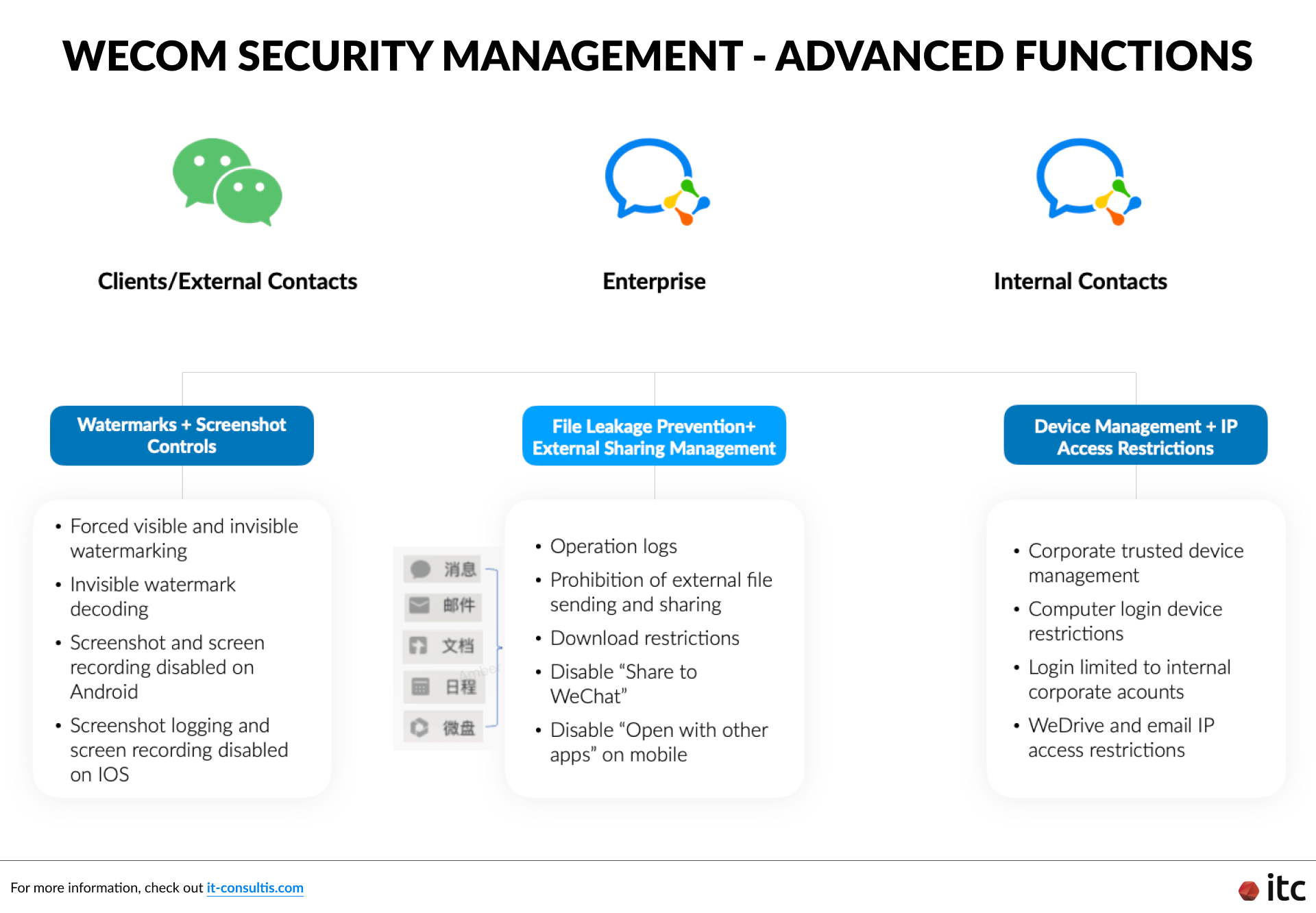
A large share of enterprise exposure comes from uncontrolled forwarding, screenshots, exports, and off-platform sharing.
WeCom environments can be configured to restrict downloads and exports, limit sharing to other apps, disable “Share to WeChat” in some scenarios, apply visible or invisible watermarks, and retain operation logs.
These are practical controls that help companies reduce avoidable data exposure, not just theoretical security risks.
4. Business Continuity and Operational Ownership
One of WeCom’s more important enterprise benefits is that it can reduce dependency on individual employees.
Capabilities around file recovery, account administration, customer-asset reassignment, and employee offboarding help companies preserve continuity when staff change roles or leave.
That matters because, in practice, “safe” also means maintaining company ownership of relationships, files, and communication history.
The key point is simple: WeCom becomes meaningfully safer when it is implemented as a governed business environment, not merely deployed as another chat tool.
Where Data Compliance Becomes More Complex in China
A company may decide that WeCom is operationally secure and still need to determine whether its specific use case is compliant.
That is particularly relevant when WeCom is used to handle:
- Customer communications
- Employee information
- Archived messages
- Approvals and workflow records
- Files, voice content, or meeting records
- Or data that may qualify as personal information or sensitive personal information under China’s regulatory framework
According to the official English text of China’s Personal Information Protection Law, personal information covers information relating to identified or identifiable natural persons, excluding anonymized information.
Sensitive personal information includes data that, if leaked or illegally used, could easily harm personal dignity or personal or property safety, including examples such as biometrics, health information, financial accounts, and location-related information.
That means the compliance question is not whether WeCom is “secure” in a general sense. The real questions are:
- What categories of data are flowing through the platform
- Who can access them
- Where they are stored
- Whether they are archived or exported
- And whether overseas review or transfer is part of the operating model
A More Practical View of Cross-border Transfer Risk
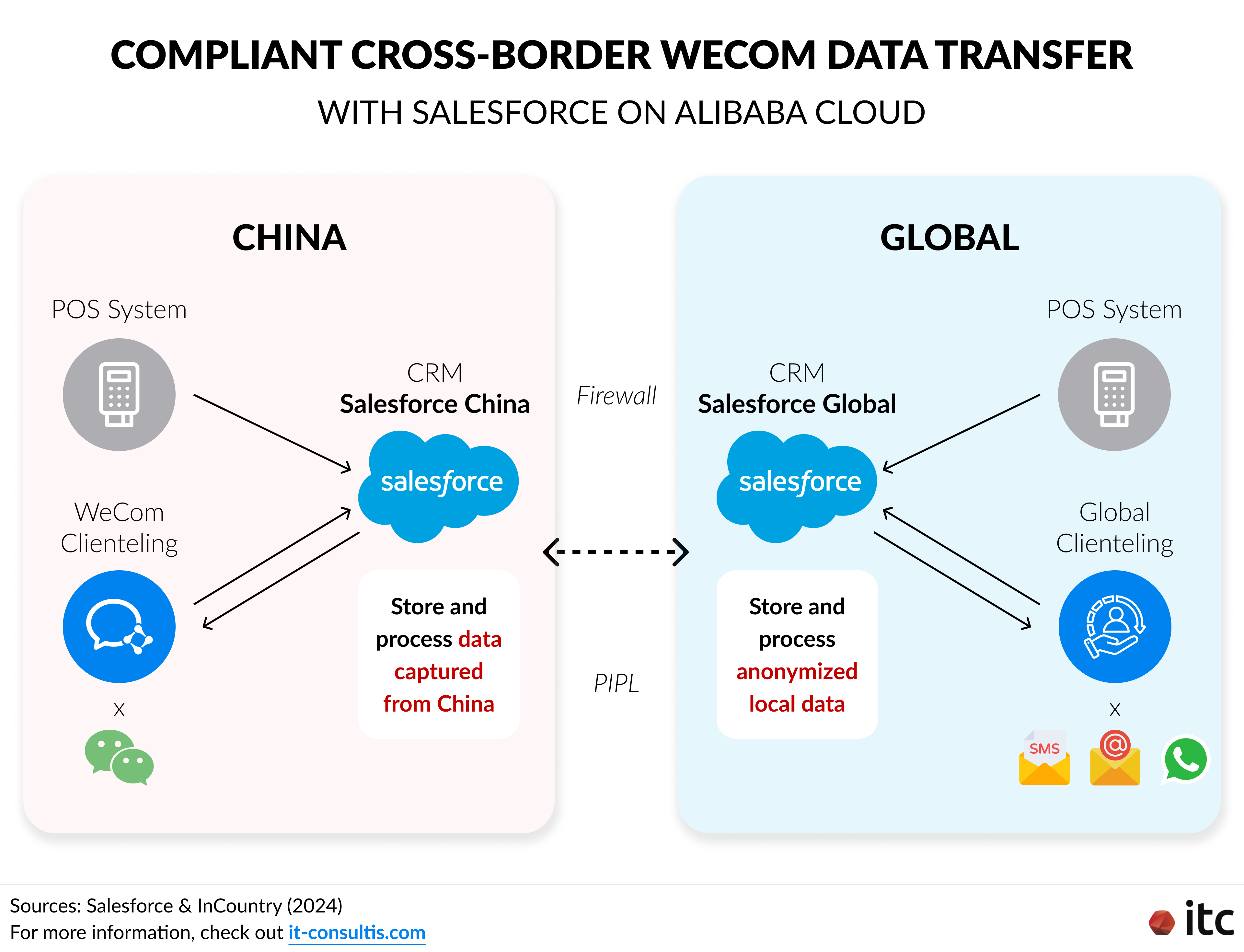
China’s 2024 CAC rules on promoting and regulating cross-border data flow created more flexibility in some transfer scenarios.
Public summaries of those rules note potential exemptions for certain contract-performance scenarios, some HR-related transfers, emergency situations, and lower-volume non-sensitive personal information transfers, while maintaining stricter requirements for important data, larger-scale transfers, and sensitive personal information at higher thresholds.
That is helpful, but it should not be read as a blanket simplification.
For enterprises using WeCom, the prudent interpretation is this: some lower-risk transfer patterns may be easier to justify than before, but regulated or data-sensitive use cases still require careful classification, internal documentation, and operating discipline.
For a broader business view of this issue, see our article on cross-border data transfer in China.
Which Sectors Should Evaluate WeCom Most Closely
The more sensitive the communications, the more valuable the records, and the stronger the retention or oversight obligations, the more rigor companies should apply before scaling WeCom.
Financial Services, Insurance, and Securities
The core question here is whether the company can support retention, surveillance, and evidentiary traceability across employee and client interactions.
In these sectors, message archiving, supervision, approval records, and communication ownership are often more important than generic messaging convenience.
Healthcare, Pharma, and Life Sciences
The key concern is whether health-related information, partner communications, internal approval chains, or field-team interactions create heightened exposure.
Even where WeCom is used mainly for coordination rather than patient communication, companies still need a disciplined approach to access, retention, and oversight.
Legal and Professional Services
The main issue is control over confidential information, matter-related communication, and document handling.
For these firms, the standard should be whether the platform supports stronger containment, traceability, and client-service continuity without creating unnecessary governance gaps.
Manufacturing, Automotive, and IP-heavy Sectors
The central question is whether the business can reduce exposure around technical files, supplier coordination, internal know-how, and employee offboarding.
Watermarking, file restrictions, access controls, and operational logs matter here because the main risk is often not broad consumer privacy, but loss of sensitive operational or intellectual assets.
Luxury, Retail, Automotive Retail, and Consumer Brands
The issue is not only internal communication security. It is whether the company retains control over clienteling relationships, frontline communication practices, and customer continuity when teams change.
In these environments, WeCom safety is closely linked to contact ownership, governance over customer-facing behavior, and continuity of the commercial relationship.
For more information, check out our ITC Insights Vol. 1 white paper on how to elevate clienteling in China with WeCom.
Questions to Ask Before WeCom Rollout
Before concluding that WeCom is safe enough for enterprise use, companies should answer six practical questions:
- What is WeCom being used for? Internal collaboration, customer communication, approvals, message archiving, file sharing, or all of the above?
- What data categories will pass through the platform? Employee data, customer data, financial records, health-related information, confidential documents, or lower-risk operational content?
- Which controls will actually be activated? Trusted devices, IP restrictions, watermarking, download controls, archiving, external-sharing rules, or meeting permissions?
- What is the policy on cross-border access or export? Will data stay in China, be archived locally, or be accessible to overseas teams?
- How will offboarding and asset handover be managed? This affects company ownership of contacts, files, and communication history.
- Who owns the compliance interpretation internally? Security, legal, IT, China leadership, and business stakeholders need aligned decisions rather than fragmented assumptions.
These questions usually determine the quality of the deployment more than the feature list does.
Final Verdict: Is WeCom Safe?
For many enterprises operating in China, the answer is yes: WeCom can be a strong and safer option for business communication.
What makes it compelling is not simply that it offers enterprise messaging. It offers a company-governed environment with stronger control over communication, files, permissions, customer continuity, and operational oversight inside China’s digital ecosystem.
What makes the decision more demanding is that safety is not only a product question. It is also a governance and data-handling question.
If your organization deals with regulated communications, sensitive personal information, or cross-border oversight requirements, WeCom should be evaluated as part of a broader operating model that combines platform controls, policy choices, and compliance review.
IT Consultis (ITC) is a certified Tencent and WeCom partner helping global enterprises design, implement, and optimize WeCom environments for controlled collaboration, customer engagement, and practical compliance in China.


![[Website] WECOM 5.0 cover image draft 2](/_next/image/?url=https%3A%2F%2Fit-consultis.com%2Fapp%2Fuploads%2F2025%2F12%2FWebsite-WECOM-5.0-cover-image-draft-2-1024x576.png&w=3840&q=100 "[Website] WECOM 5.0 cover image draft 2")