Luxury brands entering or expanding in China often arrive with mature global clienteling tools already in place.
Many already run clienteling apps for sales associates, CRM-driven outreach programs, appointment workflows, and long-established service standards in other markets. But success in China does not come from copying that same setup into a new market.
In this article, we look at why luxury retail clienteling tools in China need more than interface translation or feature migration, how global brands should rethink the operating model behind those tools for the Chinese market, and where WeCom can fit into a more practical localization approach.
While luxury retail is the main lens of this article, much of the same clienteling logic also applies to premium beauty, fashion, jewelry, lifestyle, and other high-touch retail categories that depend on relationship-led service in China.
For luxury and premium retail, this matters especially because clienteling is not just a sales support layer. It is part of how the brand expresses exclusivity, continuity, relevance, and service quality.
In China, where customer relationships may span WeCom, WeChat Mini Programs, Chinese-hosted CRM, local membership systems, e-commerce, and physical boutiques, the operating model behind the tool matters as much as the tool itself.
Executive Summary:
1. Luxury retail clienteling tools in China need more than feature migration. Global brands need to adapt the operating model behind their clienteling setup to fit China’s digital ecosystem, local workflows, and premium service expectations.
2. The biggest localization risks are often structural, not technical. Common problems include CRM insight that does not translate into sales associate action, fragmented experiences across touchpoints, and clienteling workflows that become either too informal or too standardized.
3. China clienteling requires a clearer role for each touchpoint. WeCom, Mini Programs, local CRM environments such as Salesforce on Alibaba Cloud, boutiques, and loyalty systems should work together as part of the same customer relationship rather than as disconnected platforms.
4. A strong localization approach is to preserve, adapt, and reorganize. Brands should preserve the core intent of the global clienteling strategy, adapt frontline workflows for China, and reorganize the local ecosystem around how relationships are actually maintained in the market.
5. A Clienteling WeCom Mini Program provides a practical localization layer. For brands that need a China-facing execution layer, it connects client data, workflows, and sales tools in a format local teams can use every day.
Table of Contents
- Why Relationship Quality Matters More in Luxury Retail Today
- Why Luxury Retail Clienteling Tools in China Need a Different Approach
- Three Common Problems with Localizing Luxury Retail Clienteling Tools for China
- A Better Framework for Localizing Luxury Clienteling Tools for China
- Where a Clienteling WeCom Mini Program Fits
- What WeCom-Ready Luxury Clienteling Actually Means in China
- How Luxury Brands Should Scope the Work
- Conclusion
Why Relationship Quality Matters More in Luxury Retail Today
Reuters reported in 2024, citing Bain, that global sales of personal luxury goods were expected to remain flat or grow by up to 4% that year, representing one of the weakest growth periods since 2020.
The slowdown in China was particularly pronounced, and the report also noted that some Chinese consumers were moving toward more discreet purchasing behavior and private appointment services.
These findings primarily reflect the luxury and premium retail sectors and should not be treated as representative of every retail category.
However, they point to an important market signal: as consumers become more cautious and selective, the quality of customer relationships, the relevance of service, and the timing of each interaction become increasingly important.
For brands that rely on advisor-led service, longer consideration cycles, repeat purchases, or long-term customer relationships, clienteling is no longer simply a tool for helping teams manage customers.
It is a way for the brand to understand, serve, and maintain existing customer relationships more consistently.
Consequently, clienteling tools are valuable only if they help sales associates act naturally, consistently, and with the right level of context.
Why Luxury Retail Clienteling Tools in China Need a Different Approach
Luxury clienteling depends on timing, context, trust, and personalization.
In mature global markets, luxury and premium retail sales associates may use a combination of the brand’s global clienteling apps, CRM prompts, email, SMS, WhatsApp, social media, appointment outreach, and in-store history to maintain customer relationships.
Those workflows are often well established and supported by years of operational refinement.
China changes that equation. The challenge is not simply that the digital ecosystem is different. It is that the relationship model itself often needs to be reorganized around different customer behaviors, channels, data environments, and team workflows. For additional context, see the psychology of clienteling in China.
A luxury client in China moves across touchpoints such as:
- Discover a collection through a local digital touchpoint (e.g., Tmall, WeChat Official Account)
- Continue the relationship with a sales associate through WeCom (a dedicated clienteling tool for customers on WeChat) or a RedNote Key Opinion Sales
- Browse through a WeChat Mini Program or RedNote Mini Program
- Receive tailored follow-up from the sales associate
- And later convert at the physical store or through remote sales
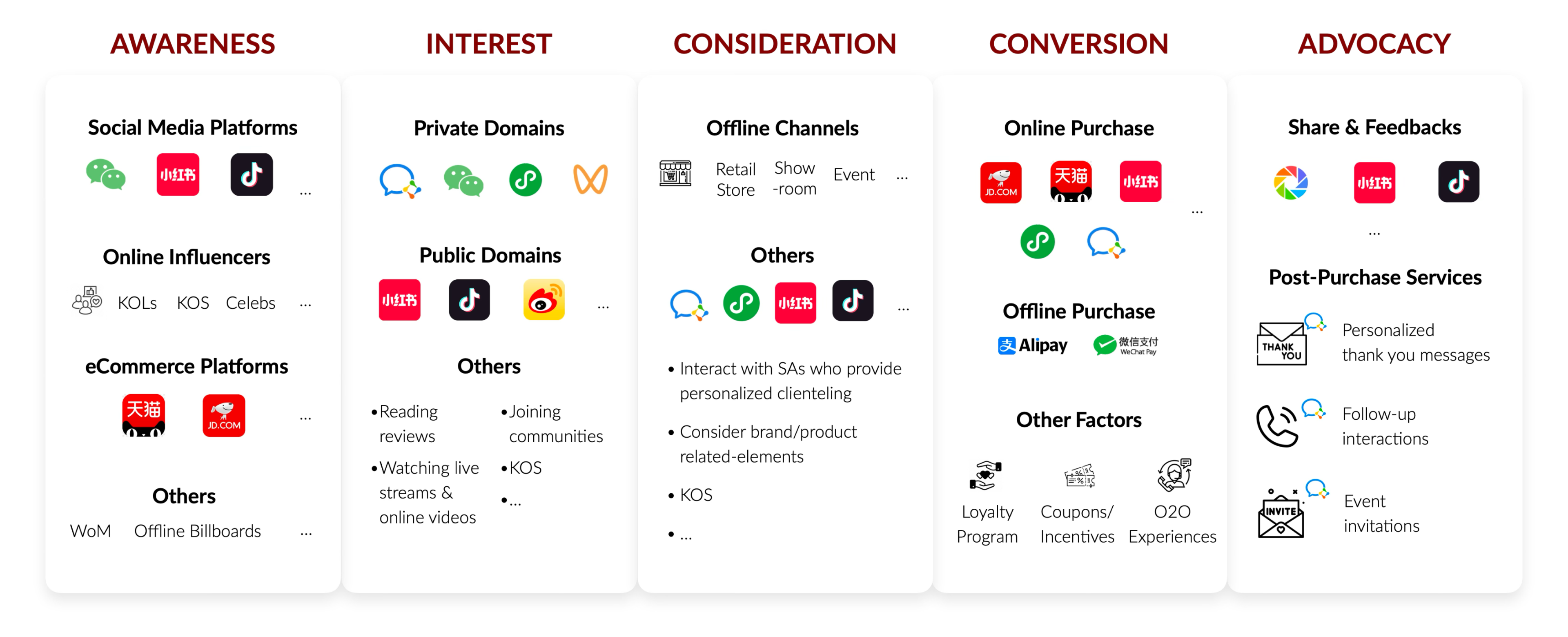
That journey may still feel continuous to the customer, but internally it can be fragmented if the operating model was not designed for China.
That is why luxury retail clienteling tools in China should be treated as a localization challenge, not just a deployment project.
Brands need to ask:
- Can the existing global clienteling logic work inside China’s digital ecosystem, namely WeChat and WeCom?
- Do current workflows support how local sales associates or client advisors actually manage relationships?
- What roles should the Chinese CRM (such as Salesforce on Alibaba Cloud), WeCom, WeChat or RedNote Mini Programs, and in-store service each play?
- How can a customer relationship be internally understood and continuously managed across different touchpoints?
- How can the brand preserve premium service quality while staying realistic about adoption and governance?
The main risk is not losing a few features of the existing global clienteling app. It is preserving the wrong assumptions.
Three Common Problems with Localizing Luxury Retail Clienteling Tools for China
When global luxury and premium retail brands bring clienteling tools into China, the biggest problems are not feature gaps alone. They appear as disconnects between customer insight, local touchpoints, and the way advisor-led service actually works in practice.
These disconnects are easy to miss in the interface, but they determine:
- Whether frontline teams can adopt the tool effectively.
- Whether the luxury customer experience remains connected, relevant, and consistent across interactions.
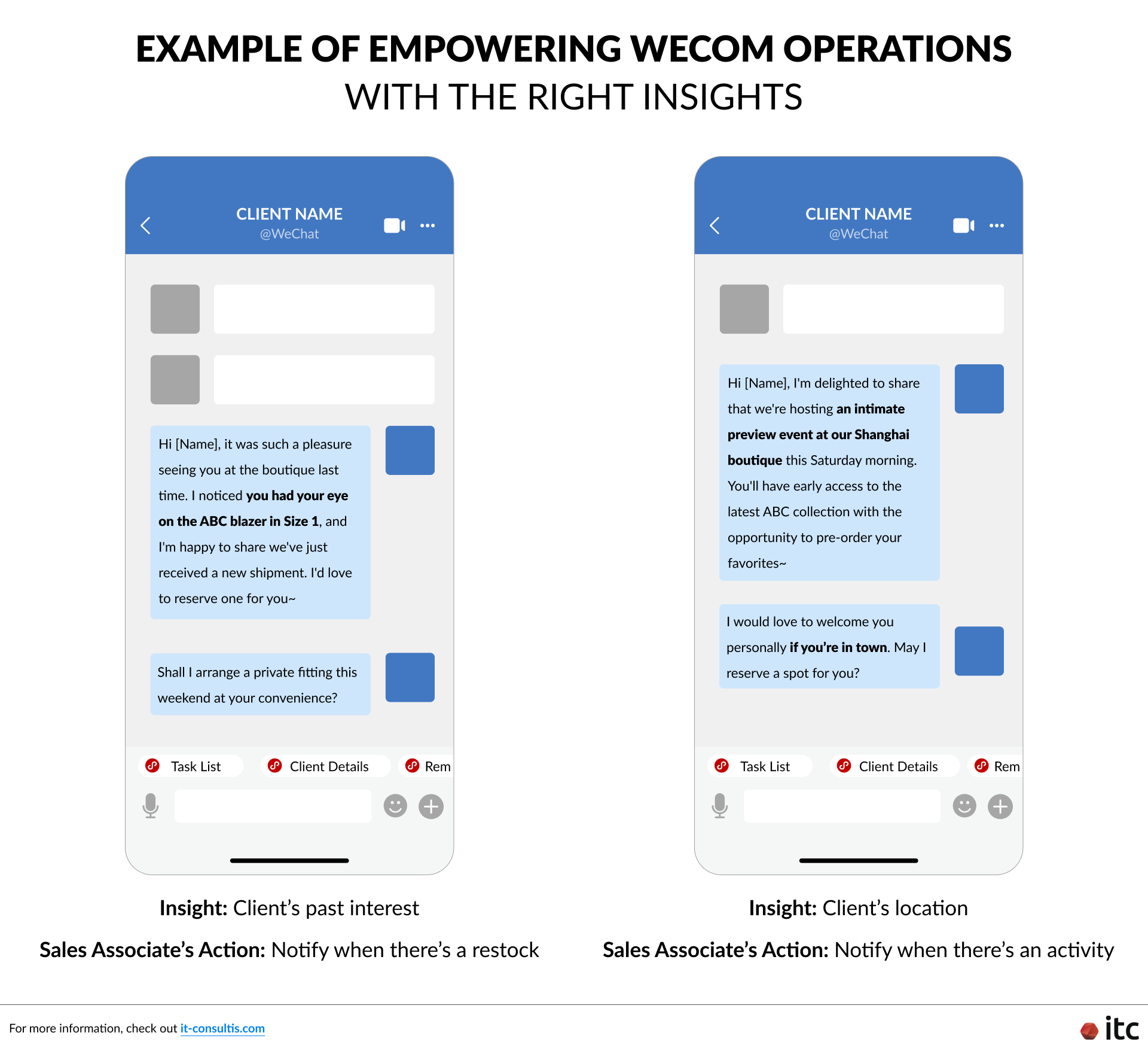
1. CRM Insight is Visible but Does Not Translate into Sales Associates’ Actions
Global teams often think about customer intelligence in terms of segments, lifecycle stages, spend level, purchase history, and engagement frequency.
Luxury sales associates, however, operate much closer to the real service moment. They need to understand questions like:
- When is the right time to contact this client?
- Why is this moment relevant?
- What kind of outreach and content feels appropriate for this relationship?
- What should happen after this touchpoint?
If the localized Chinese clienteling tool simply exposes more data without reorganizing it for sales associates’ actions, the result is a better dashboard but a weaker service workflow.
Client advisors may see more information, but still lack the structure needed to turn it into timely, relationship-led action.
In luxury retail, that gap matters. The goal is not to overwhelm salespeople with more CRM visibility. It is to help them act with more confidence and relevance.
2. Local Touchpoints Exist, But the Premium Experience Still Feels Fragmented
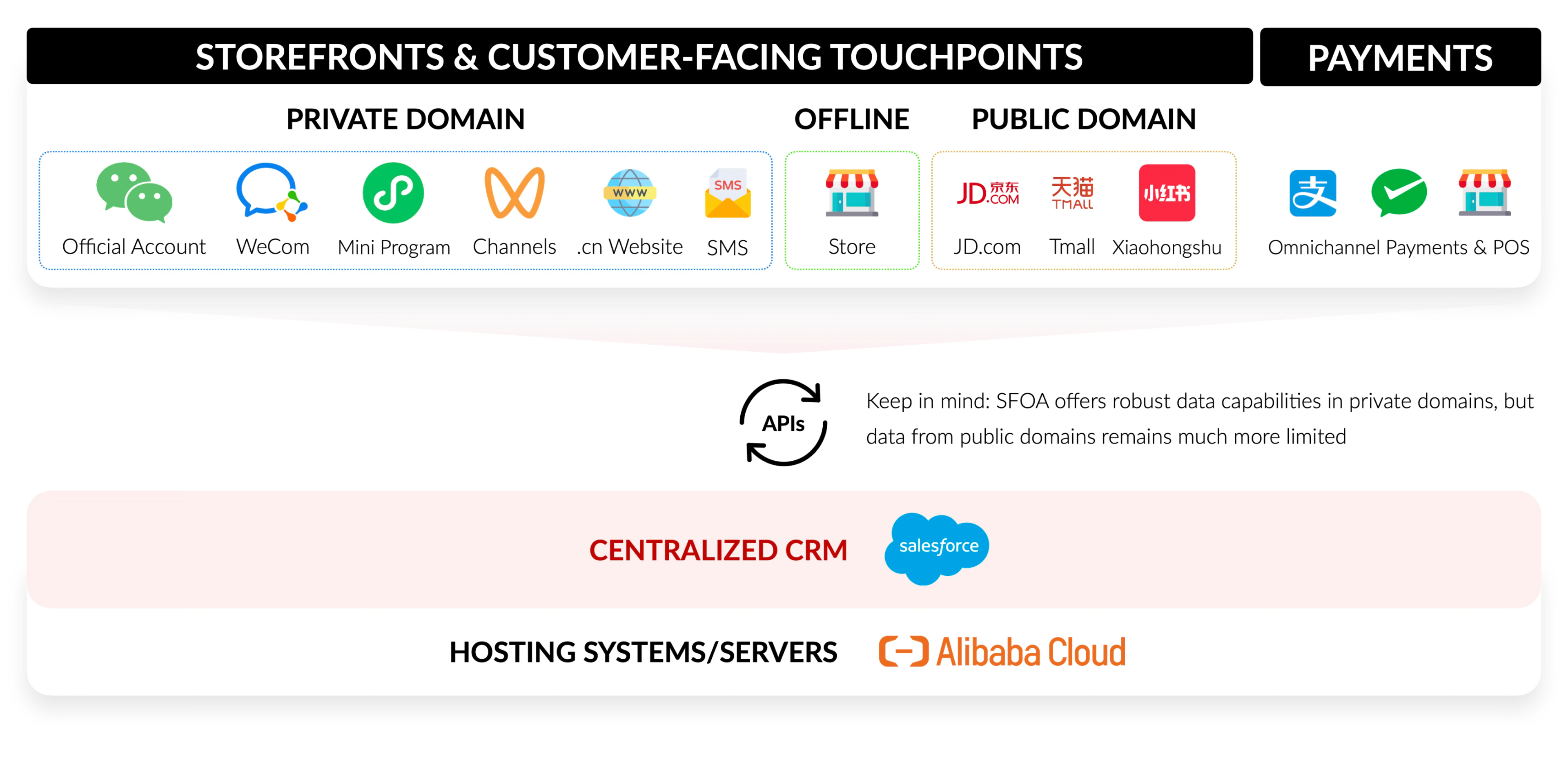
Many luxury and premium retail brands already have the building blocks they need in China, such as CRM for China (i.e., Salesforce on Alibaba Cloud instead of the global instance), WeCom, a Mini Program, store systems, local membership tools, and e-commerce support.
But if these touchpoints are not clearly organized around the same client relationship, the service experience can still break down.
A sales associate may not know:
- What the client has already seen or received
- Which interaction history should inform the next conversation
- Which channel is most suitable for the next service step
- How to continue the relationship without duplicating or disrupting the experience
For luxury brands, the answer is not full technical consolidation. The higher-value move is to reduce unnecessary disconnects and define clearer roles for each touchpoint in the relationship.
A platform such as Salesforce on Alibaba Cloud creates a stronger foundation for centralizing data from multiple sources, including WeChat / WeCom, websites, offline stores, and other customer-facing systems, so sales associates and client advisors have a more holistic view of each customer.
3. Advisor-led Service Becomes Too Informal or Too Standardized
Luxury clienteling works because strong sales associates know how to adapt. They recognize tone, timing, and client preference. That flexibility is essential.
But when the relationship depends entirely on personal habits, private notes, or informal communication patterns, brands lose continuity, visibility, and governance.
At the other extreme, over-structured clienteling can make luxury communication feel scripted or mechanical.
The real design question is not whether to standardize. It is:
- Where the brand should provide structure, content, principles, and workflow support.
- Where advisors should retain room to behave like trusted relationship owners.
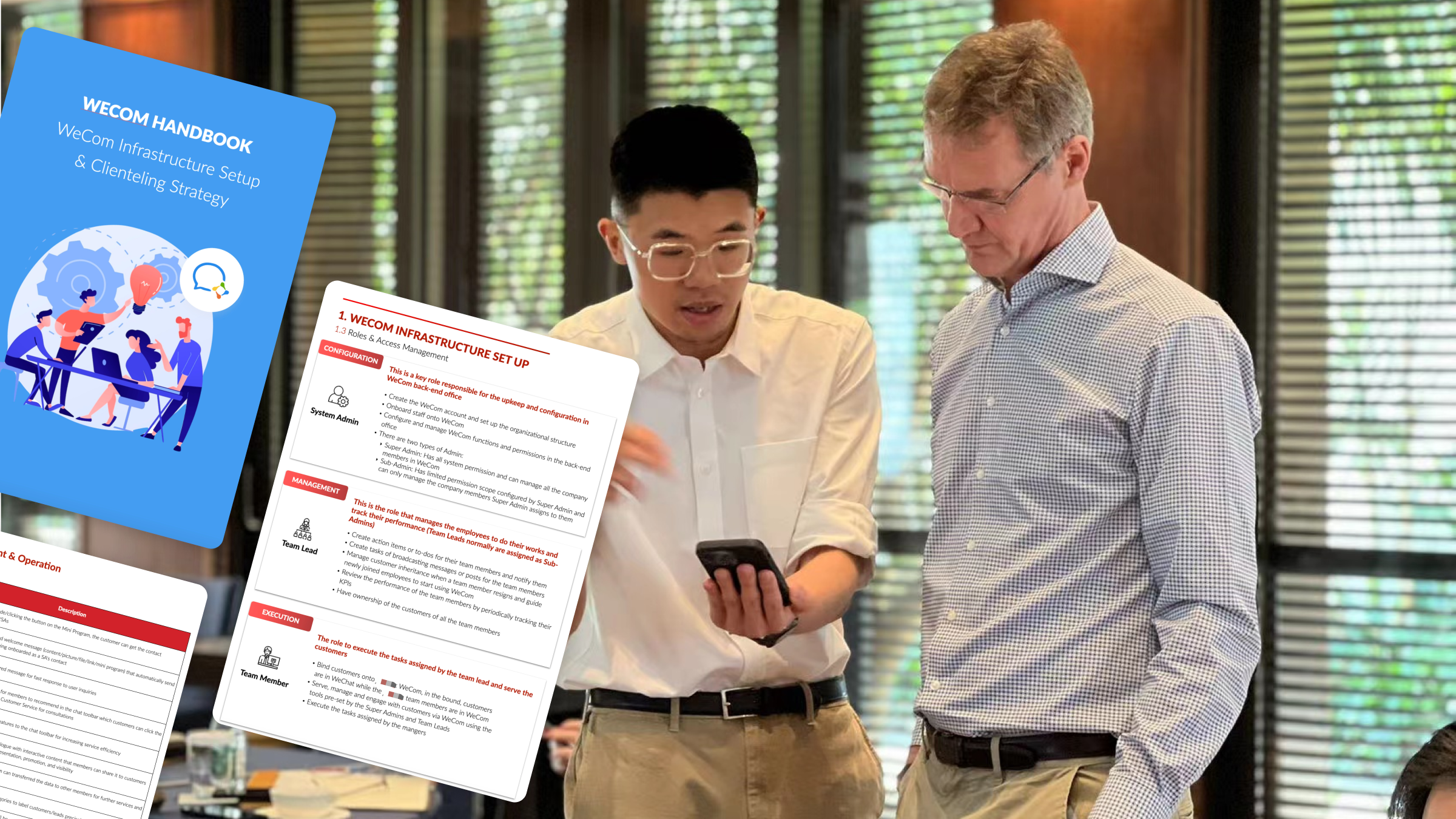
At IT Consultis (ITC), we help brands across sectors build their own custom standard operating procedures (SOPs) for WeCom clienteling operations and deliver training sessions to their sales associates and retail managers to ensure they are well-equipped to succeed in their role.
A Better Framework for Localizing Luxury Clienteling Tools for China
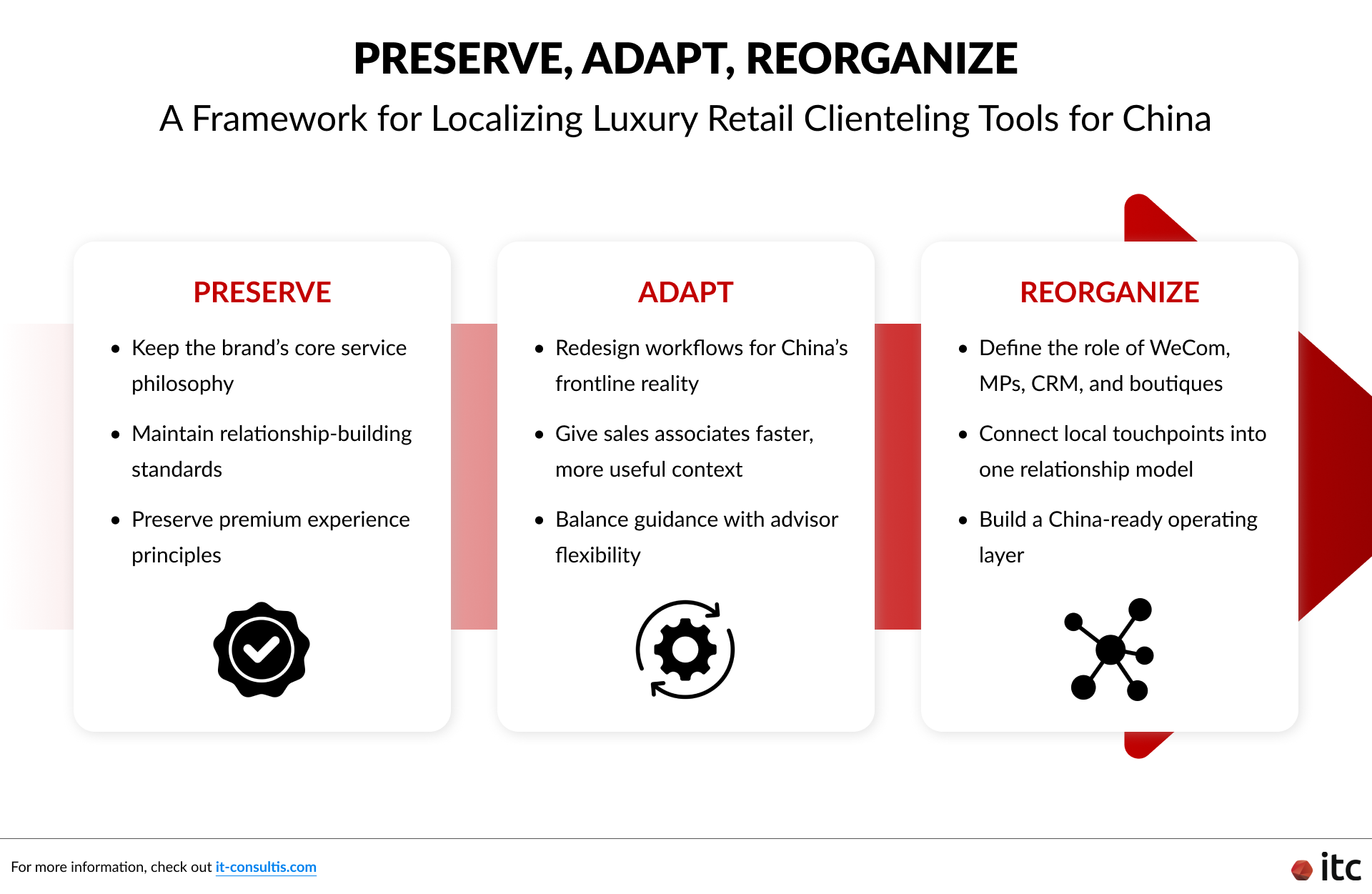
For luxury and premium retail brands, the most practical way to approach China localization is through three decisions: preserve, adapt, and reorganize.
Preserve the Core Intent of the Global Clienteling Strategy
Localization should not dilute the brand’s core service philosophy. Luxury brands still need consistency in tone, customer treatment, relationship-building standards, and premium experience principles.
What should remain consistent is the intent behind the clienteling model, even if the tool, workflow, or touchpoint structure changes.
The goal is not to copy the global system exactly. It is to preserve the luxury service logic that matters most.
Adapt the Workflow for China’s Frontline Reality
Headquarters teams and Chinese sales associates do not use clienteling in the same way.
Global teams often need macro visibility and strategic reporting. Local client advisors need fast, useful context within real interactions.
That means luxury retail clienteling tools in China need:
- A different workflow emphasis
- A different information hierarchy
- A different balance between guidance and flexibility
An effective China workflow should help sales associates understand who the client is, what matters now, and how to continue the relationship elegantly. It should not force them to interpret a headquarters-centered logic during live service moments.
Reorganize the Clienteling Ecosystem around WeChat & WeCom and Chinese Touchpoints
WeCom should not be treated as a simple add-on to the global clienteling stack.
For many luxury and premium retail brands, WeChat / WeCom is one of the main environments in which customer relationships are maintained in China. That does not mean they replace every other system.
It means they often play a more central role in how client advisor communication, follow-up, service continuity, and relationship maintenance happen locally.
At the same time, Mini Programs, loyalty programs, boutiques, and MarTech systems such as CRM, Social CRM, and Customer Data Platforms (CDPs) each support a different part of the luxury customer journey.
The objective is not to make one tool do everything. It is to give each touchpoint a clear role within the same premium customer relationship.
Where a Clienteling WeCom Mini Program Fits
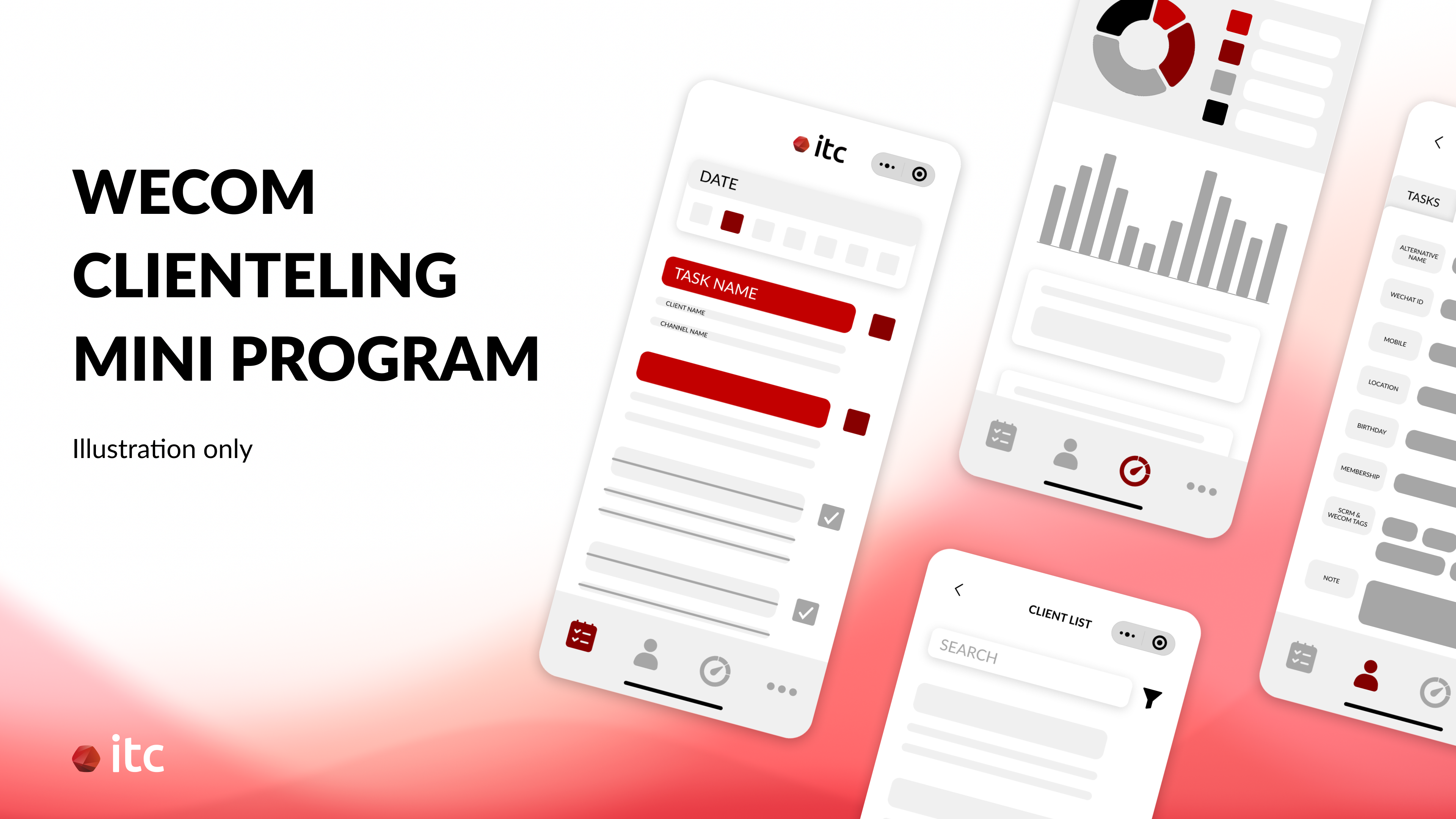
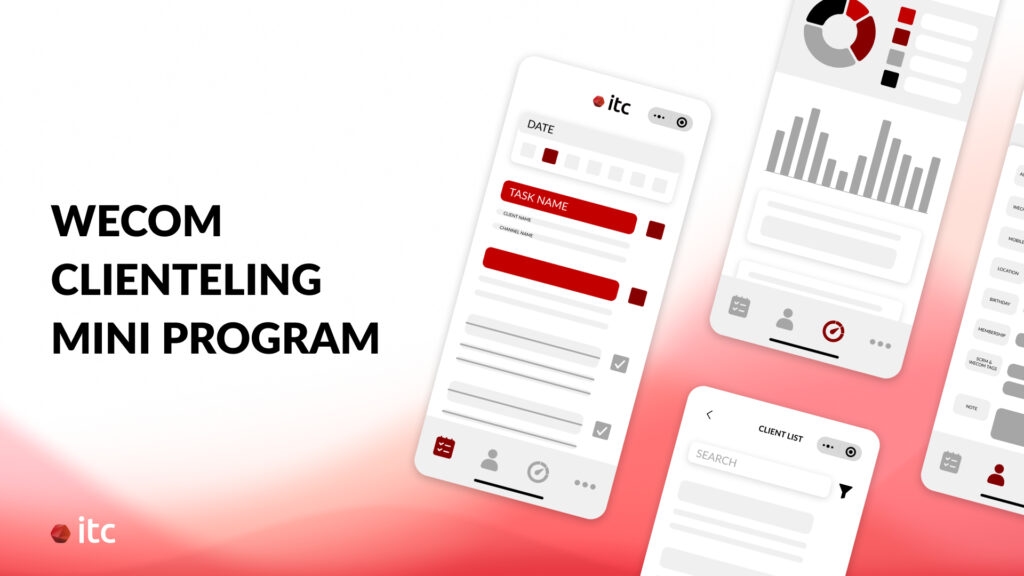
For brands that already have a global clienteling app, one practical way to localize for China is to build a Clienteling WeCom Mini Program as an execution layer inside WeCom.
In this model, the Mini Program can give sales associates, managers, and retail leaders a more usable China-facing interface for day-to-day clienteling workflows, while connecting with systems such as Salesforce on Alibaba Cloud or other China-side CRM environments to surface relevant client data in a more actionable way.
Rather than replicating the global app feature by feature, this approach can support day-to-day clienteling through capabilities such as:
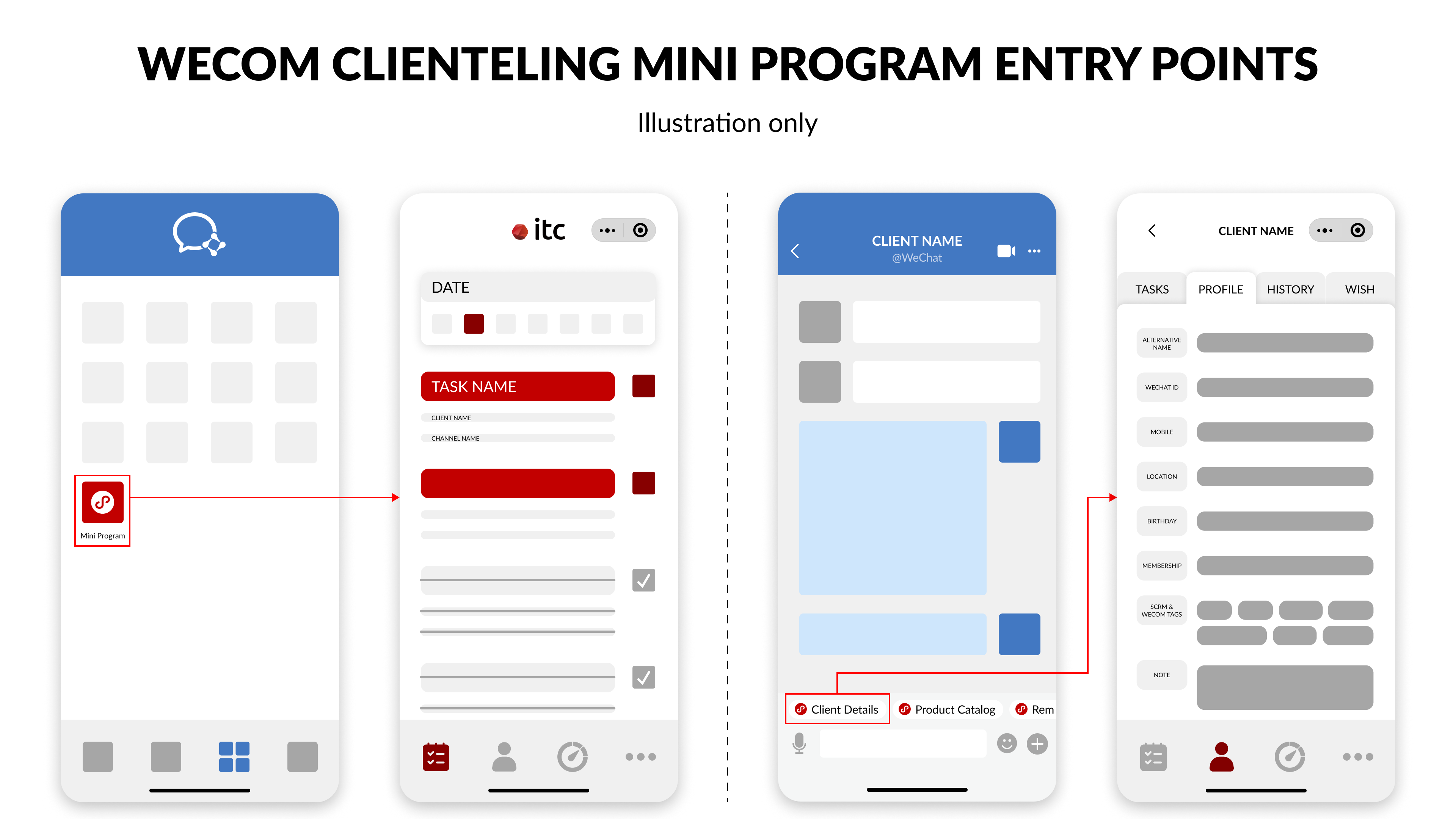
- Direct access to client profiles, task lists, and service workflows inside WeCom.
- Role-based visibility for different teams and store structures.
- Additional clienteling features such as dashboards, wish lists, and guided follow-up actions.
This preserves the core logic of the global clienteling model while adapting the frontline experience, local touchpoints, and advisor workflows to the realities of the Chinese market.
What WeCom-Ready Luxury Clienteling Actually Means in China
For luxury brands, a WeCom-ready setup is not just a technical integration status. It does not simply mean that the brand has set up WeCom, or that selected global clienteling features have been made available in a China-facing interface.
It means the global luxury clienteling model has been translated into a local operating model that supports premium service in China.
In practice, it means:
- Sales associates can use customer context more naturally during live service moments
- WeChat / WeCom, RedNote, Mini Programs, physical boutiques, and MarTech tools each play clearly defined roles
- Customer journeys feel more continuous across touchpoints
- The brand avoids both uncontrolled advisor workarounds and over-standardized outreach
- The localized workflow feels realistic for daily luxury retail operations
That is why success should not be measured only by migration volume. A better test is whether the localized setup helps advisors deliver more relevant service, maintain stronger continuity, and protect premium brand standards.
How Luxury Brands Should Scope the Work
Before localizing global clienteling tools for China, luxury brands benefit from a structured assessment rather than a feature-copying plan.
A strong scoping phase must clarify:
- Which elements of the global luxury clienteling model are essential to preserve
- How local China teams actually manage advisor-client relationships today
- What role WeCom should play within the premium service journey
- Which systems should hold profile data, interaction context, and workflow triggers
- Which compliance and governance boundaries shape the design
- What level of structure will help adoption without making the service feel rigid
This is often the stage where brands realize they do not need a one-to-one China replica of the global clienteling app.
They need a localized operating layer that preserves strategic logic while fitting the realities of China’s luxury retail far more effectively.
Conclusion
Luxury retail clienteling tools in China are most effective when they support the relationship model local teams actually need, not when they simply reproduce a global interface in a different market.
For brands with mature global clienteling capabilities, the real challenge is not whether they already have the right technology foundation. It is whether that foundation can be localized around WeCom, China-specific touchpoints, sales workflows, and premium service expectations.
The strongest approach is to preserve the brand’s service intent, adapt the workflow for local frontline use, and reorganize the role of WeCom and surrounding touchpoints.
For many brands, a Clienteling WeCom Mini Program is one of the most practical ways to make that localization usable in daily operations by giving local teams a China-facing execution layer without discarding the logic behind the global model.
When that happens, localization becomes more than a technical rollout. It becomes a way to make luxury clienteling work in China as a real operating model.
IT Consultis (ITC) helps global brands localize clienteling for China by connecting WeCom, CRM environments such as Salesforce on Alibaba Cloud, and frontline workflows into operating models that local teams can use with confidence.
As a certified WeCom partner with experience in WeCom, luxury clienteling, CRM strategy, and China digital transformation, ITC advises brands on what to preserve from their global clienteling model, what to adapt for China, and how to build a more connected local execution layer.