
For luxury brands in China, personalization on WeChat Mini Programs is not just a feature layer.
In practice, this often means product personalization experiences such as engraving, monogramming, stamping, or decorative customization inside a broader customer journey that connects discovery, gifting, CRM, private-domain engagement, and clienteling.
That means personalization quality shapes more than usability alone. If the experience feels too generic or mechanical, it can weaken premium perception, increase hesitation, and undermine relationship-building across the broader journey.
In this article, we examine how luxury brands design personalization on WeChat Mini Programs so digital interactions feel refined, brand-consistent, and appropriate to luxury customer expectations.
Executive Summary:
1. Luxury personalization on WeChat Mini Programs works best when it protects exclusivity instead of feeling like a standard product configurator.
2. The strongest brands make abstract personalization choices easier to understand through live previews, visual typography, material close-ups, or direct interaction with the product itself.
3. Different luxury categories solve personalization differently, but the common goal is always to reduce hesitation and reinforce emotional confidence.
4. Structural choices shape the premium feel of the experience, especially the use of modal versus full-page flows, visible versus embedded constraints, and open exploration versus guided progression.
5. In China, personalization should be designed as part of a broader customer engagement ecosystem, not as a standalone ecommerce feature.
Table of contents
- Why Personalization Is Especially Challenging for Luxury Brands
- What Luxury Brands Need From Product Personalization on WeChat Mini Programs
- Key Personalization UX Design Patterns on WeChat Mini Programs
- 1. The Container Shapes the Tone of Personalization
- 2. Live Preview Turns Choice into Confidence
- 3. Strong Luxury Brands Make Abstract Options Tangible
- 4. The Best Luxury Experiences Embed Constraints Naturally
- 5. The Strongest Brands Treat Personalization as Part of Product Identity
- Luxury Personalization UX/UI Design Takeaways Across Categories
- Beyond UX: Four Operational Factors to Plan Before Launch
- Conclusion
Why Personalization Is Especially Challenging for Luxury Brands
WeChat Mini Programs are built for convenience, speed, and embedded digital services. That makes them highly effective for commerce, loyalty, and engagement in China.
For luxury brands, however, efficiency and ease of use alone are not enough. The experience also needs to feel controlled, intentional, and aligned with the brand’s tasteful standards.
Product personalization is one of the clearest places where this tension becomes visible.
Standard digital configuration often rewards more options and faster interaction, but in luxury, that can quickly make the experience feel too generic or mechanical.
Luxury personalization needs to make the choices feel deliberate, reassuring, and consistent with the brand’s world.
In China, the issue is broader than interface quality alone.
Because the WeChat Mini Program often connects to the brand’s CRM (such as Salesforce on Alibaba Cloud), loyalty program, WeCom conversations, and private-domain follow-up, poor personalization UX can also weaken advisor-led engagement and interrupt continuity across the broader customer journey.
What Luxury Brands Need From Product Personalization on WeChat Mini Programs
Luxury brands are usually not trying to maximize feature depth within a WeChat Mini Program. They are deciding what the experience should help the customer feel and what the business should protect.
Therefore, luxury WeChat Mini Program personalization should do four things well:
- Create exclusivity: The experience should feel like access to a more intimate layer of the brand, not a generic self-service tool.
- Preserve ritual: The pacing should feel deliberate enough to support high-consideration or gift-led decisions inside the Mini Program environment.
- Build confidence: Customers should feel sure about what they are choosing and how it will look, without leaving the Mini Program.
- Stay brand-consistent: Typography, spacing, imagery, and interaction patterns should feel native to the brand world, even within WeChat’s container.
These goals also have commercial value.
A stronger personalization layer inside your WeChat Mini Program can reduce purchase hesitation, make gift-giving feel more thoughtful and bespoke, support cleaner CRM capture, and create a smoother handoff to client advisors when a purchase needs human follow-up.
Once those goals are clear, the next question is how interface design can support them in practice within the WeChat Mini Program environment.
Key Personalization UX Design Patterns on WeChat Mini Programs
Across luxury WeChat Mini Programs, the strongest personalization experiences do not all look the same. What they share is a set of design choices that help personalization feel more deliberate, more reassuring, and more consistent with premium brand expectations.
1. The Container Shapes the Tone of Personalization
The first important decision is how the personalization flow is structured. In luxury, this is not just a layout choice. It helps determine how focused, immersive, and elegant the experience feels.
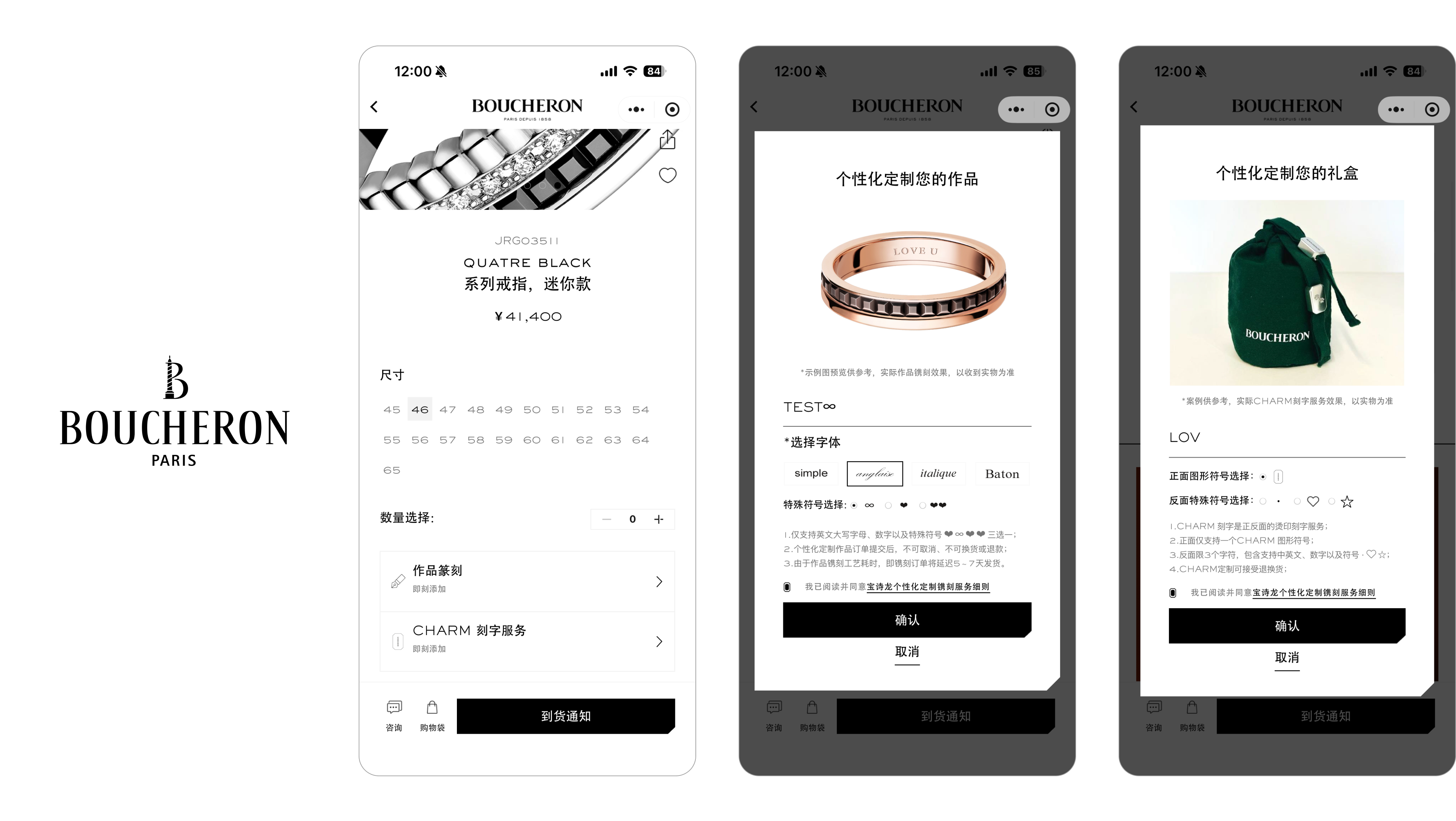
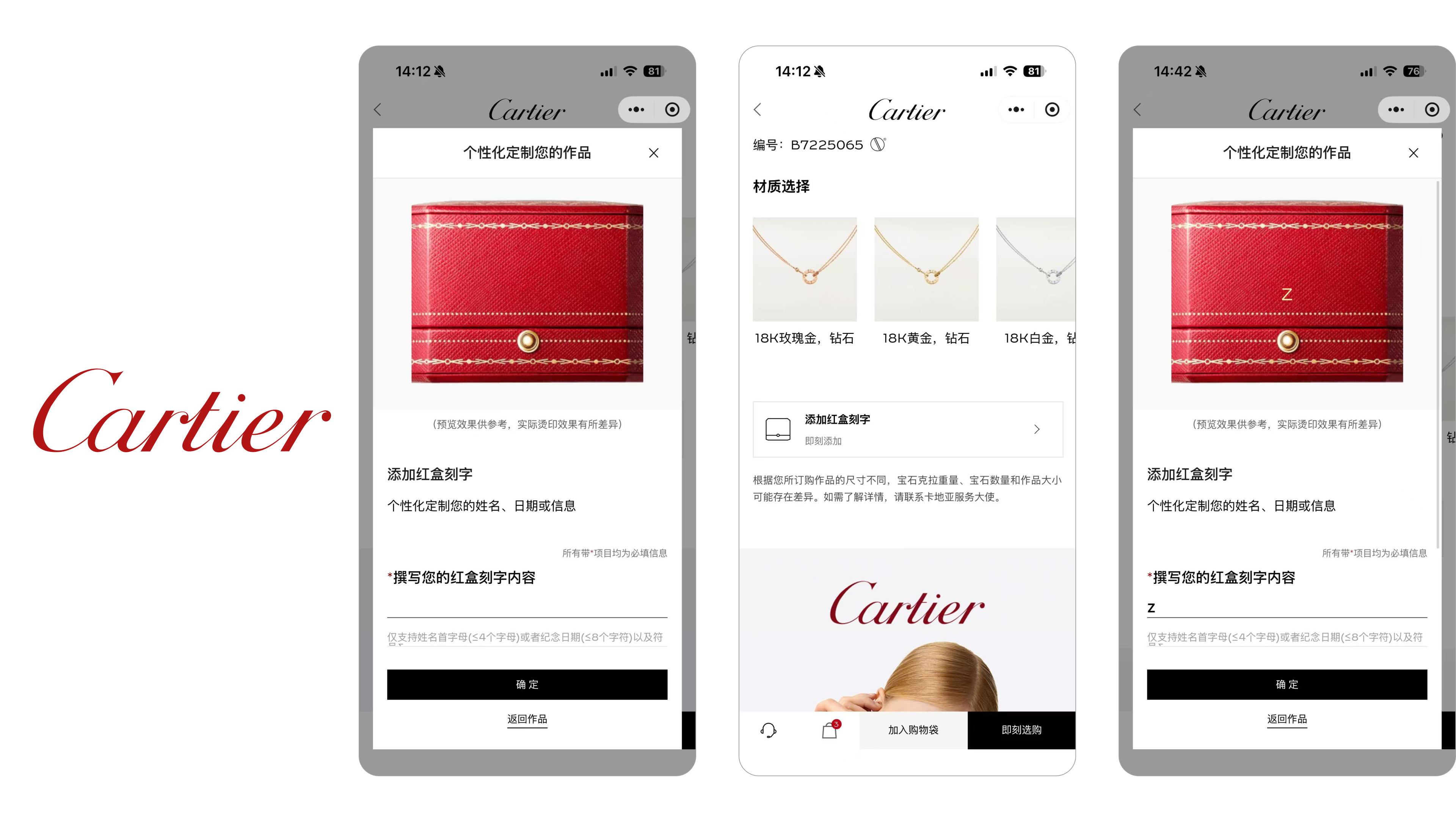
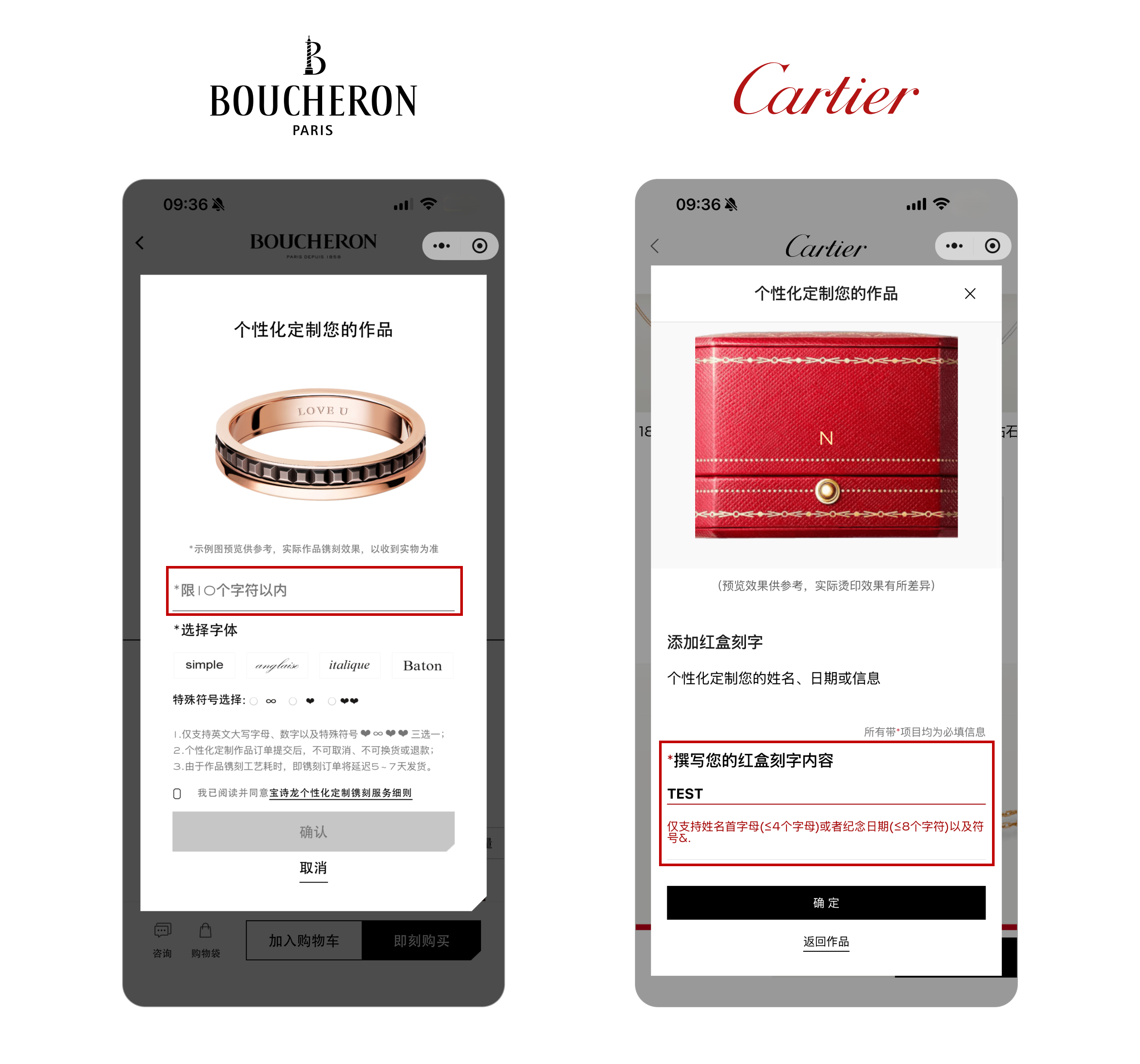
Boucheron and Cartier show why pop-up windows work well for more contained personalization moments. In both cases, the modal creates a distinct visual pause from the product page and gives the act of personalization its own focused stage.
At Boucheron, this works especially well because the pop-up window opens with a strong emotional visual reference rather than a blank form. The ring already appears engraved, so the user enters a framed scenario instead of an empty task.
At Cartier, the modal shifts focus from the product to the packaging. The pop-up opens with a close-up of the iconic red box and gold motifs, making the red-box engraving feel like an emotionally weighted gesture rather than a simple product modification.
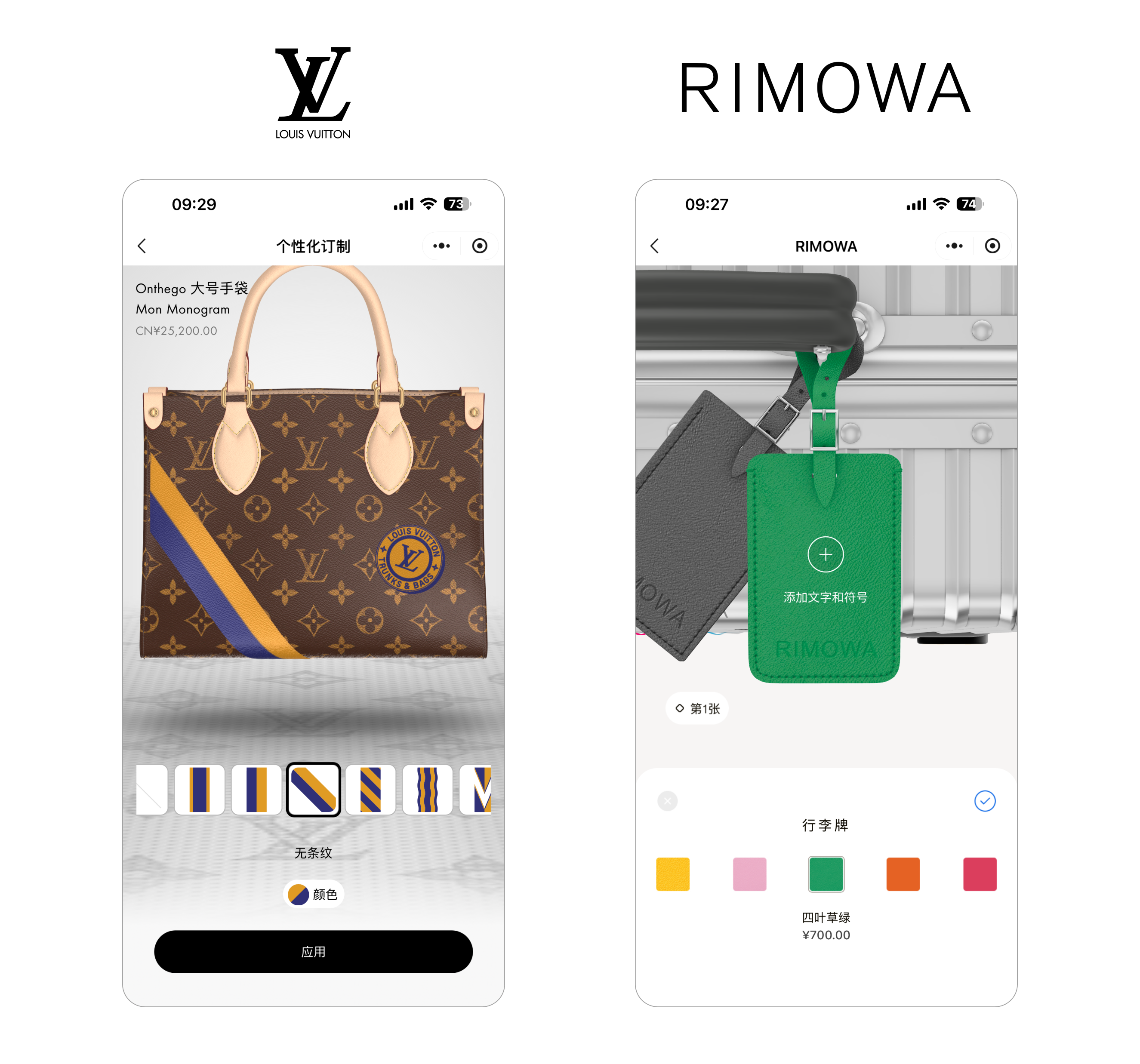
By contrast, brands like Louis Vuitton and RIMOWA show that dedicated full-page personalization flows make more sense when users need to move across multiple choices, track a persistent preview, or interact with the product more deeply over time.
The design lesson is simple: luxury brands should choose the container based not only on feature complexity, but also on how much ceremony and decision weight the personalization moment should carry.
2. Live Preview Turns Choice into Confidence
In luxury personalization, users are not just checking whether a configuration technically works. They are deciding whether the personalized product still feels tasteful, premium, and appropriate to buy or give.
That is why live preview matters so much.
Louis Vuitton makes this clear in Mon Monogram. The product remains visible above the controls while the user adjusts letters, stripes, and colors below. The result is always present, so the customer can judge the outcome continuously rather than mentally assemble it.
As seen above, Cartier takes a more unusual route by shifting the personalization focus from the product to the packaging.
The pop-up opens with a close-up of the iconic red box, complete with its signature gold motifs, making the act of engraving feel like an extension of the brand’s gifting ritual rather than just a product modification.
In all three cases, the goal is similar: reduce hesitation by keeping the personalized outcome visible while the choice is being made.
3. Strong Luxury Brands Make Abstract Options Tangible
One recurring strength across the best examples is that they do not ask users to interpret too many abstract labels.
Instead, they make the option itself visually legible.
Boucheron does this by rendering font options in their actual letterform. Users are not choosing between font names. They are seeing the visual character of the engraving before they commit.
Jo Malone makes the interaction tangible in a different way. Users choose the engraving area directly on the bottle or cap, so the action is mapped to a physical part of the object rather than to a detached control label.
Le Labo takes a different approach. The preview shows a black-and-white bottle photograph with an apothecary-style label. As the user types the city, date, and recipient name, the text appears directly on the label in typewriter typography, no separate preview screen needed.
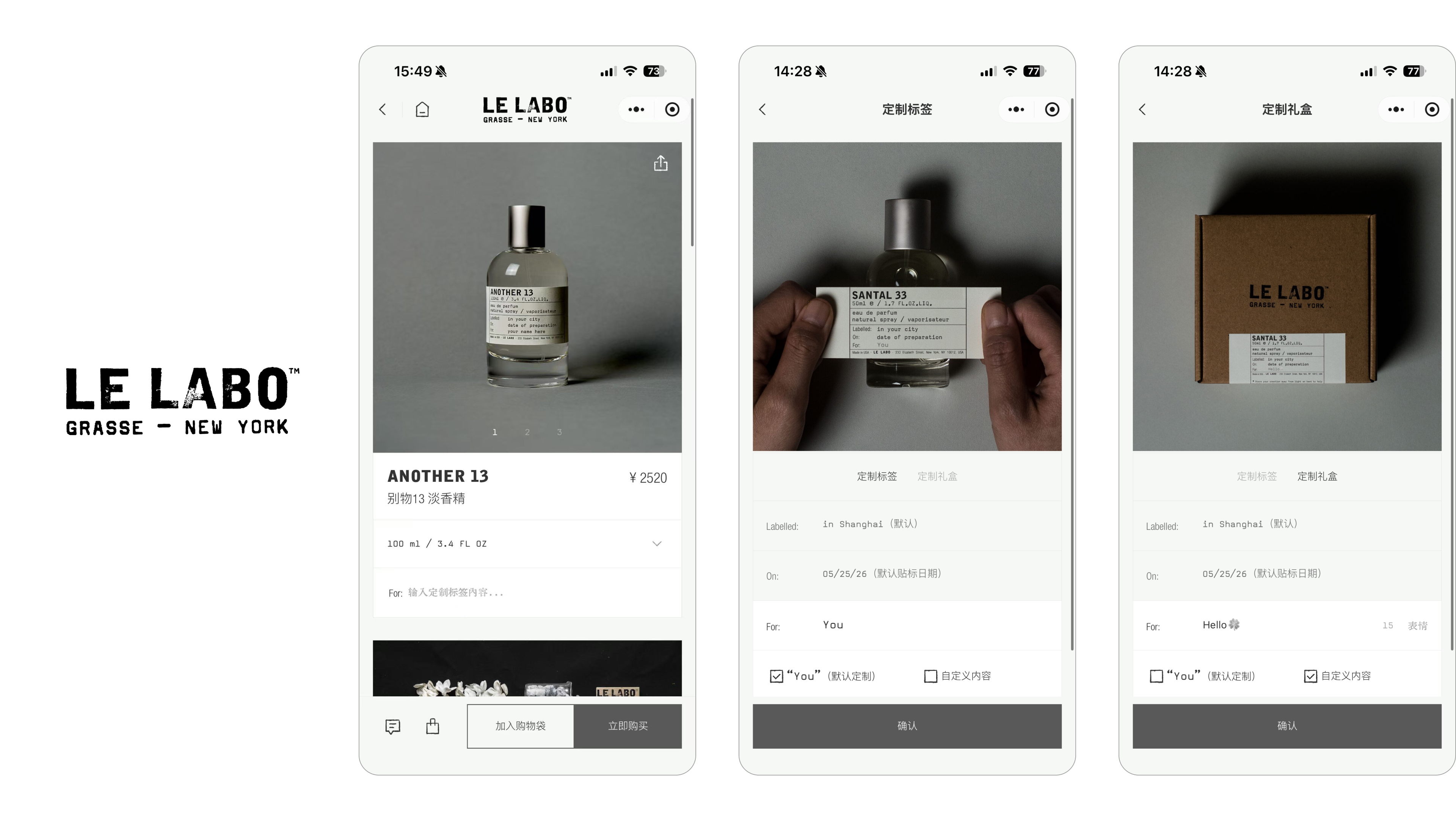
Luxury personalization works better when users can perceive what they are choosing, not just read about it.
4. The Best Luxury Experiences Embed Constraints Naturally
Personalization always comes with limits. There may be character restrictions, placement rules, production constraints, or service conditions.
The strongest luxury experiences communicate those limits through structure, not through heavy explanation.
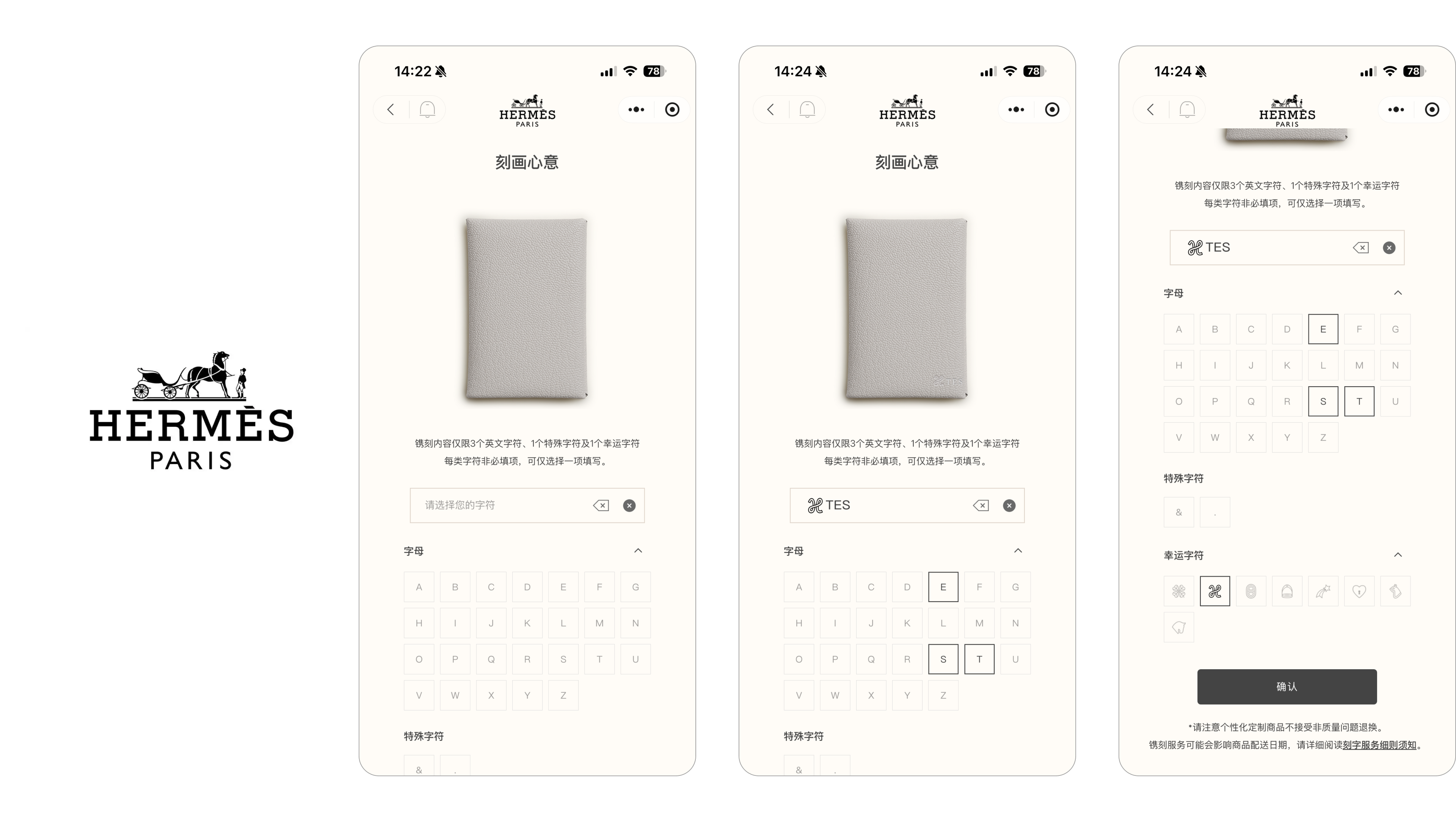
Hermès structures its engraving keyboard into three sections. Latin letters, special characters, and brand-exclusive lucky symbols. The character limit is communicated through the layout itself, not through rules copy. As the user types, the result appears on the leather surface in real time.
Boucheron and Cartier also show how service rules can sit inside a controlled flow without taking over the experience. The structure contains the decision space, so the interface feels guided rather than overly corrective.
Luxury UX should preserve calm and control. If the user is overwhelmed by warnings, conditions, or operational language, the premium effect weakens.
5. The Strongest Brands Treat Personalization as Part of Product Identity
The most sophisticated examples do not treat personalization as a temporary add-on.
They give it a more durable place in how the product is presented, remembered, or carried forward.
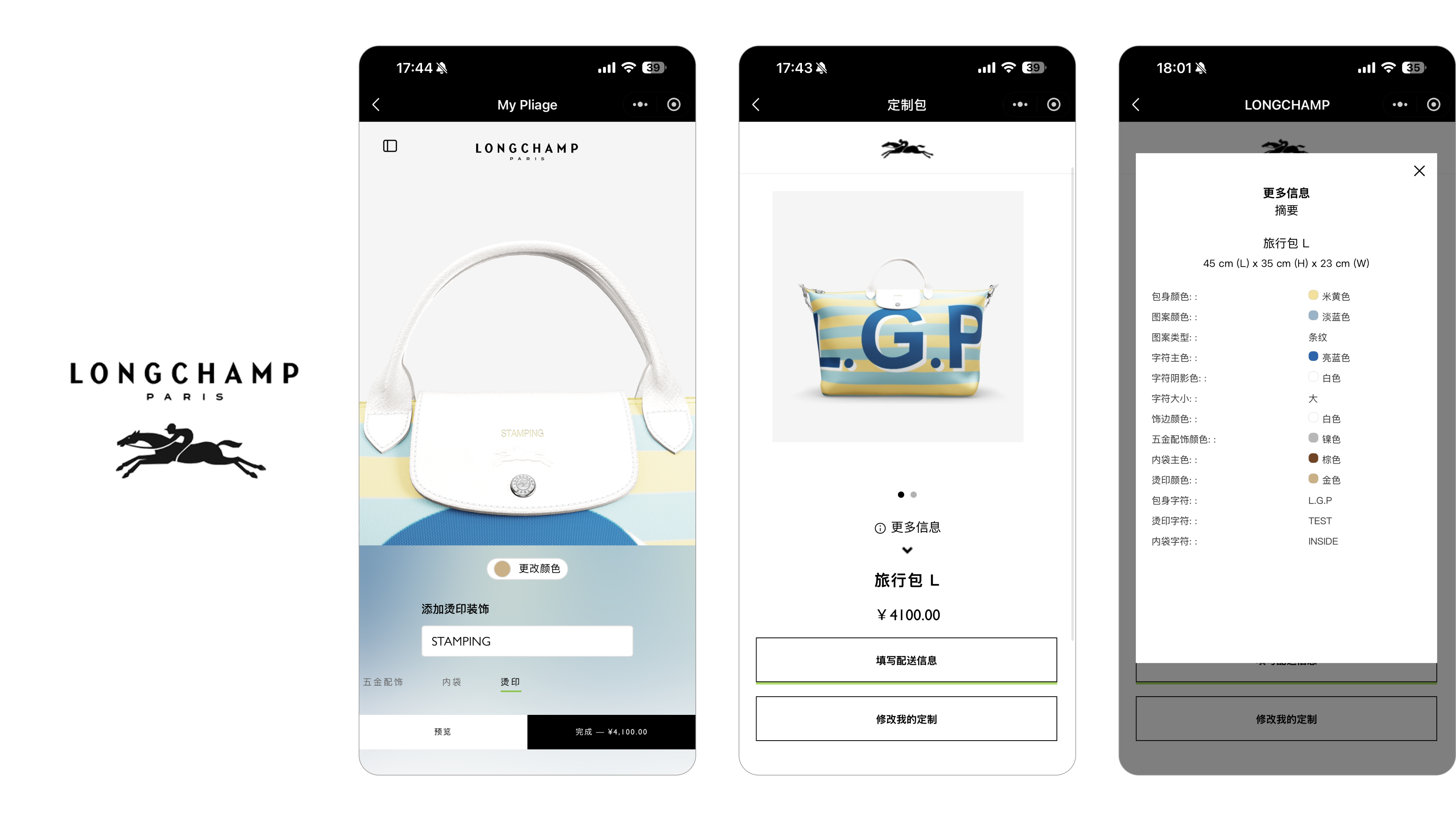
Longchamp embeds personalization into the product configurator itself. On My Pliage Signature, colors, trims, hardware, and hot-stamped flaps are core attributes, not checkout add-ons. The customized bag appears as the main product image in real-time.
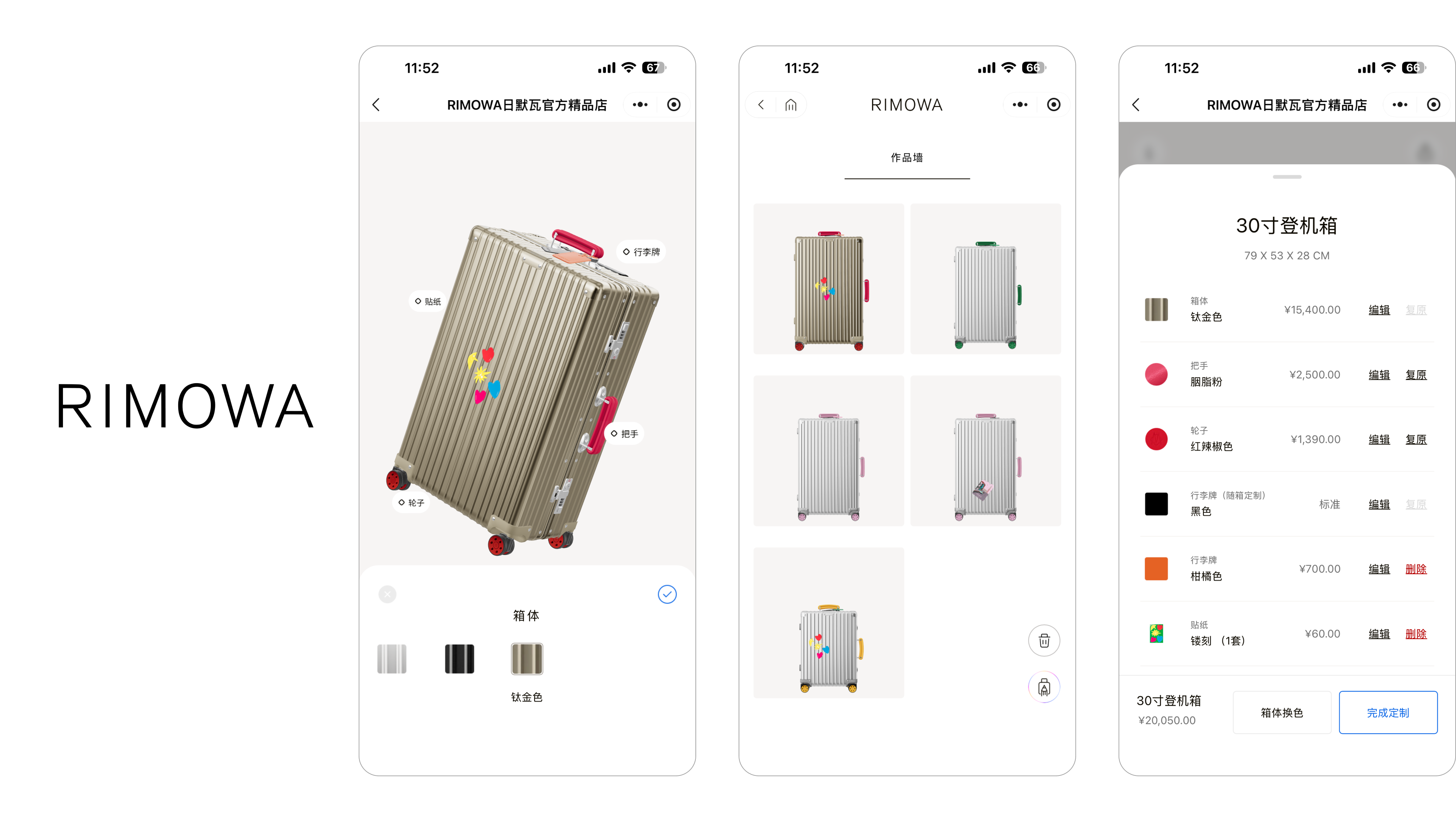
RIMOWA UNIQUE goes further by saving completed configurations into My Creations. Even before purchase, the personalized object is given a stable afterlife as something complete and revisitable.
When personalization is treated as part of product identity, it becomes easier to connect with advisor follow-up, saved preferences, gifting history, or post-purchase communication.
Luxury Personalization UX/UI Design Takeaways Across Categories
These patterns appear across categories, but the emphasis changes depending on what the product represents.
- Fine jewelry tends to emphasize emotional framing, symbolic meaning, and restraint.
- Fashion and leather goods place more weight on visible ownership, self-expression, and persistent preview.
- Beauty and fragrance often focus on gifting rituals, materiality, and reassurance around small but meaningful enhancements.
That is why personalization for luxury brands on WeChat Mini Programs should not follow one standard interface model. The strongest brands align the interaction pattern with the role the product plays in the customer relationship.
Beyond UX: Four Operational Factors to Plan Before Launch
For luxury brands in China, personalization on WeChat Mini Programs should not be planned as an isolated interface feature. It should be treated as part of a broader brand, commerce, and client engagement model.
Before launch, teams should align on four upstream planning areas:
- Decide what product customization data (engraving text, font choices, color selections, monogram placements) should be stored, how it should be structured, and whether it should support segmentation, loyalty logic, or future follow-up.
2. Clienteling and handoff
- Clarify whether store teams or WeCom advisors should see the personalization context and how they should continue the journey before or after purchase.
3. Fulfillment and governance
- Make sure character limits, service rules, exclusions, and delivery realities are built into the experience early so the interface stays elegant without creating downstream friction.
4. Post-purchase continuity
- Plan how personalization should appear in order summaries, gifting flows, service communication, and ongoing relationship touchpoints after conversion.
These questions matter because Mini Programs often sit inside a larger WeChat ecosystem that includes membership, clienteling, service, and private-domain activation.
In that context, personalization becomes a useful signal for CRM and advisor follow-up, not just a one-off UX feature.
Conclusion
Luxury brands do not need the most complex personalization system. They need one that makes personal choice feel deliberate, elegant, and easy to trust.
Across jewelry, leather goods, and fragrance, the strongest examples use different interaction models, but they solve the same strategic problem: how to let customers personalize a product without weakening the brand’s sense of exclusivity.
In China, the opportunity is broader still. When product personalization (engraving, monogramming, stamping) is connected to CRM, gifting, and advisor-led service inside the WeChat ecosystem, it can strengthen customer relationships rather than simply support a single transaction.
For brands rethinking how personalization should work inside a WeChat Mini Program, IT Consultis (ITC) can help connect design, CRM, gifting, and WeCom-enabled clienteling into the broader digital luxury customer journey in China.