
For B2B brands operating in China, the challenge is rarely just generating leads. The bigger challenge is turning those leads into structured, trackable, and well-nurtured relationships.
A prospect may first discover a brand through their website, a webinar, an offline event, or WeChat Official Account content, but the harder challenge begins after that first interaction.
If follow-up stays fragmented across personal WeChat accounts, spreadsheets, and disconnected internal handoffs, brands risk losing visibility, consistency, and momentum.
In this article, we explain the role of WeCom in B2B marketing, sales, and CRM in China, where it adds the most value, and which mistakes most often limit results.
Executive Summary:
1. WeCom helps B2B brands turn lead capture into a managed relationship process. It extends the journey beyond a one-time form submission and supports more structured follow-up.
2. Its strongest value often appears after campaigns, events, and other lead-generation touchpoints. It helps brands continue the conversation in a more organized and trackable way.
3. The value of WeCom goes beyond communication alone. It also supports better data ownership, clearer governance, stronger team coordination, and improved CRM readiness.
4. WeCom works best when supported by a strong acquisition setup. Websites, Official Accounts, webinars, events, and other channels still need to generate qualified interest first.
5. Successful deployment depends on process design and team adoption. Without clear ownership, consistent tagging, training, and change management, even a strong setup can underperform.
Table of contents
Key Benefits of WeCom for B2B Marketing in China
In China, generally, B2C email outreach and communication do not work. Brands instead prioritize reaching consumers through mobile-driven platforms such as WeChat, which can be amplified with Marketing Automation tools.
In the B2B space in China, however, websites, email, webinars, and offline events still play an important role in building awareness and generating leads.
But those channels do not solve the operational question that follows: What happens after the lead arrives?
That is where WeCom, also known as WeChat Work, becomes strategically important.
As Tencent’s enterprise communication platform, it gives B2B brands a more structured way to manage follow-up, capture lead data, and support sales and CRM workflows within the WeChat ecosystem.
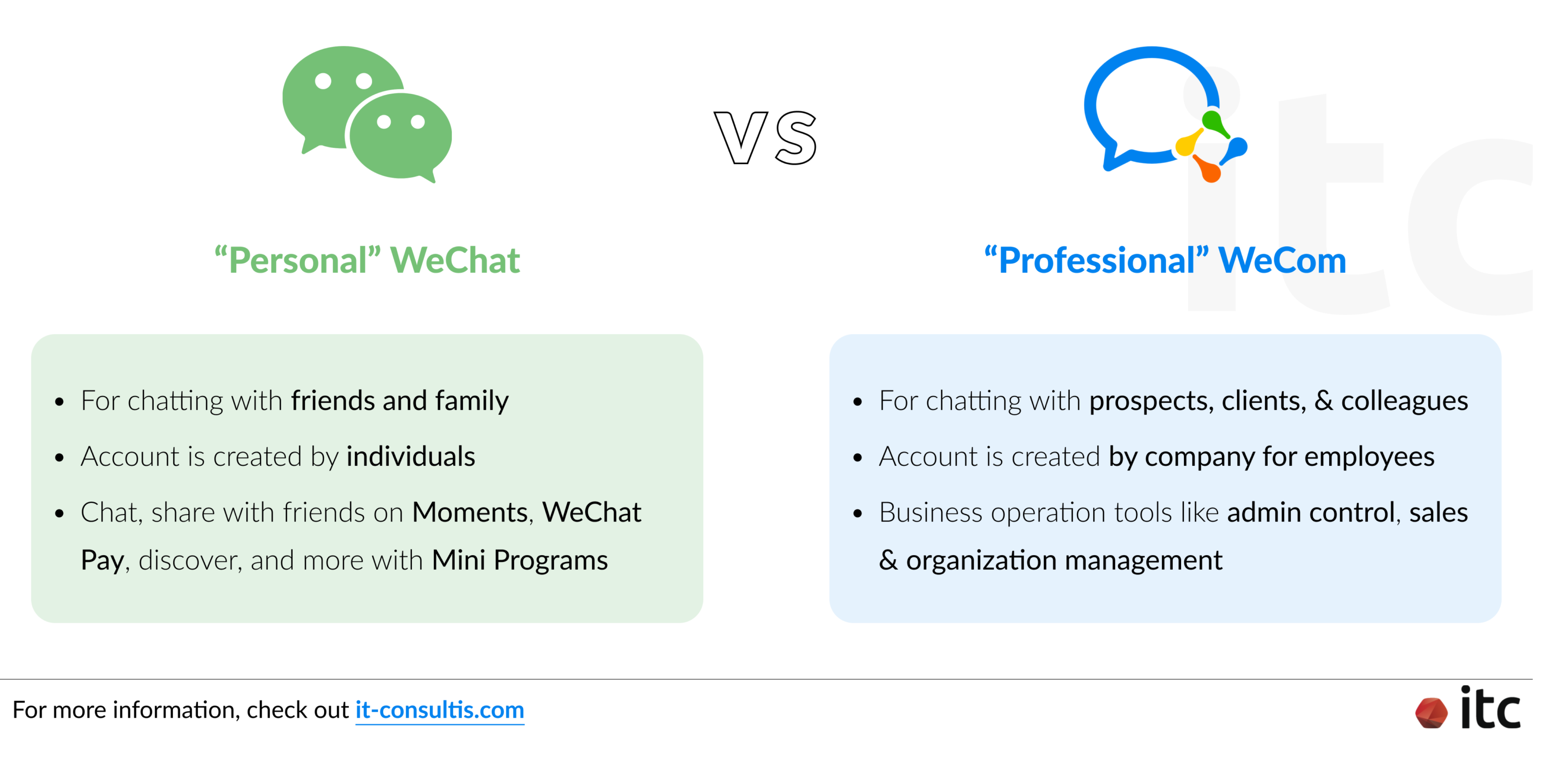
A Professional Alternative to Personal WeChat
When sales associates or client-facing teams rely on personal WeChat for business conversations, customer relationships can become tied to individual accounts rather than the company.
That creates clear operational risks. Contact details, conversation history, and follow-up context may stay scattered across personal chats, making oversight, continuity, and team coordination harder to manage.
WeCom gives brands a company-managed environment for customer communication. Instead of leaving important relationships in personal accounts, brands can manage them through company-controlled WeCom identities under the brand’s business setup.
This helps teams:
- Keep customer relationships tied to the organization rather than an individual employee.
- Maintain better visibility over lead handling and follow-up activity.
- Organize customer data more consistently.
- Reduce the risk of data loss when staff change roles or leave.
This matters in China’s B2B environment because relationship-building is still highly conversational. A static website form or disconnected email thread may collect data, but it does not necessarily create relationship continuity.
WeCom (WeChat Work) helps brands bridge that gap.
Data Capture That Feeds Your CRM
When client advisors or sales associates use personal WeChat to talk with leads and clients, important contact details and conversation history often stay trapped in individual accounts.
Teams then have to manually copy that information into Excel files or CRM systems, which is time-consuming and hard to manage consistently.
WeCom gives brands a more structured way to capture and manage lead data inside the WeChat ecosystem.
Instead of leaving information buried in personal chats, teams can collect customer data in a format that is easier to organize, export, archive, and use for follow-up.
Data is secured, stored, and can be leveraged directly within the platform — even without connecting to an external CRM system.
Notably, in-chat WeCom forms and WeCom AI can help seamlessly capture company name, industry, business email, and interest areas, making follow-up more efficient, relevant, and actionable.
This gives marketing and sales teams cleaner lead data, better follow-up context, and a stronger foundation for CRM workflows, whether the data is later synced into an external CRM or first managed within WeCom’s own customer contact environment.
Other advantages include:
- Starting conversations immediately in a familiar channel.
- Tracking lead sources through parametric WeCom QR codes.
- Scaling follow-up more efficiently than manual lead handling across personal accounts.
Extending the Relationship After Lead Capture
WeCom is usually not the first discovery touchpoint.
Before WeCom can work, brands need a reason for prospects to connect. That means placing WeCom QR codes strategically across existing touchpoints. Once a prospect scans the QR code and adds your WeCom contact, the real work begins.
Without a structured approach, the prospect adds the contact, receives no welcome message, sees no form, and the journey ends. The brand has a contact but no context — no company name, no interest area, no qualification data.
With a structured WeCom-led approach, the prospect immediately receives a welcome message introducing the brand. A short in-chat form can collect key information like company, role, and interest area.
From there, the prospect stays connected through a branded business contact, ongoing follow-up, and clear handoff across marketing and sales teams.
This is where WeCom often creates its clearest business value. It reduces friction, captures data at the first interaction, and turns a one-time submission into an ongoing relationship channel.
B2B Marketing on WeCom for Lead Nurturing
For B2B marketers, WeCom is a channel for lead qualification, content distribution, and pipeline acceleration.
Tagging comes first. Tags by source, sector, service interest, or funnel stage structure your lead data. For example, a lead tagged “Webinar – Supply Chain” is nurtured differently from one from an offline event.
Personalization comes second. With tags, you can tailor B2B-specific content like case studies and industry reports to each segment.
Activation comes third. Send targeted content through WeCom Moments, segmented broadcasts, or WeCom groups. Track opens, clicks, and responses to identify sales-readiness.
Sales handoff is the goal. When a lead shows strong signals — multiple content engagements, a form completion, or a pricing question — WeCom makes it easy to hand off that lead with full context to sales.
Over time, this helps marketing teams keep communication relevant without becoming intrusive. It also gives sales a better context when a lead is ready for deeper engagement.
What Makes a Strong B2B WeCom Setup
A good B2B WeCom strategy should not be framed as “we can now message customers.” The stronger story is that WeCom combines communication with process, usable data, and organizational control.
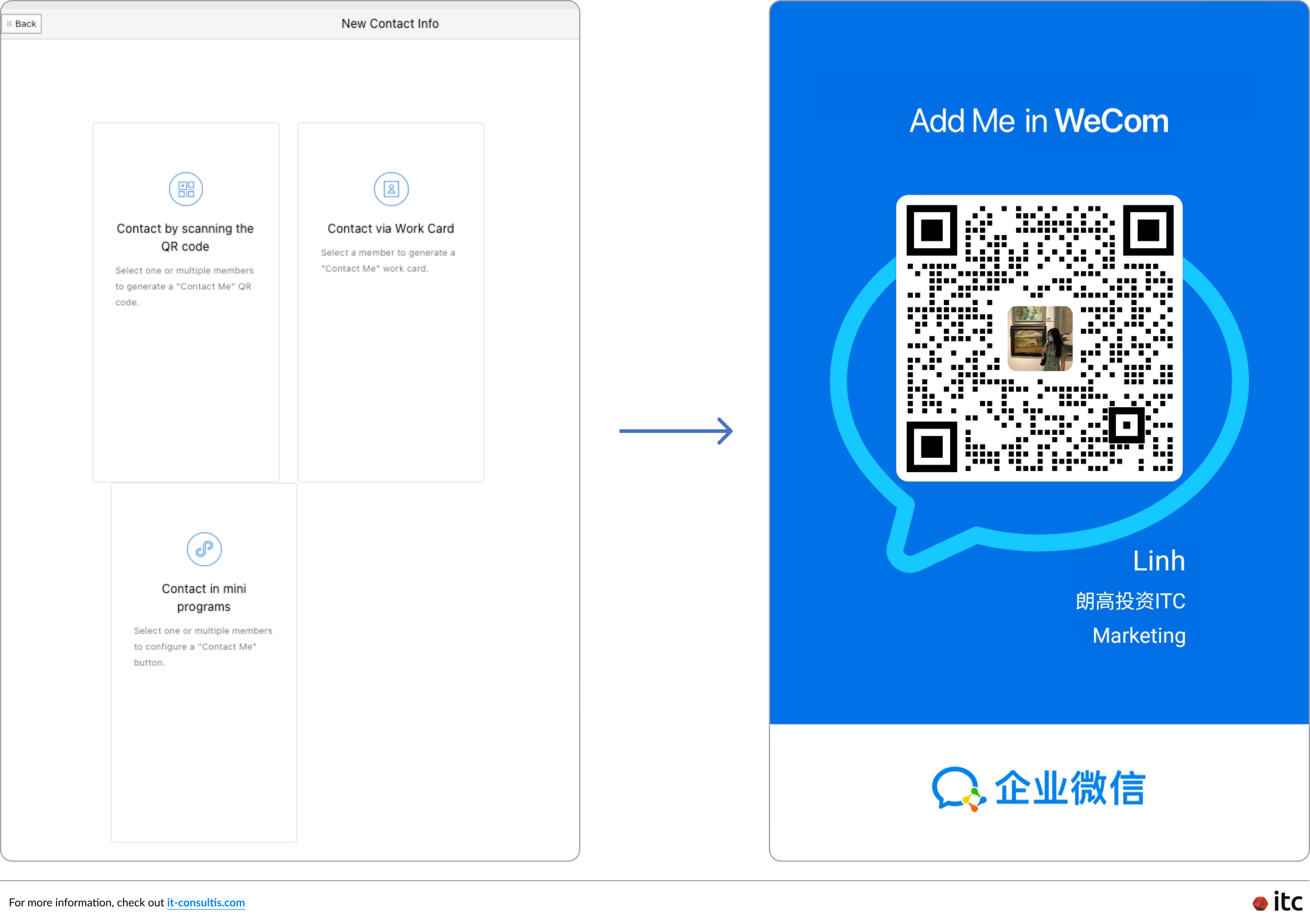
1. “Contact Me” WeCom QR Codes
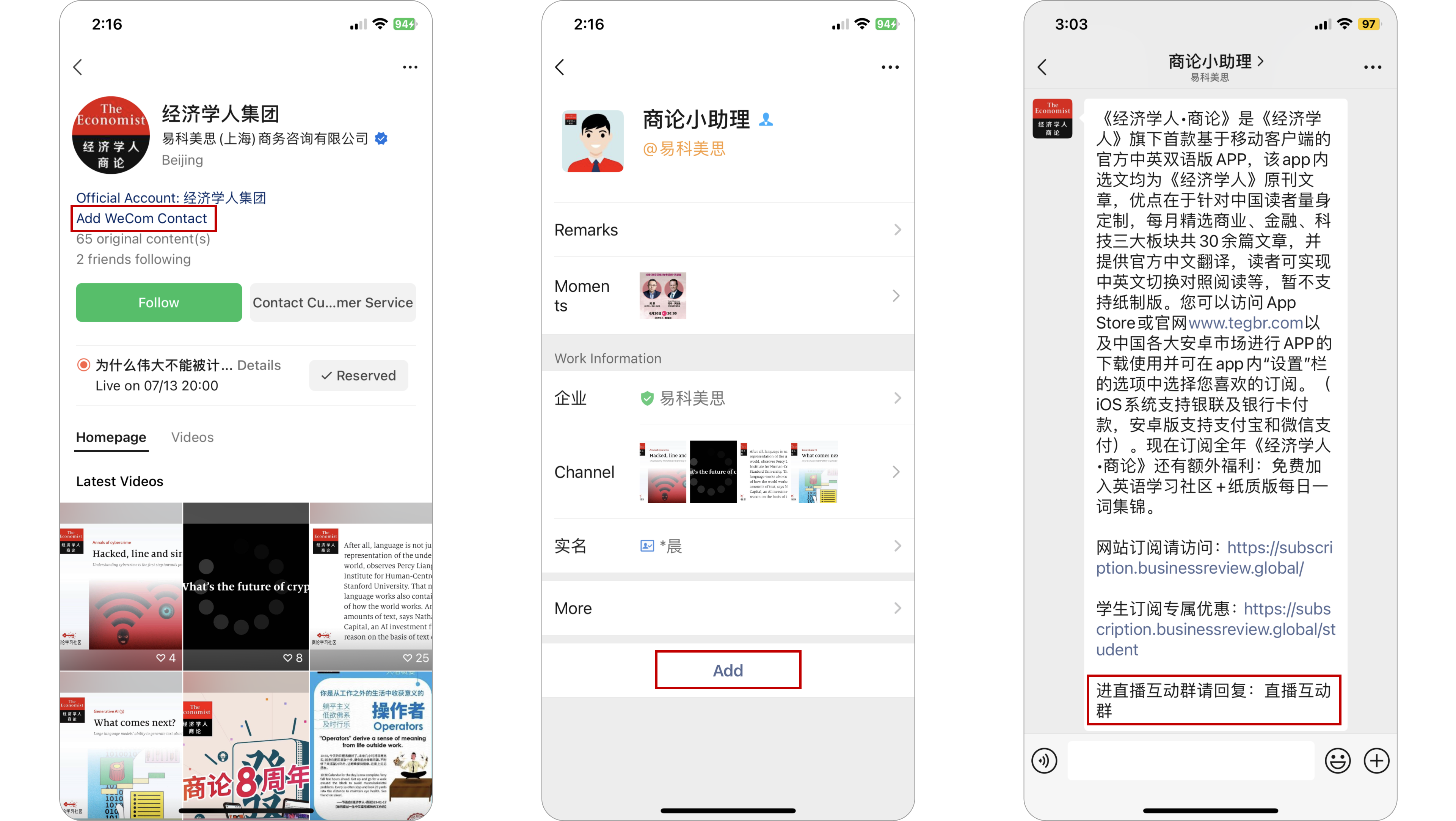
As mentioned above, “Contact Me” QR codes can turn every touchpoint into a lead capture opportunity. Placed on event booths, webinar registration pages, website Contact Us page, WeChat Official Account menu bar and articles, Mini Programs, and more, each scan moves a prospect from anonymous to connected.
Parametric WeCom QR codes can also track which source generated each lead, giving teams cleaner source attribution and better context for later segmentation.
For more tips on getting more leads and customer WeChat contacts on WeCom, see Strategies for Onboarding WeCom Customers.
2. Welcome Journeys & In-Chat Data Collection
Once a user has added a Client Advisor’s WeCom, they trigger different welcome flows based on the parametric QR code. For example, a webinar prospect can receive a different journey than an offline event attendee.
In-chat questions, content guidance, and qualification tools can help teams better understand the prospect before or alongside form-based qualification.
3. Customer Tagging
Tags by event source, sector, funnel stage, or product/service interest make personalization more scalable. They also support cleaner segmentation and more relevant outreach over time.
When relevant, brands can also push the tagged WeCom profile into CRM workflows, which is more useful than transferring tag labels alone.
4. Customer Allocation & Inheritance
When sales associates use personal WeChat, past customer data and contact information can be lost if an associate leaves or transfers roles.
WeCom helps reduce that risk by keeping customer relationships within a company-managed environment. That makes it easier to preserve continuity, reassign conversations, and protect valuable relationship history.
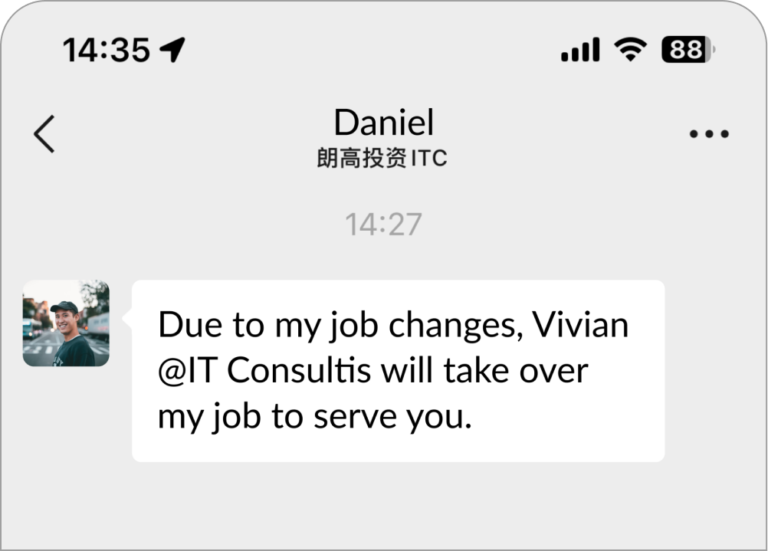
With the right supporting tools and governance model, brands can also retain and transfer chat history more effectively, so a new team member can continue the relationship with proper context.
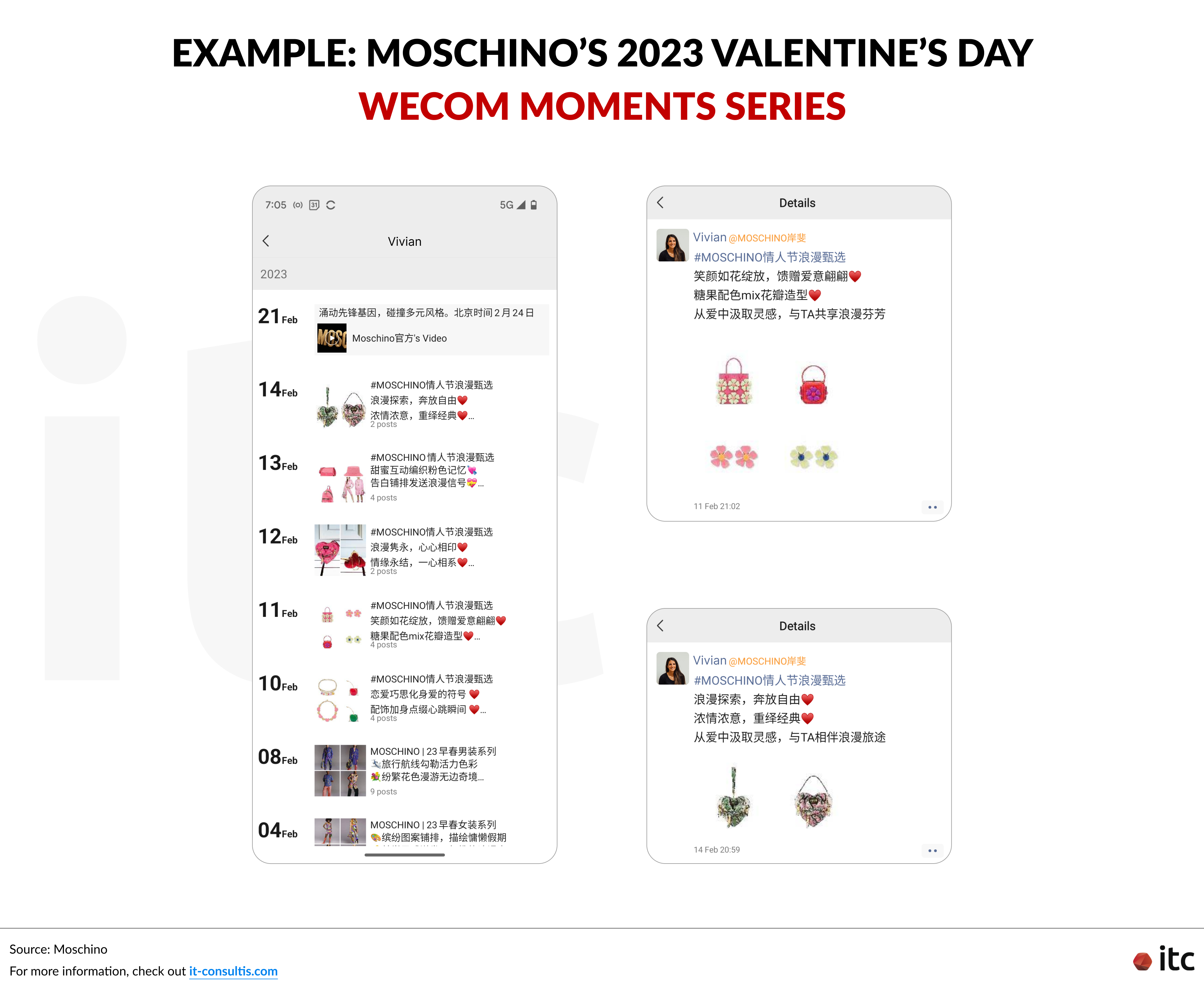
5. WeCom Moments
WeCom Moments can help brands stay visible with relevant content such as industry insights, case studies, and event invitations. In B2B, this matters less as a volume tactic and more as a continuity tactic.
6. WeCom Group Chats
Group-based engagement may be relevant in some cases, but it is not necessarily a core B2B use case for every brand. Where appropriate, WeCom groups in China can support event-driven discussion, education, or community-style engagement.
7. Connecting WeCom to the Wider Ecosystem
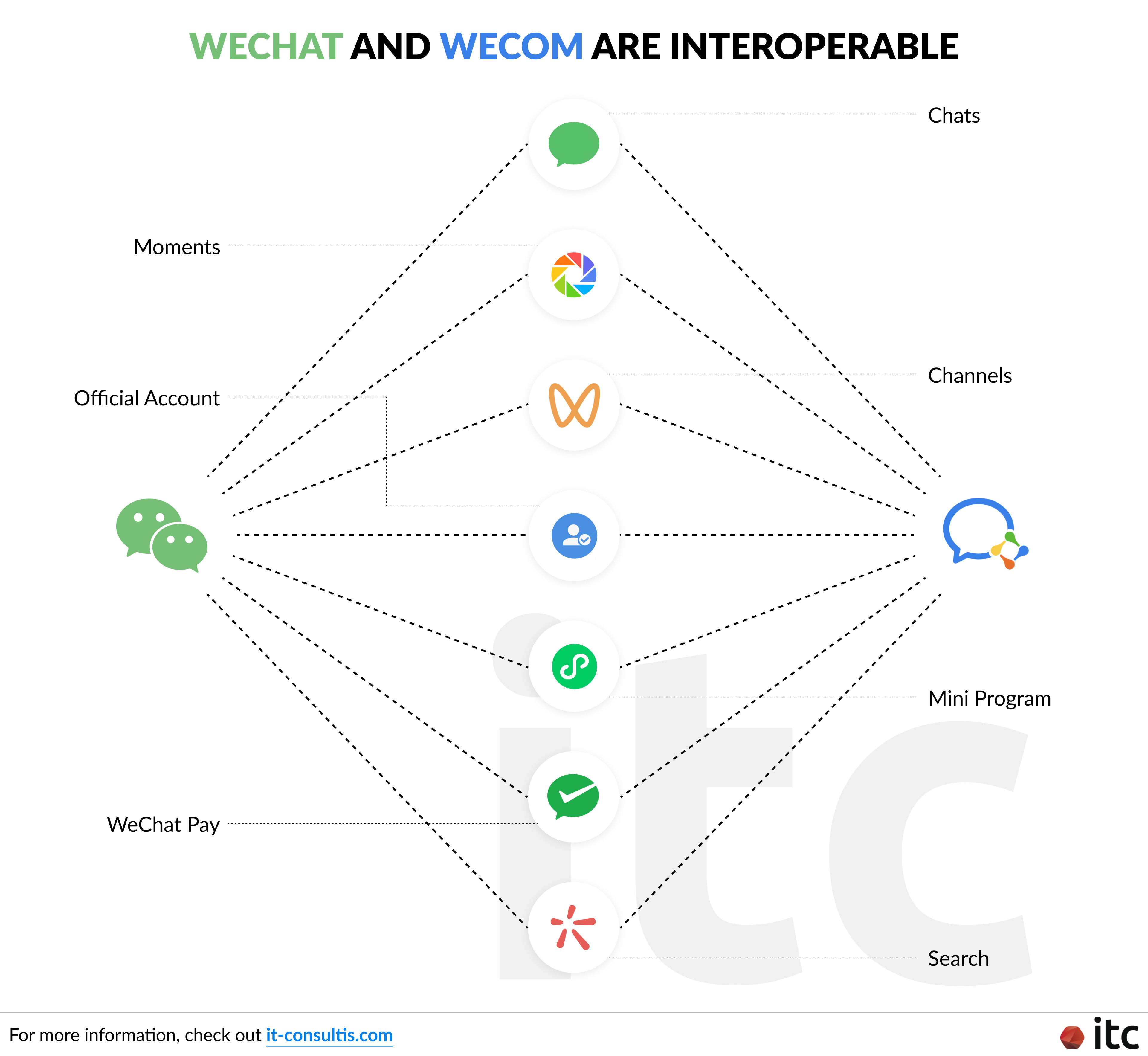
WeCom becomes more powerful when it is connected to the wider Chinese digital ecosystem and to the brand’s own systems.
Within the WeChat ecosystem, WeCom can work alongside Official Accounts, Mini Programs, WeChat Channels, and Moments, helping brands connect content, lead capture, and follow-up more seamlessly.
It can also be connected with brand systems such as CRM and CDP platforms.
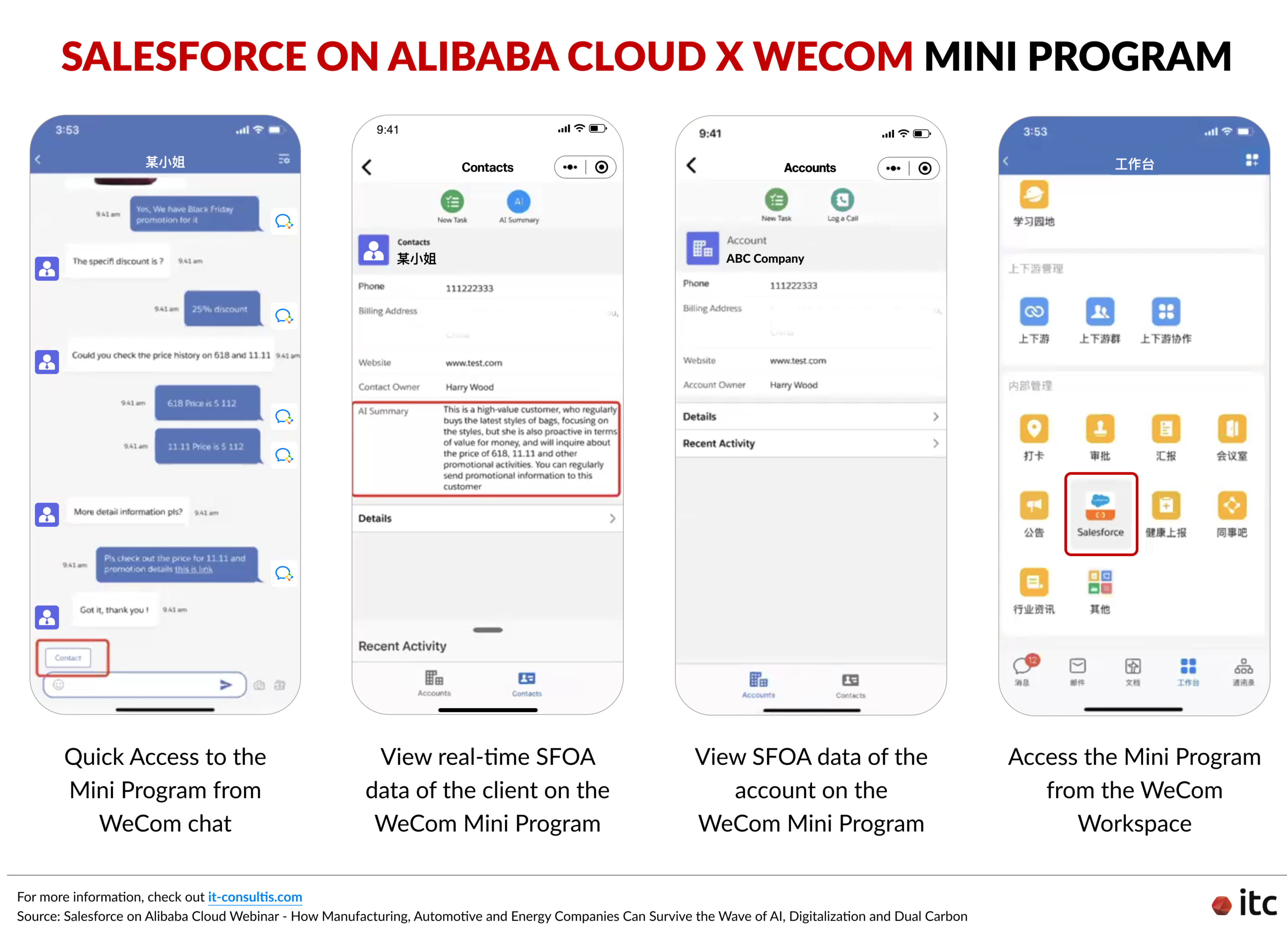
For example, through WeCom and Salesforce on Alibaba Cloud integration, brands can embed centralized CRM data access inside a WeCom Mini Program so that:
- Internal sales associates can view a fuller customer profile directly within WeCom
- Approved external partners and distributors can access the information relevant to their own role, account scope, or sales territory.
This distinction matters in B2B environments where brands need both collaboration and control: internal teams may require broader visibility across accounts and workflows, while external partners should only see the data needed to support their part of the customer relationship.
When paired with role-based permissions and seamless login or Single-Sign-On-style access, this setup can support a smoother user experience without losing governance over sensitive customer data.
Likewise, a CDP in China can centralize customer data from WeCom alongside other sources, supporting stronger segmentation and more coordinated activation.
8. Message Archiving for Regulated Industries
For B2B brands in finance, banking, legal, or insurance sectors, WeCom message archiving can support governance requirements and provide stronger traceability for audit-related needs.
This is especially relevant where organizations need tighter control over client communication history and internal oversight.
How Marketing, Sales, and CRM Teams Should Work Together When Using WeCom
A strong B2B WeCom setup is not just a channel decision. It is an organizational design decision.
In practical terms:
- Marketing often captures leads, sends the first touchpoints, collects information, tags contacts, and supports early-stage engagement. This includes sharing segmented content through WeChat Official Account, website, white papers, and event assets.
- Sales receives qualified contacts, uses the collected context, continues the conversation, and moves leads toward deeper qualification, demo, pricing, or conversion.
- CRM and Operations Teams support the data flow, visibility, reporting, and process discipline that make the system reliable.
Without that operational layer, WeCom activity can remain isolated instead of feeding a broader business process.
That bridge only works when governance is clear. Teams need to define:
- Who is client-facing and who is not
- Who needs which level of access
- How leads move from one team to another
- Which WeCom tool is used at which stage of the journey
Training and change management are equally important. Brands often treat WeCom as a plug-and-play tool, but that is one of the main reasons deployments underperform.
Common B2B WeCom Mistakes vs. A Mature Approach
Many brands treat WeCom like just another WeChat account, assume the tool alone will fix follow-up problems, or underuse existing Official Account assets.
Others skip manual tagging because it does not create an immediate visible payoff, or leave roles and permissions unclear.
A weak WeCom setup often looks similar across organizations:
- The tool is deployed, but the process is not redesigned
- Users are added, but responsibilities remain unclear
- Tagging is inconsistent
- CRM handoff is weak or undefined
- Multiple overlapping tools run without a clear workflow boundary
By contrast, a mature setup starts with a clear acquisition funnel and a strong reason for prospects to add the brand.
It uses welcome messages and forms intentionally, maintains tagging discipline, defines the marketing-to-sales handoff, and aligns WeCom activity with CRM visibility and governance.
The difference is not whether WeCom exists in the stack, but whether it is integrated into the buyer journey, team workflows, and the wider data model.
B2B WeCom KPIs That Matter Most
To evaluate whether a B2B WeCom setup is working, brands should focus on relationship progression, data quality, and movement toward commercial outcomes, not just message volume.
Acquisition-to-Connection
- QR scan to add rate: How many scans turn into WeCom connections?
- Add-to-form completion rate: Once connected, how many complete qualification forms?
Nurturing Quality
- Response speed: Are teams responding fast enough to maintain momentum?
- Qualified conversation rate: How many chats progress beyond surface-level questions?
- Content engagement from tagged segments: Are tagged leads engaging with relevant content?
Pipeline Impact
- MQL-to-SQL progression: How many marketing-qualified leads become sales-qualified?
- Event follow-up conversion: What percentage of event leads move to the next step?
- Opportunity creation from WeCom-managed leads: Is WeCom generating pipeline?
What Matters Less in Many B2B Cases
As mentioned above, WeCom Moments is less used in B2B contexts than in B2C for mass reach. Therefore, broad WeCom Moments engagement metrics and other vanity metrics are usually less useful in B2B.
The better question is whether WeCom improves relationship continuity, data quality, post-event follow-up, and conversion readiness across a long sales cycle.
Conclusion
Overall, for B2B marketing in China, WeCom should not replace the channels that generate initial interest. Brands still need strong content, events, Official Account activity, websites, and other touchpoints to attract qualified leads.
But once interest exists, WeCom can help turn fragmented follow-up into a more structured relationship process that supports better qualification, better coordination, and better CRM visibility.
At IT Consultis (ITC), we are a certified WeCom partner with over 6,000 users trained and recognized as a Greater China Agency of the Year.
If your brand is struggling to connect lead acquisition, follow-up, CRM connection, and operational rollout, ITC can help design a WeCom strategy that works.


![[Website] WECOM 5.0 cover image draft 2](/_next/image/?url=https%3A%2F%2Fit-consultis.com%2Fapp%2Fuploads%2F2025%2F12%2FWebsite-WECOM-5.0-cover-image-draft-2-1024x576.png&w=3840&q=100 "[Website] WECOM 5.0 cover image draft 2")
