
Global teams often assume that if HubSpot works well in their existing marketing stack, it can be deployed the same way on a China-facing website. In mainland China, that assumption can create unnecessary performance, governance, and compliance risk.
In this article, we explain why HubSpot forms need a different design logic for China-facing lead capture, what decision-makers should evaluate first, and how to think about safer, more governable alternatives.
For mainland China-facing websites, HubSpot forms should not be directly embedded as-is when personal data compliance, consent governance, and cross-border data flow need to be properly controlled.
Disclaimer: This article focuses on marketing lead-capture use cases, such as contact requests, gated content, newsletters, and event registrations. It does not address login, registration, or authentication flows, which usually require a separate architecture and governance model. It is strategic guidance, not legal advice.
This is not just a MarTech configuration issue. For leadership teams, it is a China operating-model decision touching performance, consent, data flow, governance, and internal reviewability.
Executive Summary:
1. A standard direct HubSpot embed is not the right default for mainland China-facing websites. The issue is not only whether a form loads, but whether the setup is governable and reviewable.
2. Where user data lands first matters. Consent capture, local visibility, onward transfer, and overseas-recipient disclosure all change the risk profile.
3. HubSpot can still play an important role in China. But in many cases, it should not be the first China-facing collection layer.
4. The right answer is usually a controlled architecture, not a copy-paste embed. Teams need to balance local performance, user experience, governance, and internal approval requirements.
5. The right solution depends on the business context, so the detailed approach should be assessed on a case-by-case basis.
Table of contents
- Why Direct HubSpot Embedding Becomes More Complex in China
- When Using HubSpot Forms in China, Where Does the Personal Information Land First?
- What Global Teams Should Evaluate Before Using HubSpot Forms in China
- A High-Level View of Safer Approaches for HubSpot Forms in China
- When HubSpot Should Not Be the Front-End Form Layer in China
- Conclusion
Why Direct HubSpot Embedding Becomes More Complex in China
For many organizations, website forms are treated as a routine marketing component. A team creates a form, adds the embed code, and routes submissions into its existing automation and CRM workflows.
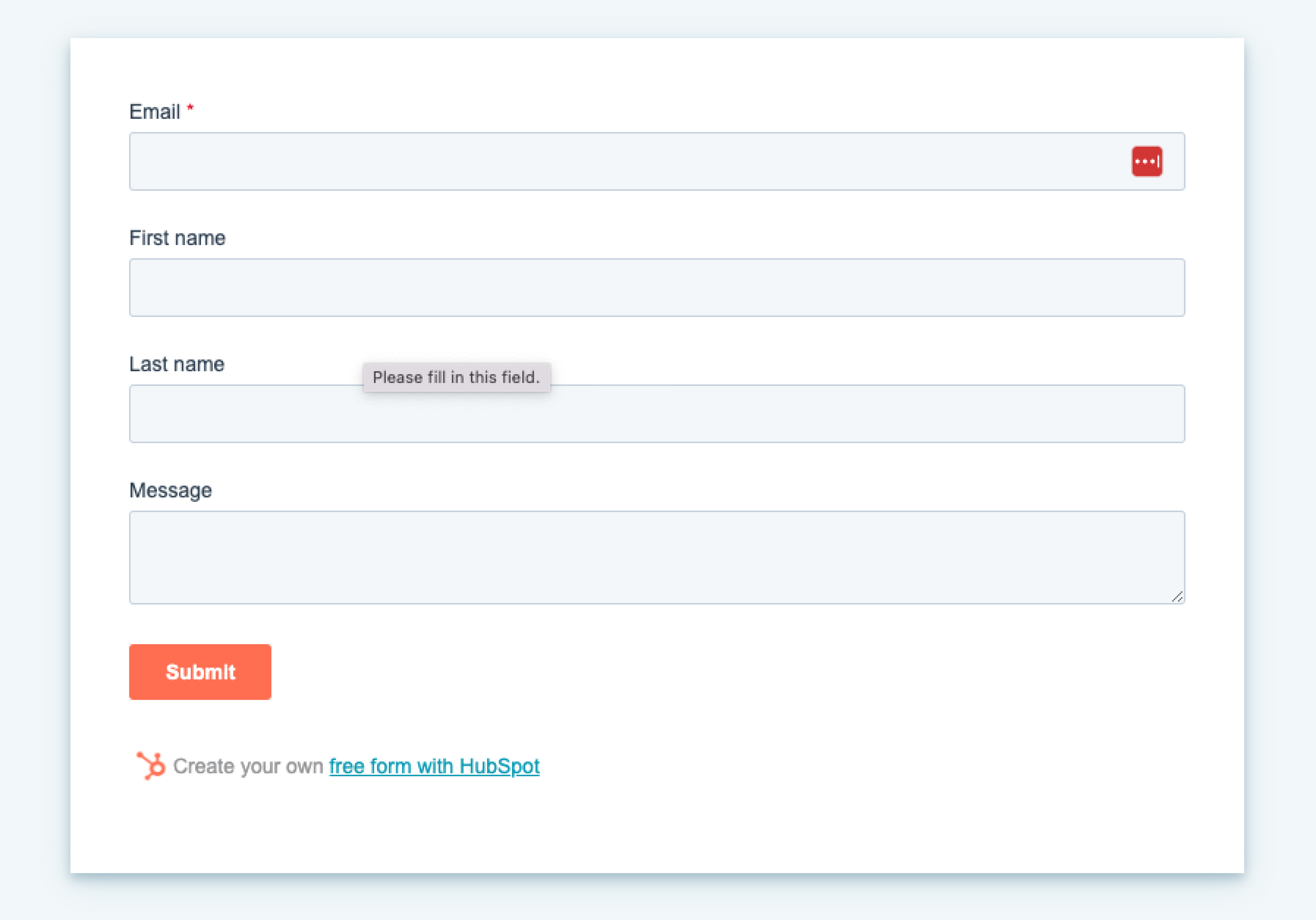
In many markets, that workflow is operationally straightforward, and HubSpot’s own guidance for embedding forms on external websites reinforces that assumption.
For mainland China-facing websites, however, directly embedding HubSpot forms as-is is not a China-ready default.
The reason is broader than front-end performance.
Lead capture in China raises questions about consent handling, data logging, overseas-recipient disclosure, cross-border transfer, and how clearly the organization can explain its operating model to marketing, legal, security, and IT stakeholders.
The most useful question is not ‘Can HubSpot forms appear on a page in China?’ It is ‘What is the safest and most controlled way to support China lead capture without using the wrong front-end collection pattern?’
When Using HubSpot Forms in China, Where Does the Personal Information Land First?
The key question in most China form discussions is simple: Where does the user data go first?
If a user in China submits personal information through a form, leadership teams should be able to answer:
- Which infrastructure receives the submission first
- Where consent is captured and recorded
- How the business maintains records and visibility in China
- What data is stored locally, if anything
- What data is transferred onward to systems outside China
- How the organization explains what leaves China, why it leaves, and who receives it
Public references on China’s cross-border data transfer obligations under the Personal Information Protection Law (PIPL) make clear that organizations should take seriously:
- Disclosure of overseas recipients
- Handling of personal information across borders
- Separate consent requirements in applicable cases
These are reflected in Article 39 guidance and broader cross-border transfer procedure overviews.
If the website itself is hosted in mainland China, the broader deployment environment may also need to account for local requirements such as ICP filing for public-facing websites.
That is why direct embedding is such a sensitive decision: it affects the first movement of personal information, the visibility of consent, and the clarity of the organization’s cross-border data narrative.
What Global Teams Should Evaluate Before Using HubSpot Forms in China
Rather than treating this as a binary technical choice, global teams should start with the business and governance questions that define what a suitable China-facing setup actually looks like.
In practice, that usually means reviewing:
- What type of lead capture is involved — contact request, gated content, newsletter, inquiry, event registration, or another use case
- Where the site will be hosted — mainland China, Hong Kong, or offshore infrastructure serving China
- How important local performance and stability are for mainland China users
- How much China-side control is needed over consent, data flow, and record-keeping
- What personal information may need to stay in China and what may move onward to global systems
- How much internal review is required from legal, security, IT, and marketing
- Whether HubSpot should be the visible front-end form layer or sit downstream in a broader China-ready design
The right answer varies by organization. A business optimizing for speed may accept a different trade-off than one optimizing for governance clarity, internal reviewability, or local operating confidence.
The right solution is context-specific, and the operationally safe version is rarely a one-size-fits-all public blueprint.
A High-Level View of Safer Approaches for HubSpot Forms in China
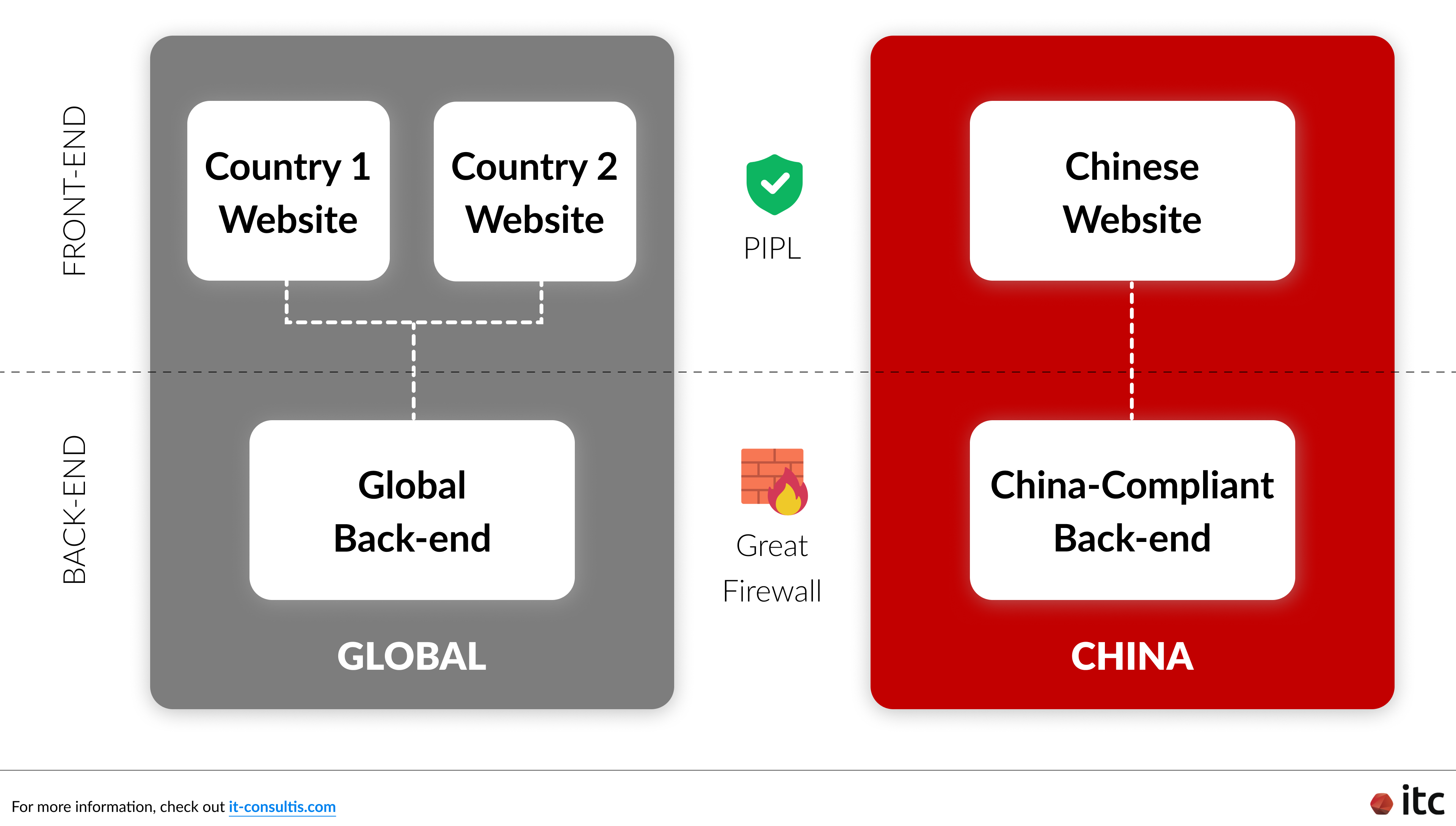
At a strategic level, stronger setups usually introduce more China-side control before data is passed onward to HubSpot or another global platform.
That can include:
- a China-facing capture layer
- clearer consent and logging design
- governed routing rules for what data is transferred, when, and for what business purpose
The exact architecture varies by organization, but the core pattern is consistent: the question is usually less about embedding HubSpot in China and more about which layer should collect, validate, store, and route information first.
When HubSpot Should Not Be the Front-End Form Layer in China
HubSpot may remain the right global platform without being the right China-facing collection layer.
This is where many teams make the wrong assumption. They treat HubSpot’s importance in global lead management as proof that it should sit directly in the front-end experience for users in China. That is not always the best design choice.
In some cases, local operating requirements, local channels, and local engagement patterns justify a different front-end approach.
That is especially true when the wider China ecosystem includes touchpoints such as WeCom, Mini Programs, or other localized interaction layers that do not map neatly to a standard global form deployment model.
For some organizations, the strongest answer is to keep HubSpot as the global system of record while using a China-controlled layer upstream for submission, validation, and routing.
Conclusion
HubSpot can still be part of a China strategy. But for mainland China-facing websites, HubSpot forms should not be directly embedded as-is when the goal is a safe, compliant, and properly governed setup.
The decisive issue is not form functionality alone. It is the quality of the architecture behind it: where data lands first, how consent is governed, how cross-border transfer is managed, and how clearly the model can be explained across internal stakeholders.
Organizations that handle this well do not treat mainland China as a copy-and-paste extension of an existing global setup. They design lead capture around China’s infrastructure, governance, and channel realities.
IT Consultis (ITC) is an award-winning Digital Transformation Consultancy guiding global enterprises to navigate the digital ecosystems in China and APAC.
If your team is evaluating how to support lead capture in China without creating governance blind spots, IT Consultis (ITC) can help assess the viable approaches and define the right high-level design.