
For many brands entering or expanding in China, a WeChat Mini Program can become an important touchpoint for commerce, service, loyalty, lead capture, and campaign activation inside the WeChat ecosystem.
In this article, we’ll walk through the ultimate WeChat Mini Program development guide, including when a Mini Program makes sense, what brands should prepare before starting, key ways to develop a WeChat Mini Program, and why maintenance and release readiness matter after launch.
Executive Summary:
1. A WeChat Mini Program is often the most practical starting point for brands that want to launch faster and reduce friction inside the WeChat ecosystem.
2. Strong WeChat Mini Program development usually starts with clear business goals, realistic scope, and early alignment on entity setup, compliance, and operations.
3. Brands can develop a WeChat Mini Program through self-development, SaaS-based solutions, or custom development, depending on the complexity of the use case and the level of localization and integration required.
4. For many enterprise and premium-brand scenarios, phased custom development is often the strongest approach because it supports both faster validation and stronger long-term fit.
5. After launch, maintenance and deployment discipline matter because a Mini Program is not a one-time build, but an operating asset that needs to evolve over time.
Table of contents
- Why WeChat Mini Programs Still Matter for Brands in China
- When a WeChat Mini Program is the Right Investment
- What Brands Should Prepare Before WeChat Mini Program Development Starts
- How to Develop a WeChat Mini Program: Three Key Ways
- Why Many Brands Approach Custom WeChat Mini Program Development in Phases
- What to Look for in a WeChat Mini Program Development Partner
- Why WeChat Mini Program Maintenance and Release Readiness Matter After Launch
- Conclusion
Why WeChat Mini Programs Still Matter for Brands in China
A WeChat Mini Program is a lightweight application built inside WeChat that allows brands to offer services, commerce, content, and customer interactions without requiring users to download a separate app.
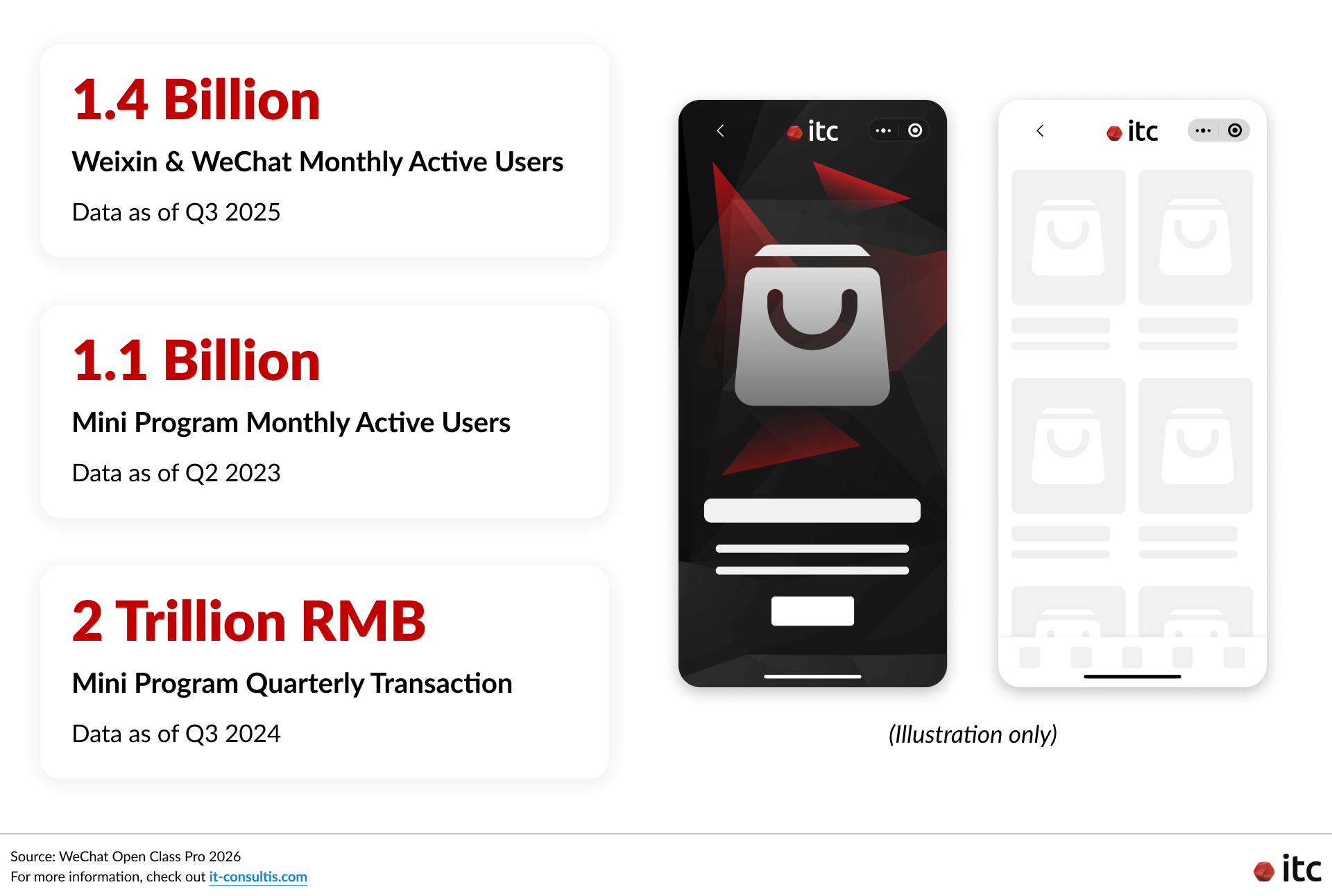
According to the WeChat Open Class Pro 2026:
- By Q2 2023, monthly active Mini Program users surpassed 1.1 billion
- By Q3 2024, quarterly transactions through Mini Programs had already reached 2 trillion RMB
- By 2025, brands from over 100 countries and regions had entered the Mini Program ecosystem, with user footprints spanning the globe
WeChat Mini Programs remain strategically important because they sit inside one of China’s most deeply embedded digital ecosystems. That matters not only for convenience, but also for discovery, sharing, conversion, and service continuity.
From a business perspective, Mini Programs can be especially useful when a brand wants to reduce friction between attention and action.
Instead of sending users into a separate app journey, a WeChat Mini Program can support a more direct path from campaign, social touchpoint, or clienteling interaction into a useful service or transaction flow.
Mini Programs can also help brands move faster than a traditional app program, benefit from WeChat-native capabilities, and support user journeys that feel more natural inside an ecosystem Chinese users already rely on every day.
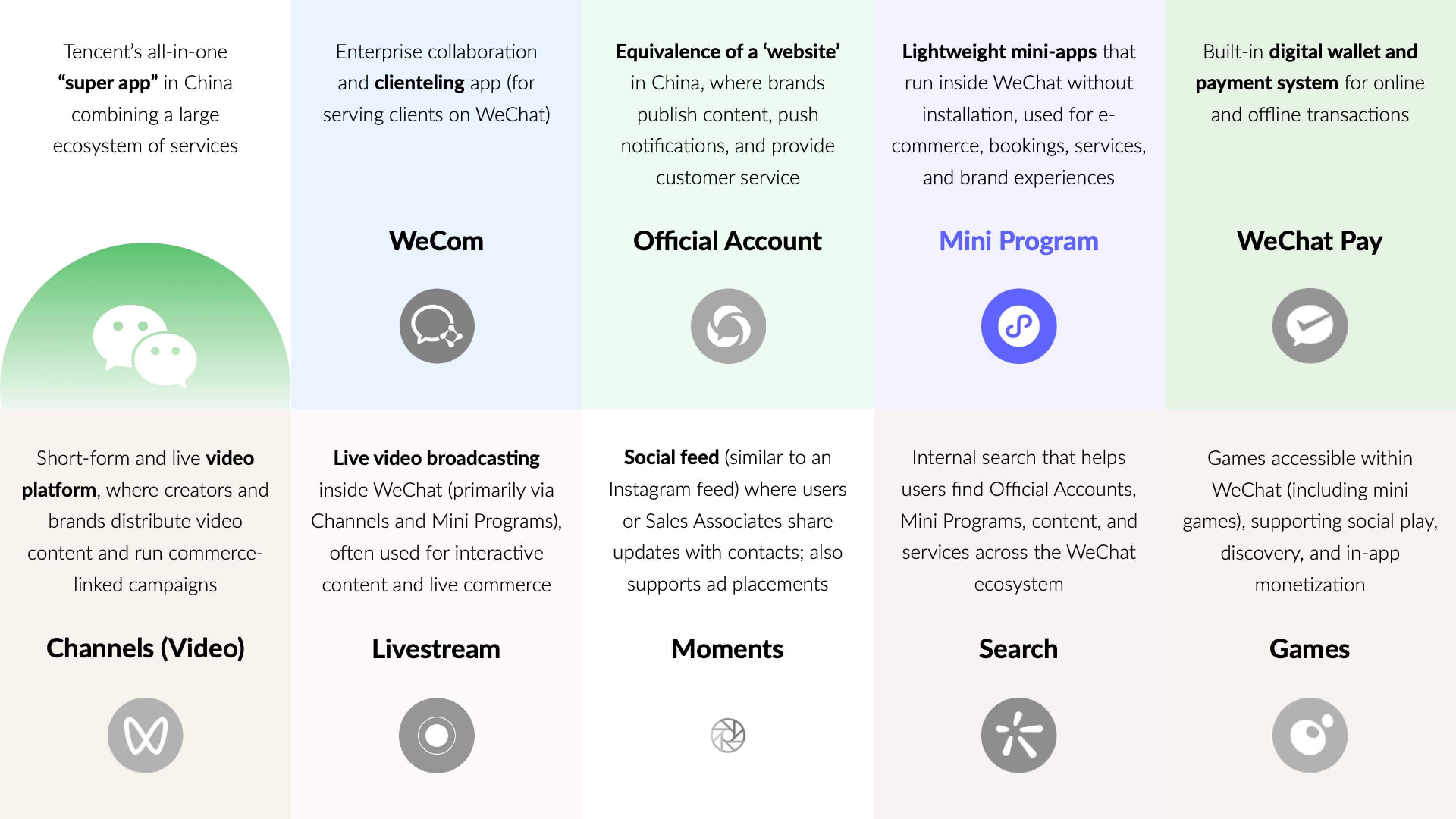
An important point that is easy to overlook is that Mini Programs are not only useful for individual users. Because they live inside WeChat, they also carry a built-in social layer that can help useful experiences spread more naturally.
That does not mean every brand needs one. It means brands should assess WeChat Mini Programs as a China-market business tool, not as a default digital checkbox.
When a WeChat Mini Program is the Right Investment
A WeChat Mini Program is usually the right investment when a brand has a clear use case that benefits from being lightweight, accessible, and connected to the WeChat ecosystem.
Common examples include:
- E-commerce
- Catalog showcase
- Membership and loyalty flows
- Customer service utilities
- Booking and reservation journeys
- Campaign activation (e.g., gamification, event, community…)
- Co-branded Mini Program game
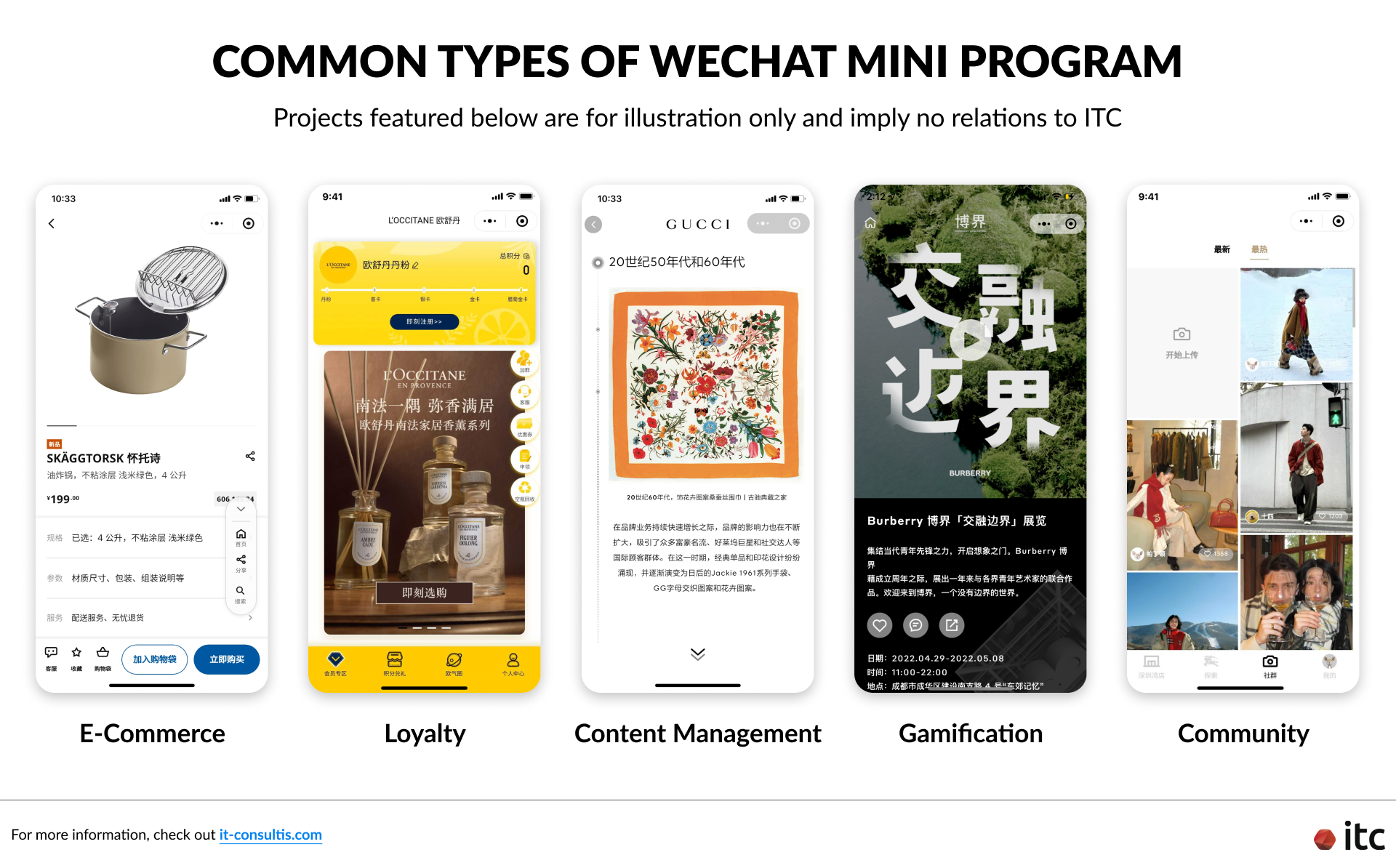
In some cases, the Mini Program can act as the smallest viable carrier for these services: a practical touchpoint where a brand validates whether a certain audience, offer, or engagement model works on WeChat before expanding further.
By contrast, a WeChat Mini Program is often the wrong starting point when the brand has not clarified the business scenario, the target audience, or the operational model behind it.
If the project starts with a vague goal like “we need a Mini Program because other brands have one,” the result is often an underused asset with an oversized scope.
A better question is: What exactly should this WeChat Mini Program help the business achieve in China? Once that answer is clear, the development path can be better mapped as well.
What Brands Should Prepare Before WeChat Mini Program Development Starts
Before kickstarting a WeChat Mini Program development project, brands should align several prerequisites early.
The more clearly these issues are addressed at the beginning, the easier it becomes to define the right scope, reduce avoidable delays, and preserve flexibility later in the project.
1. Clarify the Business Objective
The first step is to define what the Mini Program is actually meant to achieve. Is it intended to support commerce, lead capture, service, loyalty, booking, or a campaign-specific interaction?
Without that clarity, it becomes much harder to decide what should be included in the first release and what can wait.
2. Confirm the Account and Entity Setup Early
Brands should check early that the Mini Program they want to launch fits the entity that will register and operate it. If not, delays or scope changes may appear later.
This matters because WeChat Mini Programs can be registered under different types of entities, such as domestic or overseas ones, and those setups may not give access to the same service categories or functions.
In other words, what seems like an administrative detail can directly affect what the Mini Program can offer, how it can be launched, and what the brand needs to prepare in advance.
3. Address Compliance and Filing Requirements Early
China-specific compliance questions should be surfaced much earlier than many brands expect.
Depending on the project, this can include personal information obligations, privacy policy readiness, and registration or filing requirements related to launching and maintaining a Mini Program in China.
If these issues are left until late in the process, they can create unnecessary risk for launch timing, internal coordination, and long-term operations.
4. Prepare for Audience, Journey, and Operational Decisions
Brands should also define the core audience, the main user journey, and the operating model behind the Mini Program earlier than they often expect. That includes questions such as:
- Who is the priority audience?
- What is the primary user journey?
- Which systems need to connect from day one?
- Who will maintain and update the WeChat Mini Program after launch?
These are not purely technical questions. They shape the commercial and operational viability of the project.
5. Align the Internal Stakeholders Who Will Support Launch and Maintenance
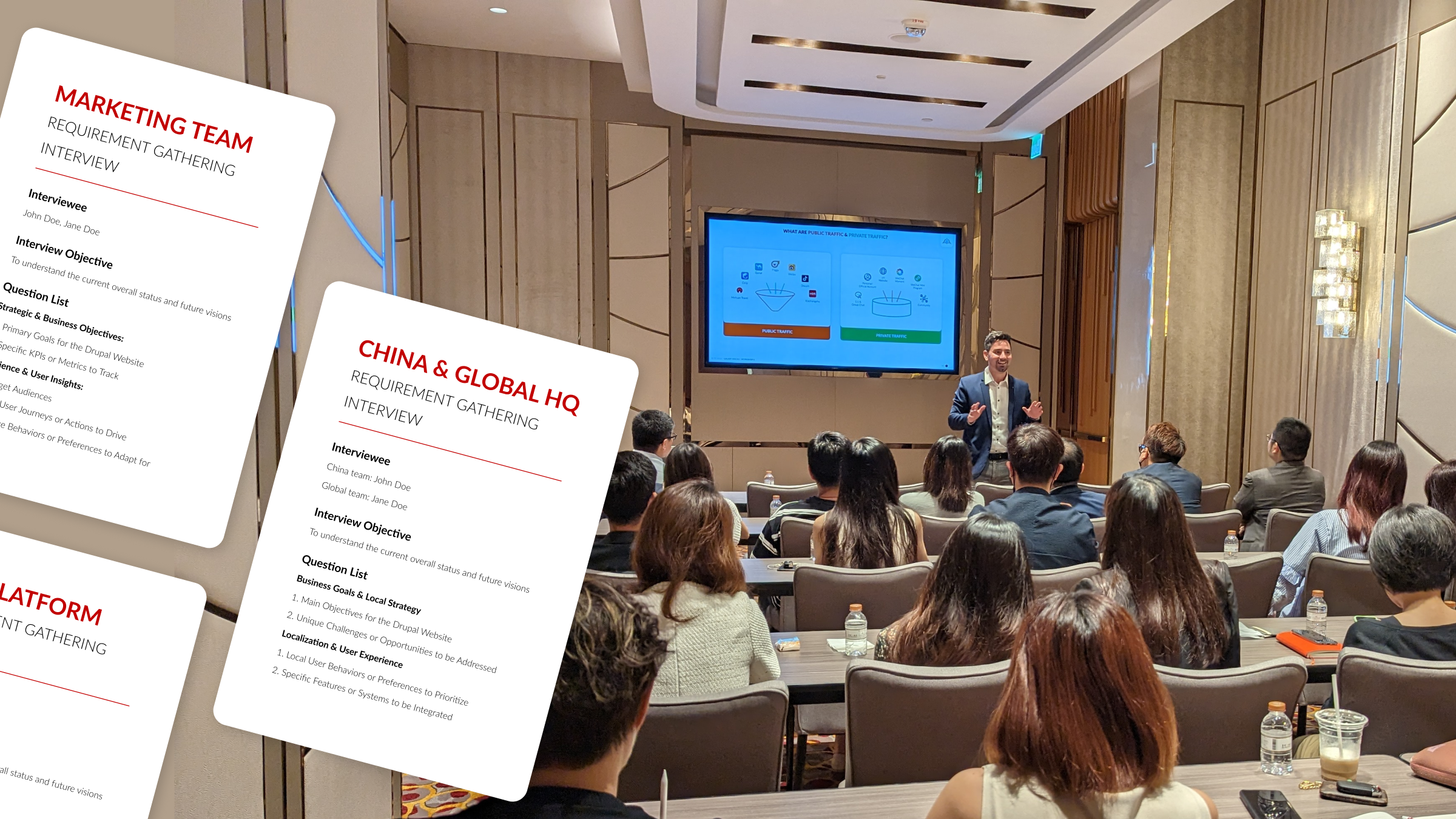
A WeChat Mini Program may look lightweight from the outside, but it still depends on the right internal teams being aligned. IT, marketing, legal, compliance, and customer service teams may all need to support the project in different ways before and after launch.
If that alignment is weak, even a well-designed Mini Program can face avoidable friction during review, launch, iteration, and maintenance.
For international brands, especially, the earlier these China-specific requirements and operational realities are surfaced, the more strategic freedom the team preserves later.
How to Develop a WeChat Mini Program: Three Key Ways
Brands usually have three main options when developing a WeChat Mini Program: self-development, templated or SaaS-based development, and custom development.
Each route comes with different trade-offs in speed, flexibility, localization quality, and long-term scalability.
Option 1: Self-Development
For brands asking how to develop a WeChat Mini Program internally, self-development means building and managing the Mini Program largely with an in-house team. Check out the Weixin Mini Program Development Guide for more information.
This usually involves:
- Setting up the right entity structure
- Choosing whether the Mini Program will sit under a domestic or overseas entity
- Creating the official developer account
- Designing and building the Mini Program
- Going through the relevant review and compliance steps
- Submitting and publishing it
- Maintaining it over time
This is best suited for:
- Brands with a strong in-house product and engineering team
- Organizations that want direct ownership of the roadmap and delivery process
- Businesses with the internal resources to manage compliance, release, and maintenance internally
Pros:
- Full internal control
- Greater ownership over roadmap and delivery priorities
- Potentially useful for teams with mature China digital capabilities already in place
Cons:
- Higher internal coordination burden
- More responsibility for compliance, platform updates, and maintenance
- Harder for teams without strong China-market or WeChat-specific experience
- Can become slow or inefficient if the business underestimates operational complexity
Option 2: Templated or SaaS-based Development
In a templated or SaaS-based model, brands use an existing Mini Program platform or provider instead of building everything from scratch.
Common examples in the Chinese market include providers such as Youzan, Weimob, and Weidian, which offer packaged capabilities for store setup, marketing features, and operational templates.
This is best suited for:
- Brands that need to move quickly
- Businesses with relatively standard requirements, especially in retail, e-commerce, and other repeatable vertical use cases
- Teams that want a faster, more structured route to launch
Pros:
- Faster time to market
- Lower upfront complexity
- Useful for standardized use cases
- Can reduce the initial build burden for internal teams
Cons:
- Less flexibility in UX, brand expression, and feature design
- More limited control over integrations and long-term extensibility
- May not be ideal for premium brands or companies with complex business requirements
- Standardization can become a constraint as the Mini Program evolves
- Potential legal and compliance risks, depending on how the solution is structured and managed
- Less visibility into data handling and isolation, which can create concerns around control over sensitive user or sales data
Option 3: Custom Development with a Strategic Partner
Brands can also work with a specialist partner like IT Consultis to develop a WeChat Mini Program around their specific business goals, user journeys, technical environment, and China-market needs.
This can include China-market and go-to-market guidance, localization and ecosystem understanding, UX and UI research and design, front-end and back-end development, integration with existing business systems, and post-launch support, iteration, and maintenance.
This approach usually gives brands more flexibility to shape the Mini Program around their own operating model rather than adapting the business to fit the limitations of a template.
This is best suited for:
- Enterprise and premium brands
- Companies with more complex business goals than a standard template can support
- Brands that need stronger localization for the Chinese market
- Projects that require more tailored UX and UI
- Businesses that need deeper integration with existing systems
- Brands looking for a Mini Program that can evolve with their wider China digital ecosystem over time
Pros:
- Stronger alignment with brand and business goals
- Better flexibility for integrations and future scaling
- More tailored user experience
- Better suited to complex or high-value use cases
- Stronger long-term strategic fit for brands investing seriously in China
- Greater control over data and deployment setup based on the client’s requirements
Cons:
- Higher upfront investment than template-based options
- Requires clearer planning and stronger delivery coordination
Why Many Brands Approach Custom WeChat Mini Program Development in Phases
For many brands, the strongest custom-development model is a phased one rather than trying to launch everything at once.
That usually means starting with a realistic minimum viable product (MVP): a first version that is focused enough to move quickly, but strong enough to validate whether the Mini Program is commercially viable.
Instead of treating the Mini Program like a full app from day one, the brand launches the core journey first, learns from real usage, and then expands based on user behavior, operational learning, and evolving business priorities.
A practical first phase usually focuses on three things:
- Making the core user journey work clearly and smoothly.
- Creating enough value that target users will actually use the Mini Program.
- Capturing enough learning to decide what should be iterated next.
This approach helps brands avoid one of the most common scoping mistakes: overbuilding too much too early. It keeps the flexibility and strategic fit of custom development, while making the first release more realistic and easier to validate.
What to Look for in a WeChat Mini Program Development Partner
A good development partner should not only know how to build a Mini Program. They should help the brand make better decisions across the full lifecycle of the project.
Three practical indicators are especially important:
- The partner should understand the Chinese market well enough to advise beyond generic development language, including platform realities, business expectations, and the operational implications of local requirements.
- The partner should have real long-term maintenance experience across multiple Mini Programs. Launch is only one part of the job. Ongoing updates, compatibility changes, and operational continuity matter too.
- The partner should have its own analysis and perspective on mainstream Mini Program patterns, trade-offs, and priorities, rather than acting only as a delivery vendor.
The strongest partners help brands think through what belongs in phase one, what can wait, what should integrate now, and what business trade-offs matter most.
That is often the difference between a Mini Program that launches and a Mini Program that actually supports business growth.
Why WeChat Mini Program Maintenance and Release Readiness Matter After Launch
Many articles about WeChat Mini Program development stop at launch. In practice, that is where an important second phase begins.
WeChat Mini Programs need stable maintenance because the platform evolves regularly and may introduce feature updates, policy changes, and new compliance expectations, including around privacy and personal information handling.
If a Mini Program is not updated in time, the consequences may go beyond inconvenience. It can create compliance risk, weaken the user experience, or lead to platform-related issues.
This is why long-term ownership matters. A Mini Program is not a one-time build. It is an operating asset.
Release management also deserves more attention. Because Mini Program release cycles can be faster than app release cycles, a stable release process becomes even more important. If releases are handled too manually, brands increase the risk of avoidable deployment errors.
A more structured release approach creates business value in several ways:
- It reduces release-related risk and human error.
- It makes testing across environments easier for internal maintenance teams.
- It helps avoid operational dependency on only one or two people who know how to release changes.
- It improves resilience when urgent fixes or updates are needed.
IT Consultis has developed a structured deployment framework for WeChat Mini Programs that replaces fully manual releases with a clearer workflow across defined environments such as testing, staging, and production.
At a high level, updates move through separate environments for validation before release, making it easier for brand teams to check changes before anything goes live.
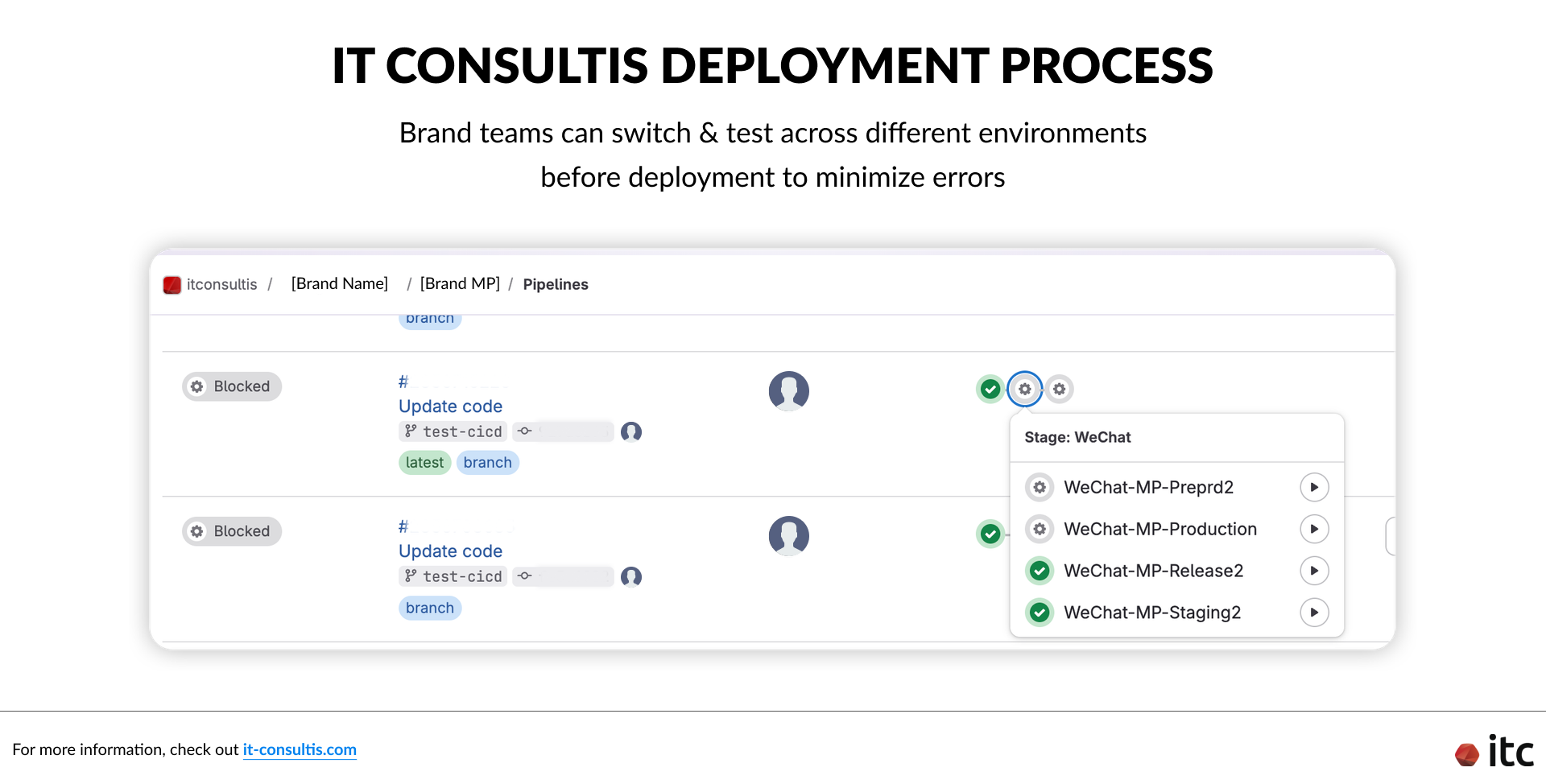
This point is especially relevant for brands that expect the Mini Program to evolve over time. The more the Mini Program matters to real operations, the more release discipline and maintenance readiness matter too.
Conclusion
A strong WeChat Mini Program is not defined by how many features it launches with.
It is defined by how well it fits a real China-market use case, how clearly the first release is scoped, how early compliance and entity questions are addressed, and how seriously the brand treats post-launch operations.
For many brands, the smartest development strategy is not to build the biggest Mini Program possible. It is to build the right first version, validate quickly, and support it with the maintenance, release discipline, and ecosystem understanding needed for long-term relevance.
That is also why WeChat Mini Program development in China should be treated as a strategic business decision, not just a production task.
IT Consultis (ITC) is a digital transformation consultancy with an award-winning Design Studio and in-house end-to-end WeChat Mini Program development capabilities, helping brands build powerful digital experiences for growth in China.