
For companies building customer relationships in China, WeCom is not just another communication tool. It sits inside the WeChat ecosystem, where sales follow-up, customer service, advisor-led engagement, and day-to-day relationship management already happen.
That is why the key question is not simply whether WeCom is capable. The real question is whether it fits the way your business builds relationships, manages ownership, and turns engagement into commercial results in China.
In this article, we compare how WeCom supports B2B lead management and B2C clienteling in China, and what operating model, data requirements, and integration priorities should shape your strategy.
Executive Summary:
1. B2B WeCom creates the most value when companies need better lead nurturing, clearer ownership, smoother handoff, and stronger visibility across a longer customer journey.
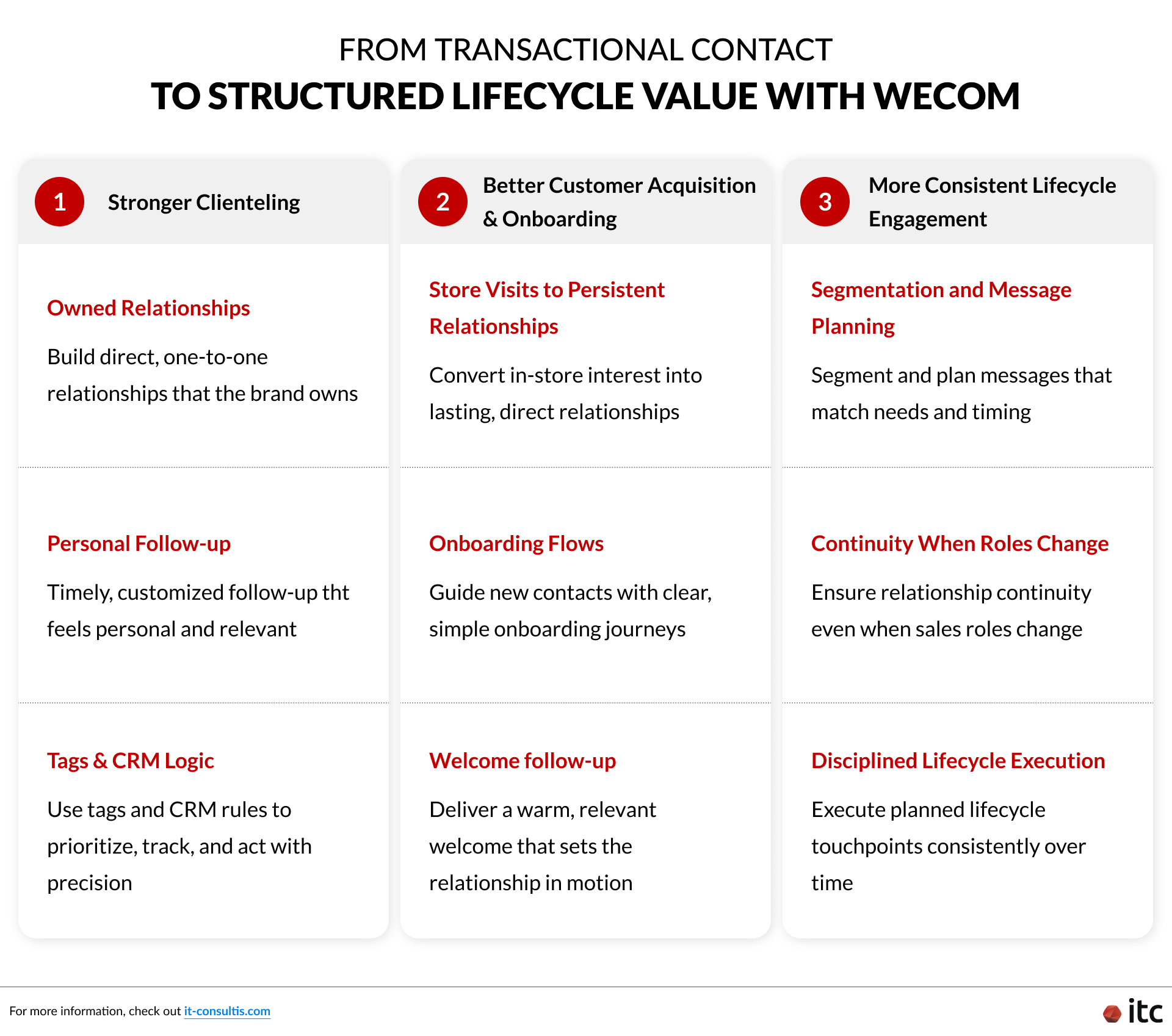
2. B2C WeCom creates the most value when brands need stronger clienteling, better customer acquisition and onboarding, and more consistent lifecycle engagement.
3. In China, WeCom matters because it helps businesses manage customer relationships inside the local digital ecosystem rather than through disconnected tools and employee-owned contact books.
4. The most useful decision lens is not the feature list alone. It is the relationship model, operating rhythm, and management control that the business needs.
5. The strongest WeCom programs succeed because the platform is tied to a clear commercial bottleneck, not deployed as a generic messaging layer.
Table of contents
Why WeCom Matters Differently in China
Most companies do not evaluate WeCom because they need another inbox.
They evaluate it because something in the customer journey feels fragmented, employee-dependent, or difficult to control at scale.
In China, that problem matters more because customer engagement, service, and commercial follow-up already sit close to the WeChat ecosystem.
WeCom gives businesses a more structured enterprise layer inside this environment.
That matters when a company needs to:
- Keep customer relationships tied to the company rather than to one employee
- Preserve continuity when staff change roles or leave
- Classify contacts with usable tags and segments
- Improve routing between marketing, sales, service, and store teams
- Connect relationship activity with CRM, reporting, or campaign workflows
This is why WeCom is strategically useful in China. The platform helps businesses move from informal customer contact to a more manageable relationship operating model.
For more information, check out our deep-dive into the 7 key benefits of WeCom.
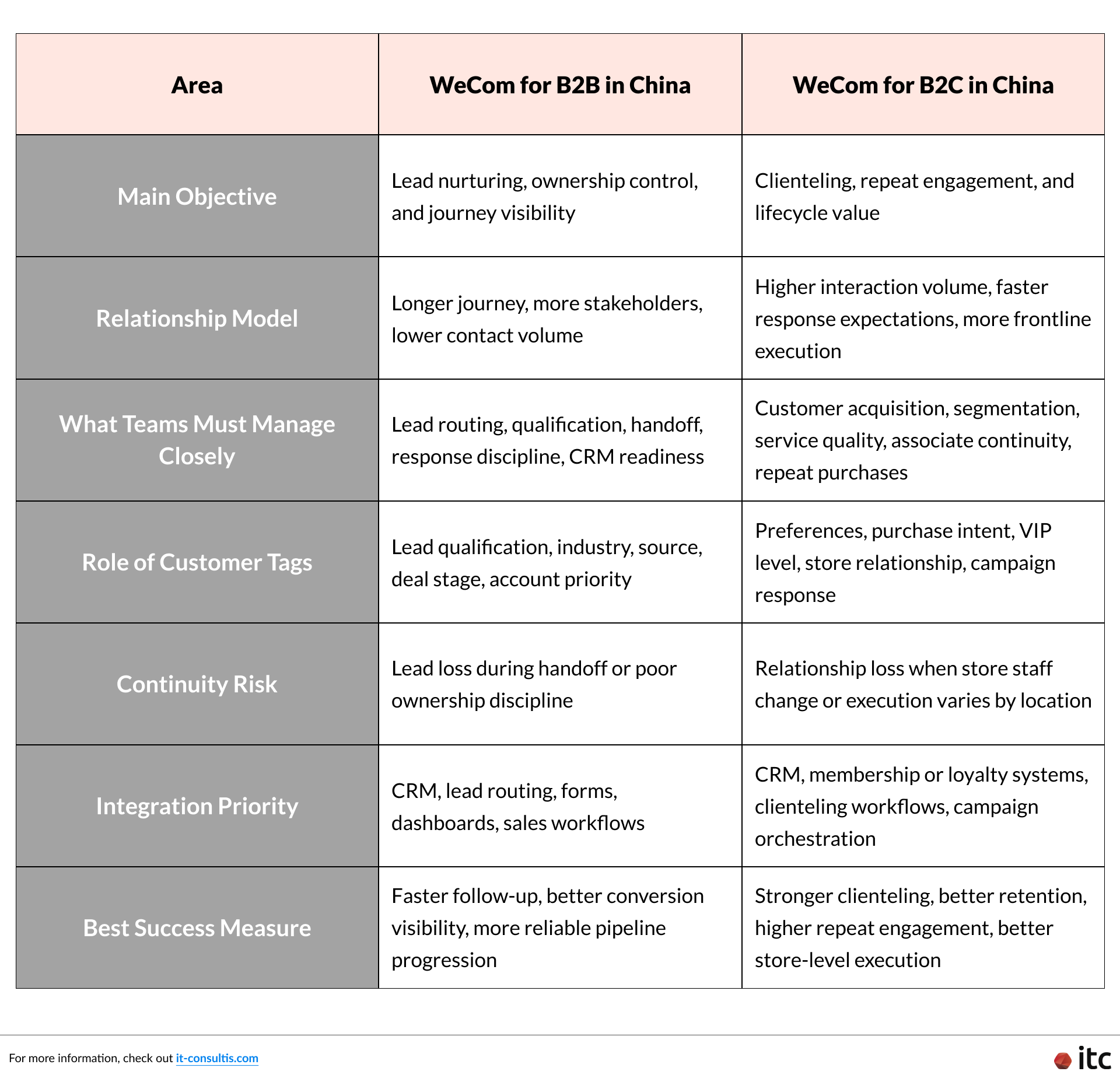
WeCom for B2B vs B2C in China at a Glance
Where WeCom Tends to Create Value in B2B
For many B2B companies, WeCom for B2B becomes most valuable when it helps teams manage a longer, more complex customer journey with more consistency inside China.
1. Lead Nurturing Over Time
B2B interest rarely converts in one step. Prospects may first engage through content, events, campaigns, referrals, partners, or inbound inquiry, then move through a longer period of evaluation.
In that kind of environment, WeCom helps keep follow-up active, visible, and better organized inside the channel where conversations are actually happening.
It also supports a more differentiated nurturing approach. Instead of treating every contact the same way, teams can tailor follow-up according to interest level, stage, sector, or potential value.
The commercial benefit is straightforward: better continuity through a long consideration cycle.
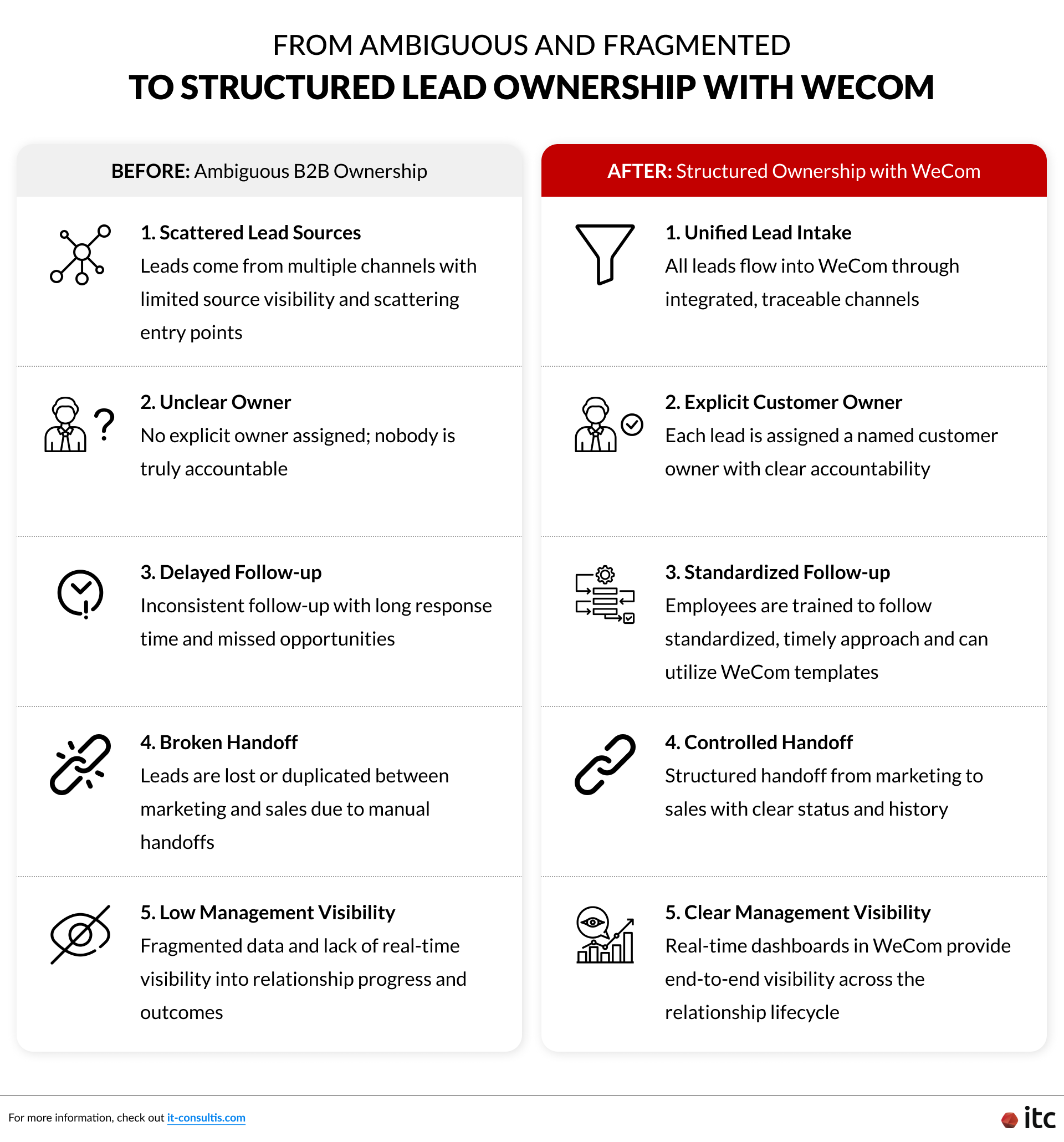
2. Clearer Ownership and Smoother Handoff
As leads qualify, they may move between teams, regions, industries, or account tiers. When that transition is unclear, businesses lose context, momentum, and accountability.
This is why B2B teams care about:
- Clearer account ownership
- More reliable handoff between stages
- Better follow-up records
- Stronger coordination between marketing and sales
In China, this matters even more when relationships are managed through employees inside the WeChat ecosystem.
WeCom helps businesses make ownership explicit at the enterprise level rather than leaving it informal or person-dependent.
3. Better Visibility into the Lead Journey
B2B organizations need more than direct communication. They also need a clearer view of how leads move through the journey and where follow-up is progressing or stalling.
That is where forms, tagging, routing logic, and dashboards become commercially useful.
They help teams capture business-critical information, classify contacts more clearly, direct leads to the right owner, and connect relationship activity with CRM or reporting environments.
The value is not the message volume. The value is better management control over the lead journey.
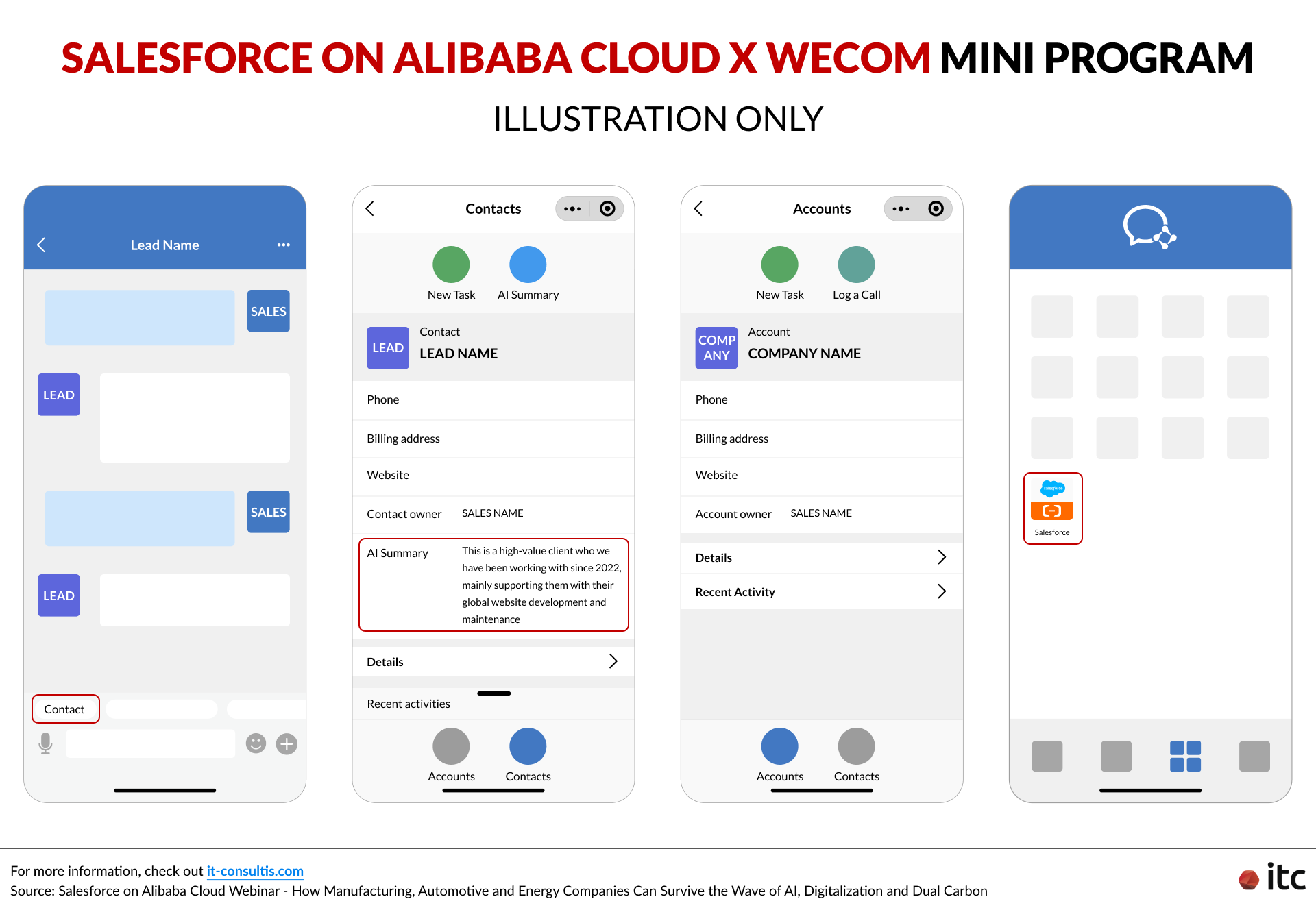
Here’s an example of connecting WeCom with Salesforce on Alibaba Cloud — a localized CRM system for China — for seamless data syncing.
Where WeCom Tends to Create Value in B2C
For B2C brands, the need is usually less about formal pipeline management and more about improving customer engagement, service quality, and lifecycle value at scale.
1. Stronger Clienteling
This is where WeCom clienteling becomes especially valuable.
Rather than limiting the relationship to one store visit, one campaign interaction, or one transaction, brands can use WeCom to support more personal and ongoing communication inside the customer’s everyday digital environment.
That matters most in sectors where relationship quality directly influences revenue, such as luxury, beauty, fashion, hospitality, wellness, education, and membership-led services.
WeCom helps brands:
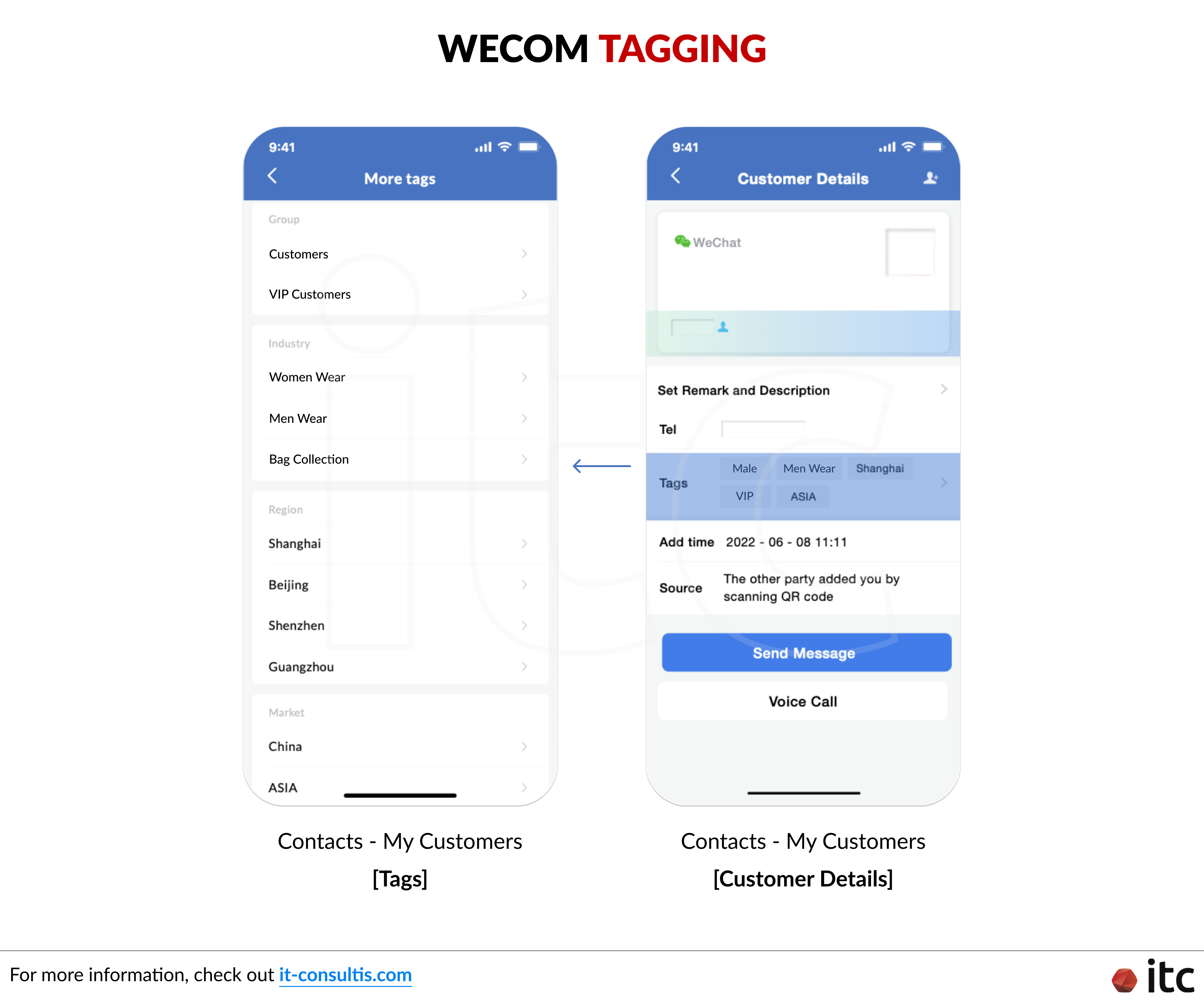
- Move customers from anonymous traffic or one-time visits into owned relationships
- Support more personal one-to-one follow-up
- Organize customers with usable tags and profile logic
- Connect service interactions with broader CRM and campaign workflows
For more information on how to elevate clienteling in China, especially in the luxury sector, check out ITC Insights Vol.1 white paper.
2. Better Customer Acquisition and Onboarding
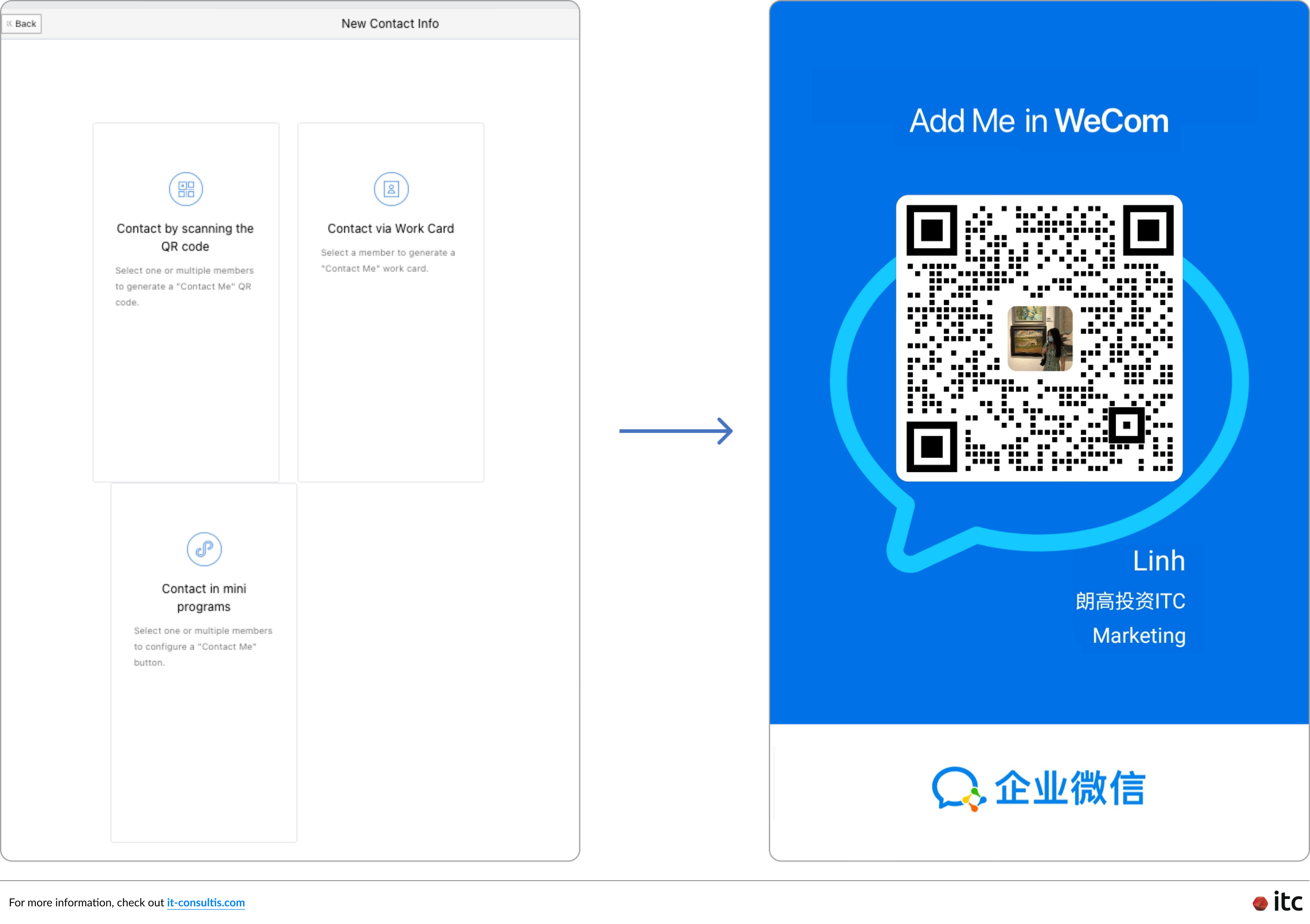
For many B2C brands, one of the biggest opportunities is turning store visits, campaign traffic, or social interest into persistent customer relationships.
WeCom can make that transition smoother through clearer onboarding flows, welcome messages, and more consistent post-acquisition follow-up.
In China, that matters because acquisition often happens quickly, but value depends on what the brand does after the first interaction. WeCom gives teams a better way to carry that relationship forward.
3. More Consistent Lifecycle Engagement
B2C teams care most about what happens after acquisition: whether customers stay engaged, come back, purchase again, or become more valuable over time.
WeCom supports that through segmentation, message planning, approved response logic, and stronger continuity when customer-facing roles change.
For frontline-heavy organizations, continuity is not a secondary feature. It is part of the commercial case.
When staff changes, the brand still needs to preserve customer history, reassignment logic, and service quality.
The value is not just better personalization. It is a more disciplined lifecycle execution.

A More Useful Executive Lens for Internal Operations
When companies compare B2B and B2C needs, the more useful operational distinction is often not product category alone. It is the difference between office-led organizations and frontline-heavy organizations.
- Office-led organizations usually care more about approval paths, structured ownership, routing discipline, and centralized management visibility.
- Frontline-heavy organizations usually care more about staffing continuity, speed of execution, location-level control, and protecting customer relationships when roles change.
This lens matters because it reflects how the business actually runs. A WeCom program that works in a centralized B2B environment can fail in a store-led B2C network if continuity, governance, and local execution are weak.
Senior decision-makers should therefore assess five questions before WeCom implementation:
- How complex is the customer journey?
- Who should own the relationship?
- How heavy is the frontline execution load?
- What data needs to be captured and used?
- How important is CRM or marketing integration?
What Strong Outcomes Can Look Like from the Right WeCom Set-up
When WeCom is aligned with the right use case, the impact is tangible because it fixes a defined operating problem.
B2B Example
For one B2B company, WeCom supported the front end of inquiry handling and lead management.
Chatbot triage kept the first response active outside standard hours, tagging helped classify inquiries by intent, and routing pushed qualified contacts to the right owner faster.
That increased early inquiry handling capacity by 94% and gave management better visibility into response quality and progression.
B2C Examples
Across WeCom case studies for luxury retail brands such as LEMAIRE, OTB Group, and Galeries Lafayette China, WeCom created value when it was used as a structured clienteling operating layer, not just a messaging channel.
- Customer recruitment was tied to clear store-level workflows
- Sales advisors owned the persistent one-to-one follow-up
- Tagging and segmentation made outreach more relevant
- Standard operating procedures (SOPs) helped maintain execution quality across teams and locations
At LEMAIRE, that model helped drive 30% of total sales and retain 95% of newly recruited customers.
In OTB Group, it supported rollout across more than 100 stores with strong response rates and more controlled remote-selling operations.
The broader takeaway is simple: WeCom performs best when its workflows, ownership rules, and integrations are tied to a specific commercial objective.
Conclusion
The value of WeCom for B2B vs B2C in China does not come from treating the platform as a one-size-fits-all solution. It comes from understanding what kind of relationship engine the business needs WeCom to support.
For some organizations, that means better lead nurturing, cleaner handoff, and stronger visibility across a long decision cycle. For others, it means stronger customer acquisition, better clienteling, and more durable lifecycle value.
In both cases, WeCom delivers the most value when its role is clearly defined from the start.
IT Consultis (ITC) helps companies define the ownership logic, workflow design, and integration priorities that make WeCom commercially useful in China.



![[Website] WECOM 5.0 cover image draft 2](/_next/image/?url=https%3A%2F%2Fit-consultis.com%2Fapp%2Fuploads%2F2025%2F12%2FWebsite-WECOM-5.0-cover-image-draft-2-1024x576.png&w=3840&q=100 "[Website] WECOM 5.0 cover image draft 2")