
Choosing a WordPress development company is easy to underestimate.
Many businesses still treat it as a website procurement exercise: compare portfolios, review pricing, and choose the team that appears most capable. That approach is too narrow.
A WordPress site is shaped by architecture, content modeling, integrations, governance, hosting, workflow design, and post-launch ownership.
Poor decisions in those areas do not always break the launch. More often, they create slower publishing, plugin sprawl, editor confusion, weak lead-routing, and a site that becomes harder to manage every quarter after go-live.
In this article, we explain how to choose the right WordPress development company, what criteria matter most, what red flags to watch for, and what additional checks matter when the website also needs to perform effectively in China.
Executive Summary:
1. Choosing the right WordPress development company is a platform decision, not only a build decision.
2. The strongest partners do more than launch attractive sites. They create maintainable architectures, usable workflows, and a structure the business can govern over time.
3. Buyers should assess agencies on strategy, architecture, governance, integrations, stakeholder management, and support maturity — not only on design polish or price.
4. Weak WordPress delivery often shows up later through plugin sprawl, poor content-model design, weak editor governance, and expensive post-launch fixes.
5. If the site also needs to work in China, buyers should add a China-readiness layer covering hosting, ICP and domain responsibilities, lead capture and CRM flow, localization governance, and in-market performance measurement.
Table of Contents
- Why Choosing a WordPress Development Company Matters
- What Makes WordPress Different From Other CMS Platforms?
- What to Define Internally Before You Compare WordPress Agencies
- Why Choosing a WordPress Development Company in China Requires a Different Approach
- What to Look for in a WordPress Development Company
- 1. Strategic Understanding of the Assignment
- 2. Strong WordPress Architecture
- 3. Mature Content-Model and Editor Design
- 4. Governance and Workflow Maturity
- 5. Integration and Ecosystem Readiness
- 6. Stakeholder Management Capability
- 7. Quality Assurance (QA) and Post-Launch Support
- 8. China Readiness When Relevant
- Red Flags to Watch For
- Questions to Ask Before You Choose a WordPress Development Partner
- Why IT Consultis (ITC) for Global and China WordPress Projects
- Conclusion
Why Choosing a WordPress Development Company Matters
A WordPress project should not be treated as a simple website build.
For most businesses, the website supports visibility, lead generation, campaigns, publishing, and future digital growth. That makes agency selection a strategic decision, not just a delivery decision.
The right partner helps the business make better decisions before development starts. The wrong one may still launch the site, but often leaves the business with more friction, weaker flexibility, and higher costs later.
What Makes WordPress Different From Other CMS Platforms?
WordPress remains attractive because it gives businesses broad control over content, UX, integrations, and future evolution without forcing a rigid platform model. That flexibility is a real advantage — but it is also where weak delivery becomes expensive.
In WordPress, poor implementation choices tend to compound over time. Too many plugins, inconsistent template logic, weak editor governance, and loosely controlled customizations can all increase maintenance overhead, slow future changes, and create avoidable extensibility risk.
That is the real commercial distinction. A strong partner turns WordPress into a governed, scalable digital platform. A weak one turns it into a site that looks fine at launch but becomes harder and more expensive to operate every quarter after go-live.
For buyers, the real question is not whether WordPress is flexible. It is whether the agency can turn that flexibility into a system that the business can scale and govern effectively.
What to Define Internally Before You Compare WordPress Agencies
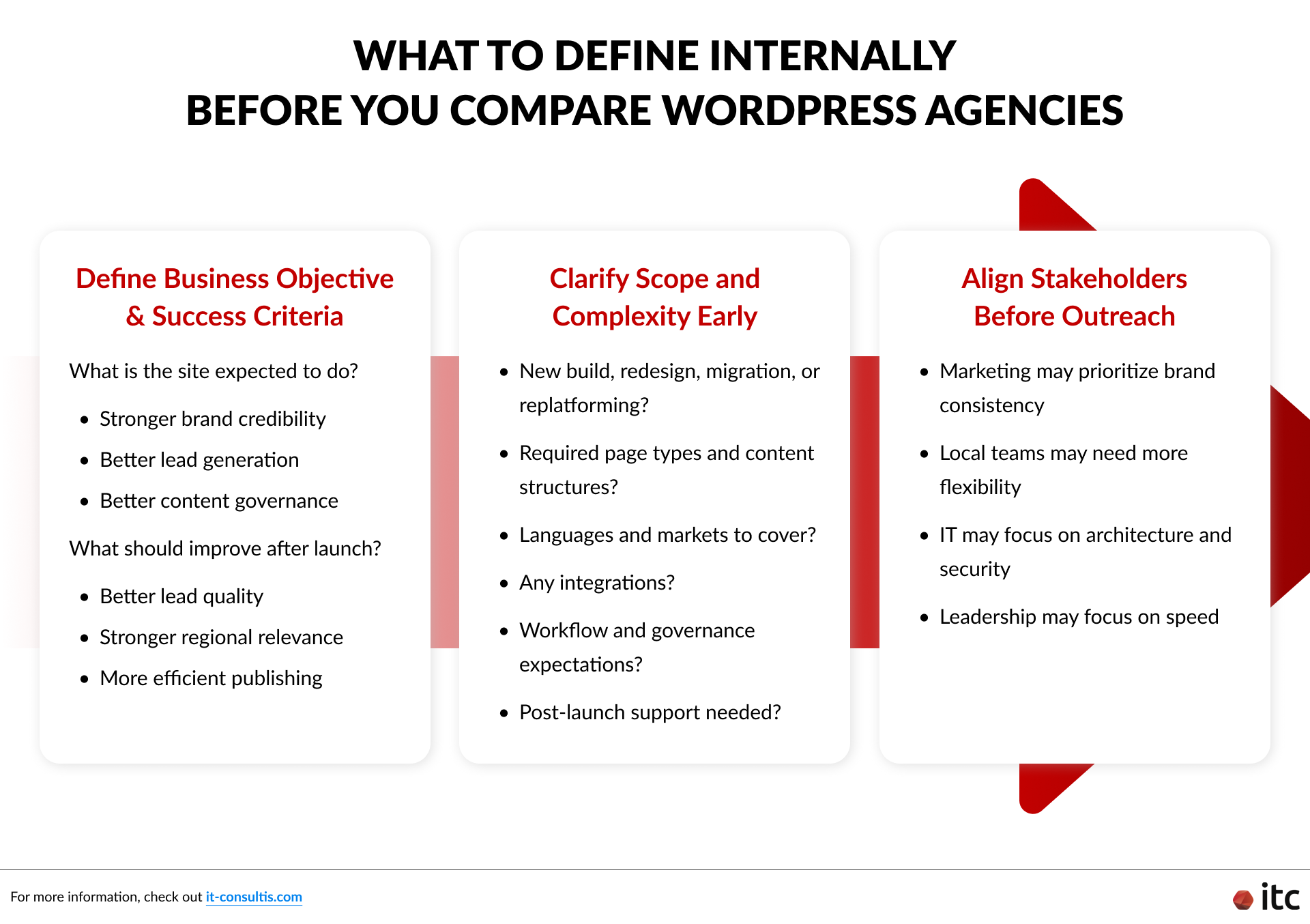
Weak agency selection often starts with weak internal clarity.
Define the Business Objective and Success Criteria
What is the site expected to do, and what should improve after launch?
The objective may be stronger brand credibility, better lead generation, improved campaign support, better content governance, or a more scalable digital foundation.
Success should also be defined in business terms: better lead quality, stronger regional relevance, more efficient publishing, improved governance, or a better platform for future growth.
If this is not clear internally, vendor comparison stays superficial.
Clarify Scope and Complexity Early
At minimum, define:
- Whether this is a new build, redesign, migration, or replatforming
- Required page types, templates, and content structures
- Languages, markets, and localization scope
- Integrations with CRM, analytics, forms, ERP, or other systems
- Editorial workflows, permissions, and governance expectations
- Post-launch support and internal ownership requirements
Align Stakeholders Before Outreach
Many website projects become difficult not because of the technology, but because of internal misalignment.
Marketing may prioritize brand consistency. Local teams may need more flexibility. IT may focus on architecture and security. Leadership may focus on speed.
If those tensions are not surfaced early, agency selection becomes noisier, and delivery becomes harder to control.
Why Choosing a WordPress Development Company in China Requires a Different Approach
If the website needs to operate effectively in China, the evaluation framework should become more specific.
A WordPress project in China should not be treated as a standard website rollout in another market.
The CMS may be global, but the operating environment is not. Infrastructure choices, local platform fit, stakeholder ownership, embedded tools, content operations, and measurement realities can all differ materially.
This is where many global teams make the wrong assumption. They choose a capable generalist WordPress agency, then try to bolt China requirements on at the end.
That often creates rework, performance issues, disconnected lead flows, or local workarounds that weaken governance.
Buyers should therefore test at least five China-specific checks:
1. Hosting Model and Delivery Architecture
- Where the site will be hosted
- How traffic from China will be handled
- What caching or CDN model is proposed
- How performance will be validated from within China rather than inferred from other markets
2. ICP and Domain Ownership Implications
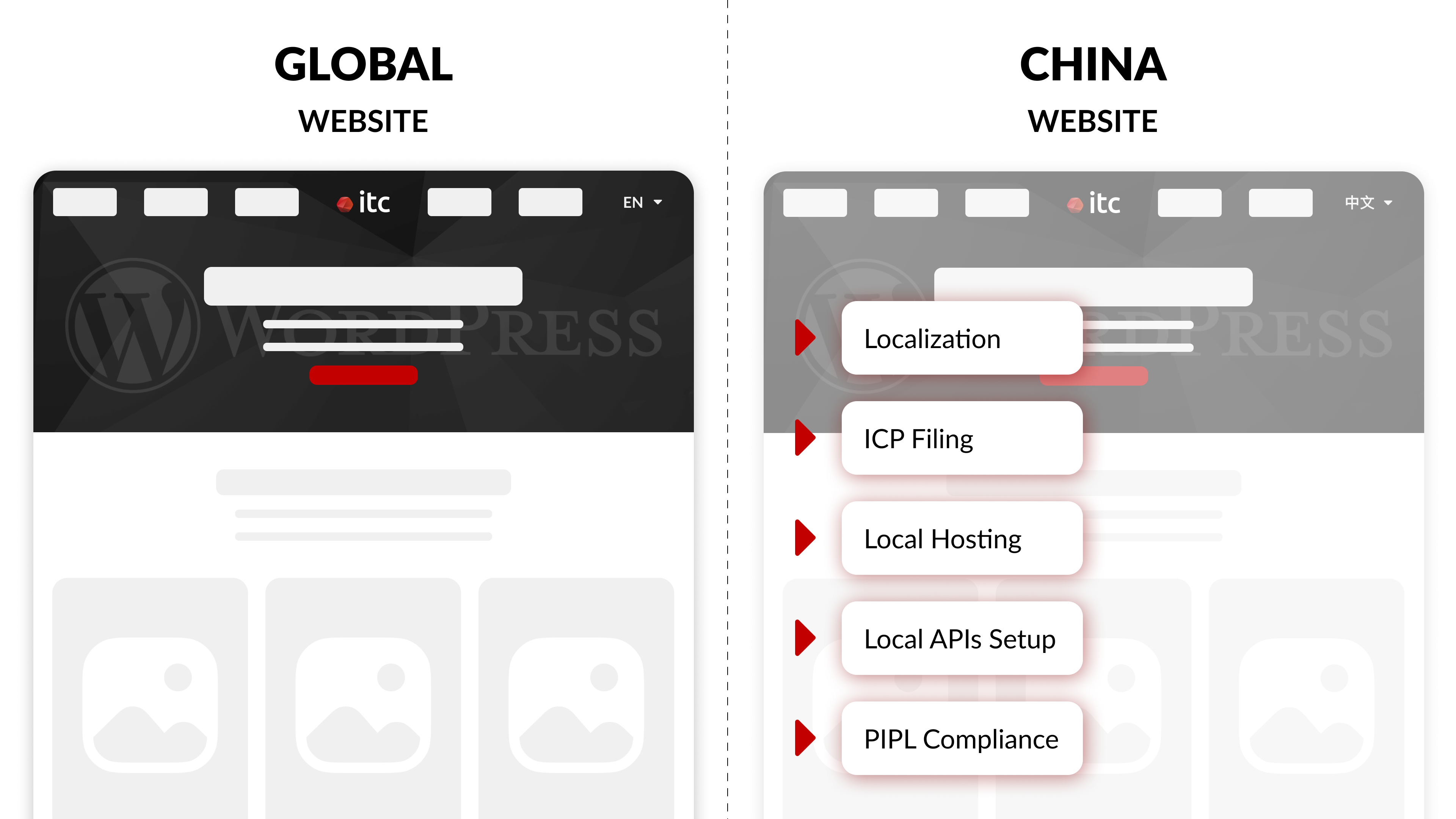
If a mainland-hosted or mainland-accelerated model is under consideration, clarify:
- Who owns the domain
- Who is responsible for the ICP (Internet Content Provider)-related steps
- How those decisions affect timelines, governance, and operational control
3. China-Compatible Lead Capture and CRM Flow
A contact form that technically works is not enough. Buyers should test how leads are captured, routed, stored, and followed up in practice — especially if the workflow needs to connect with local CRM, WeCom, sales follow-up, or China-based business teams.
In some China-market setups, the website also does not operate as a standalone conversion endpoint. It may need to hand users into WeChat Mini Program journeys, local campaign flows, service workflows, or other off-site engagement paths.
A strong partner should therefore understand how the site fits the actual China conversion path, not just whether the form technically submits.
Check out how to navigate setting up HubSpot forms for a Chinese-facing website.
4. Localization Governance
Many Chinese website problems are not translation problems. They are governance problems.
Clarify who owns localized content, how updates move from global to local teams, what can be adapted locally, and how template decisions will handle different China-market priorities.
Check out our guide to Chinese website localization for more information.
5. Performance, Measurement, and Ecosystem Reality
Ask how page speed, analytics, event tracking, conversion measurement, and downstream user journeys will be validated in China. Many teams still rely on global reporting logic that does not reflect actual in-market behavior, latency, tool fit, or how users move between the website and local platforms.
Where relevant, that validation should also test whether those journeys work reliably across local platforms and handoff points.
These are not edge considerations. They are core buying criteria when China is in scope.
What to Look for in a WordPress Development Company
This is where strong and weak partners separate quickly.
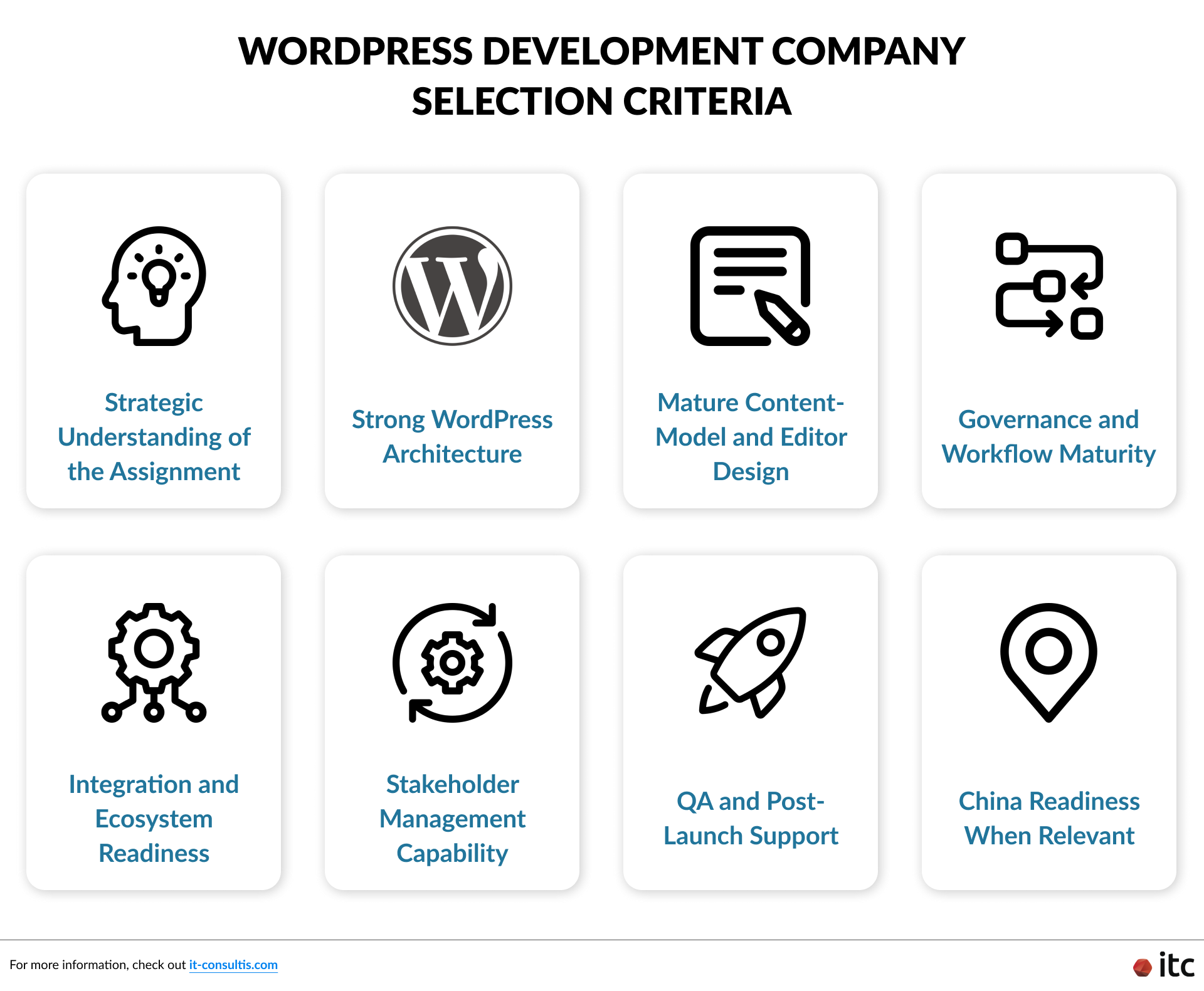
1. Strategic Understanding of the Assignment
A serious agency should understand the role the website plays in the business, not just the pages that need to be built.
It should ask intelligent questions about audiences, market goals, content operations, internal ownership, and future roadmap needs.
2. Strong WordPress Architecture
Look for partners that think in reusable components, scalable templates, flexible content structures, and maintainable implementation logic.
A polished launch means little if the setup becomes messy once the business starts using it seriously.
3. Mature Content-Model and Editor Design
This is one of the easiest areas to under-assess.
A strong partner should know how to create a content model that gives editors control without making every update dependent on developers. Poor content-model design is one of the most common reasons WordPress sites become frustrating after launch.
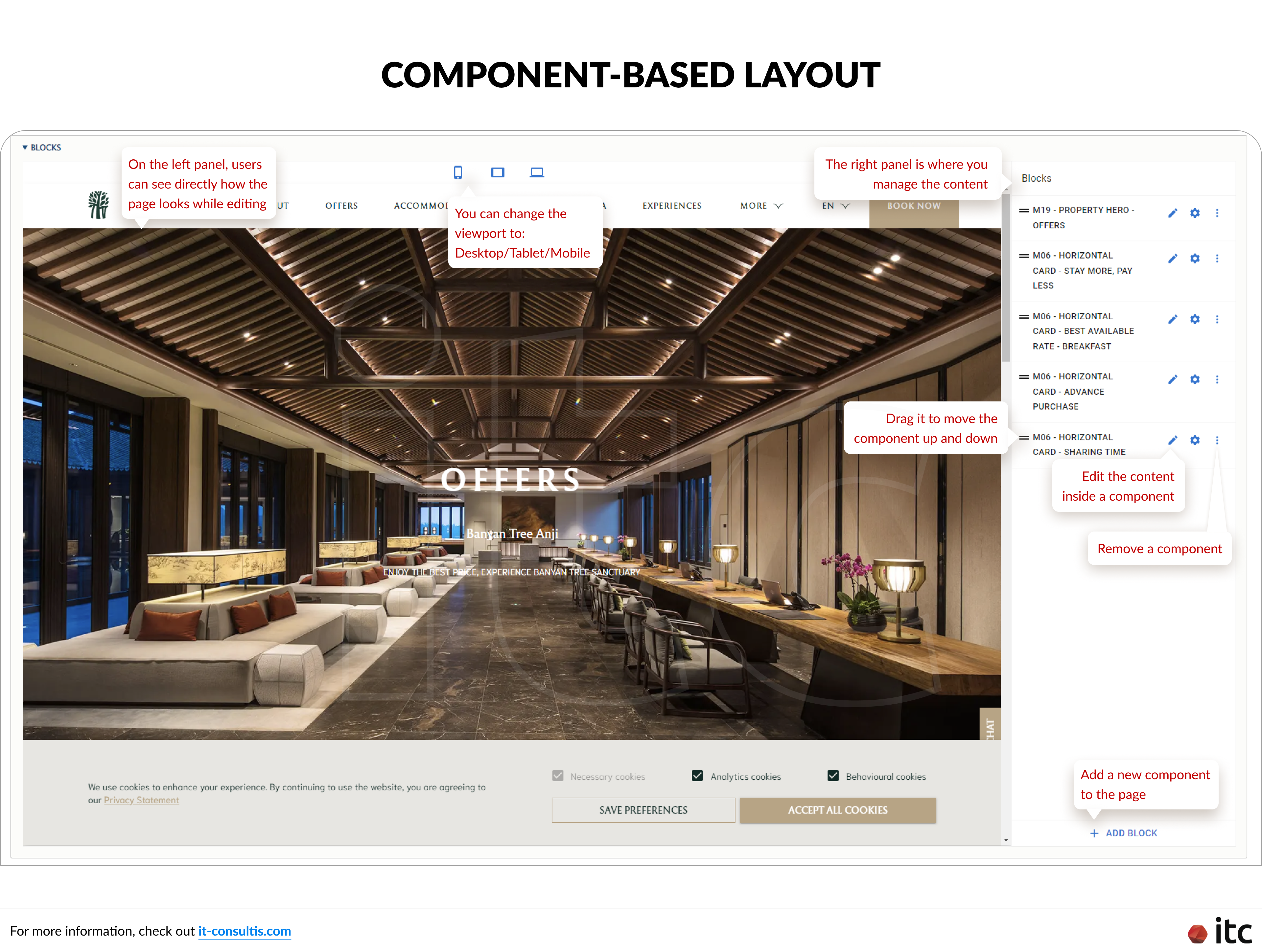
4. Governance and Workflow Maturity
A WordPress site only creates long-term value if the business can run it effectively.
That means the agency should think clearly about editorial permissions, approval flows, documentation, training, plugin discipline, and long-term ownership.
5. Integration and Ecosystem Readiness
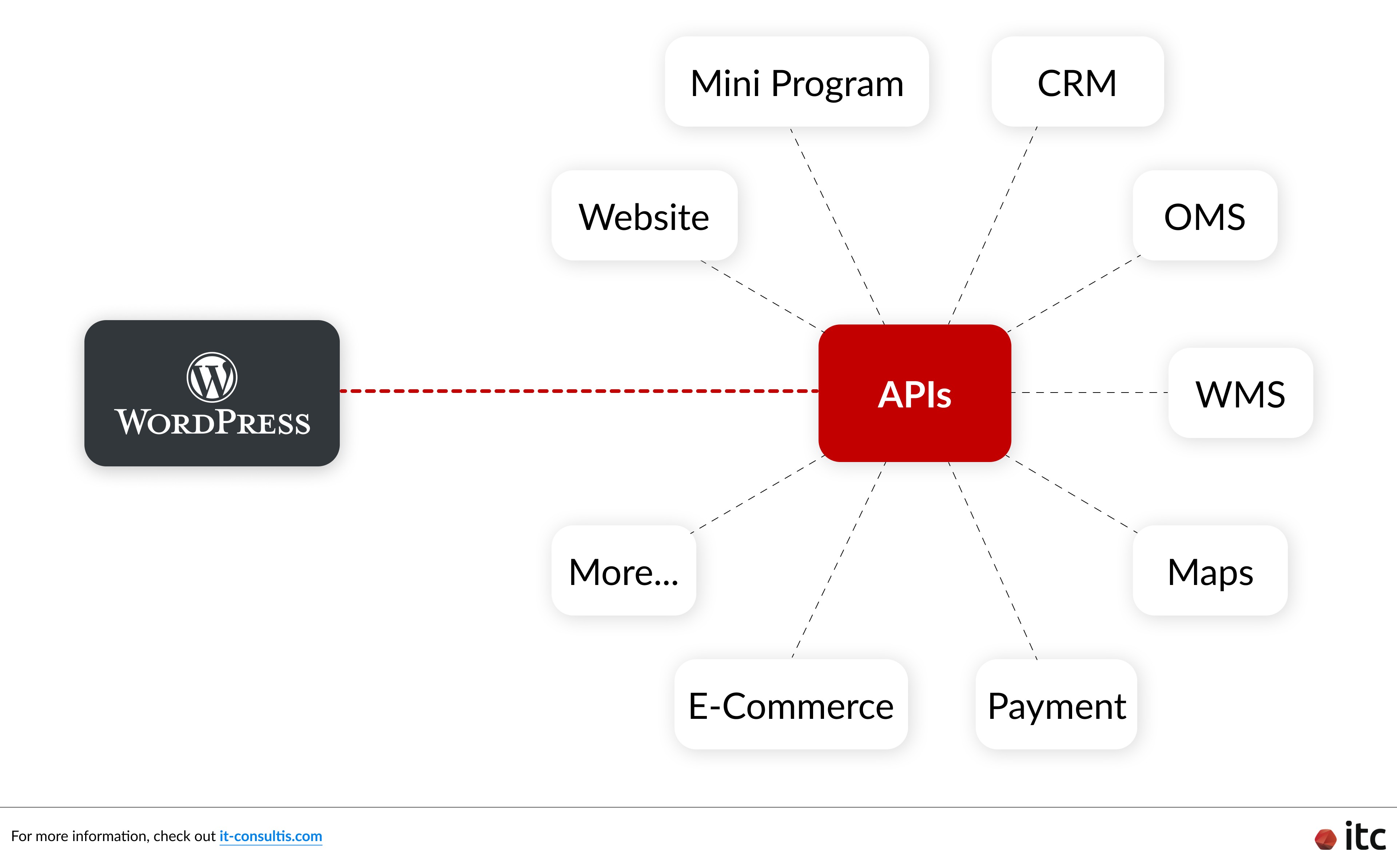
WordPress rarely operates in isolation. The site may need to connect with CRM, analytics, forms, marketing automation, ERP, customer-service tools, or broader lead-nurturing workflows.
A strong partner should understand how WordPress fits into that wider operating environment.
6. Stakeholder Management Capability
For many mid-sized and enterprise projects, stakeholder management is a real delivery capability.
The right partner should be able to work across marketing, IT, leadership, local teams, and external vendors without losing clarity or accountability.
7. Quality Assurance (QA) and Post-Launch Support
Go-live is not the finish line.
Ask how the agency handles QA, deployment discipline, bug resolution, security updates, handover, and ongoing support.
8. China Readiness When Relevant
If China is part of the scope, this should be tested explicitly.
A credible partner should understand local UX expectations, trust signals, infrastructure decisions, content operations, forms and lead-capture behavior, and the practical realities of aligning global and China-based teams.
Red Flags to Watch For
Be cautious if an agency:
- Relies too heavily on plugins as a substitute for architecture
- Cannot explain how it designs reusable templates and structured content models
- Is vague about editor permissions, approvals, or training
- Assumes global templates can be reused in China without meaningful adaptation
- Focuses heavily on visual polish but lightly on integrations and operating-model implications
- Has no concrete answer on how forms, CRM routing, or local follow-up workflows will work
- Treats China hosting, ICP implications, or in-market performance validation as afterthoughts
- Is unclear about QA, documentation, or post-launch support
These are not minor issues. They are usually early indicators of downstream friction.
Questions to Ask Before You Choose a WordPress Development Partner
- What WordPress projects similar to ours have you delivered?
- How do you approach WordPress architecture for long-term scalability and maintainability?
- How do you design content models so non-technical teams can manage the site effectively?
- How do you approach integrations with CRM, analytics, forms, or other business systems?
- How do you structure governance so the site remains usable and controlled after launch?
- Who will actually work on the project day-to-day?
- How do you manage scope change and stakeholder alignment during delivery?
- What does your QA, handover, and post-launch support model look like?
- If our site needs to work effectively in China, how do you approach hosting, ICP implications, lead capture, localization governance, and in-market performance validation?
- How would you design the platform so it remains scalable as our digital needs evolve?
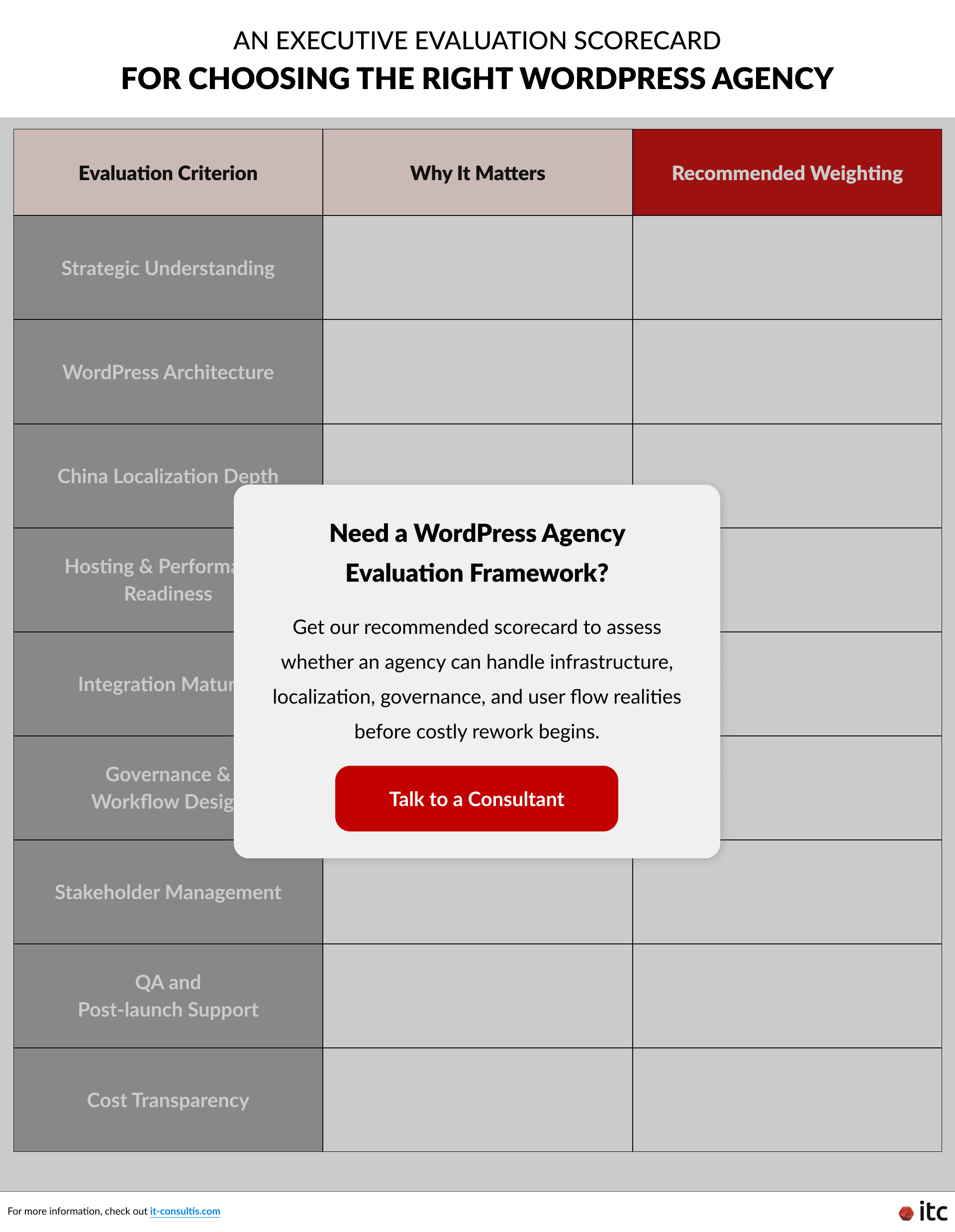
Too many businesses still choose agencies mainly on price, chemistry, or presentation polish. Those factors matter, but they are not a serious decision framework.
A better approach is to compare vendors using a weighted scorecard aligned to the realities of the project.
Why IT Consultis (ITC) for Global and China WordPress Projects
When a WordPress site needs to support both global standards and China-market performance, the delivery challenge is broader than web design and development alone.
The partner needs to understand architecture, content operations, localization governance, lead-capture flow, CRM alignment, and the practical realities of running digital platforms in China.
That is where ITC typically adds value. We help global and regional teams translate WordPress requirements into a platform model that is commercially usable, operationally governable, and better aligned with the brand’s global and Chinese digital ecosystem.
Conclusion
Choosing the right WordPress development company is ultimately a decision about risk, scalability, and long-term digital effectiveness.
The strongest partners do more than deliver websites. They help businesses make better decisions about structure, integrations, governance, stakeholder alignment, and future growth.
If China is part of the picture, they also understand how to adapt that platform to a different operating environment without turning it into a disconnected local exception.


