
For global brands using Magento or Adobe Commerce, the China question is not only whether the platform can run there, but which hosting architecture is localized enough to support website performance, Mini Program delivery, compliance, local integrations, and long-term operational control.
A setup that works well in Europe or the US often creates friction in mainland China. In this market, hosting decisions are shaped by network behavior, regulatory requirements, third-party dependencies, and local customer expectations in ways that many global teams underestimate.
In this article, we outline the main Magento hosting model in China, explain the trade-offs behind it, and show what global teams should evaluate before choosing an architecture for the China-facing experience.
Executive Summary:
1. Magento hosting in China requires a different approach because brands need to account for ICP, offshore performance constraints, local integrations, and China-specific infrastructure realities.
2. Offshore hosting often creates friction through slower load times, blocked or degraded third-party services, weaker analytics visibility, and lower confidence during key user journeys.
3. Adobe Commerce Cloud is not a default mainland China solution, so many brands need a more tailored self-managed or partner-managed architecture.
4. The key decision is not simply server location but how localized the overall China architecture needs to be to support the intended business model.
5. When fully localized, Magento becomes a high-performance, compliant, and commercially powerful engine for growth in China.
Table of contents
- Why Magento Hosting in China Is Different
- What Happens When Magento Is Hosted Outside Mainland China
- The Main Magento Hosting Model for China
- What Adobe Commerce And Magento Setups Still Need to Be Localized Beyond Hosting In China
- How To Evaluate The Right Magento / Adobe Commerce Hosting Architecture For China
- Conclusion
Why Magento Hosting in China Is Different
Hosting in China is different from hosting in most other markets because performance, compliance, content delivery, and local ecosystem requirements all shape the architecture decision more directly.
In most markets, Magento hosting decisions focus on uptime, scalability, and security. In mainland China, those priorities are still important, but they sit inside a very different operating environment.
Regulatory and Operational Readiness
If a brand wants to host an e-commerce website in mainland China, Internet Content Provider (ICP)-related compliance becomes part of the hosting decision rather than a separate launch checklist item.
For transactional use cases, brands may need to assess not only a basic ICP filing but also whether a commercial ICP license is required.
In practice, this often depends on having a Chinese legal entity or local partner and can take several months.
Network Performance and Delivery
Cross-border routing, differences in delivery conditions across major internet providers such as China Telecom, China Unicom, and China Mobile, and broader mainland delivery constraints mean a setup that performs well in Europe or the US may behave very differently for users in China.
In practice, offshore setups can be 4x or more slower for mainland users. Even global Content Delivery Networks (CDNs) may still underperform for China-facing delivery if they do not offer strong mainland Points of Presence (PoPs).
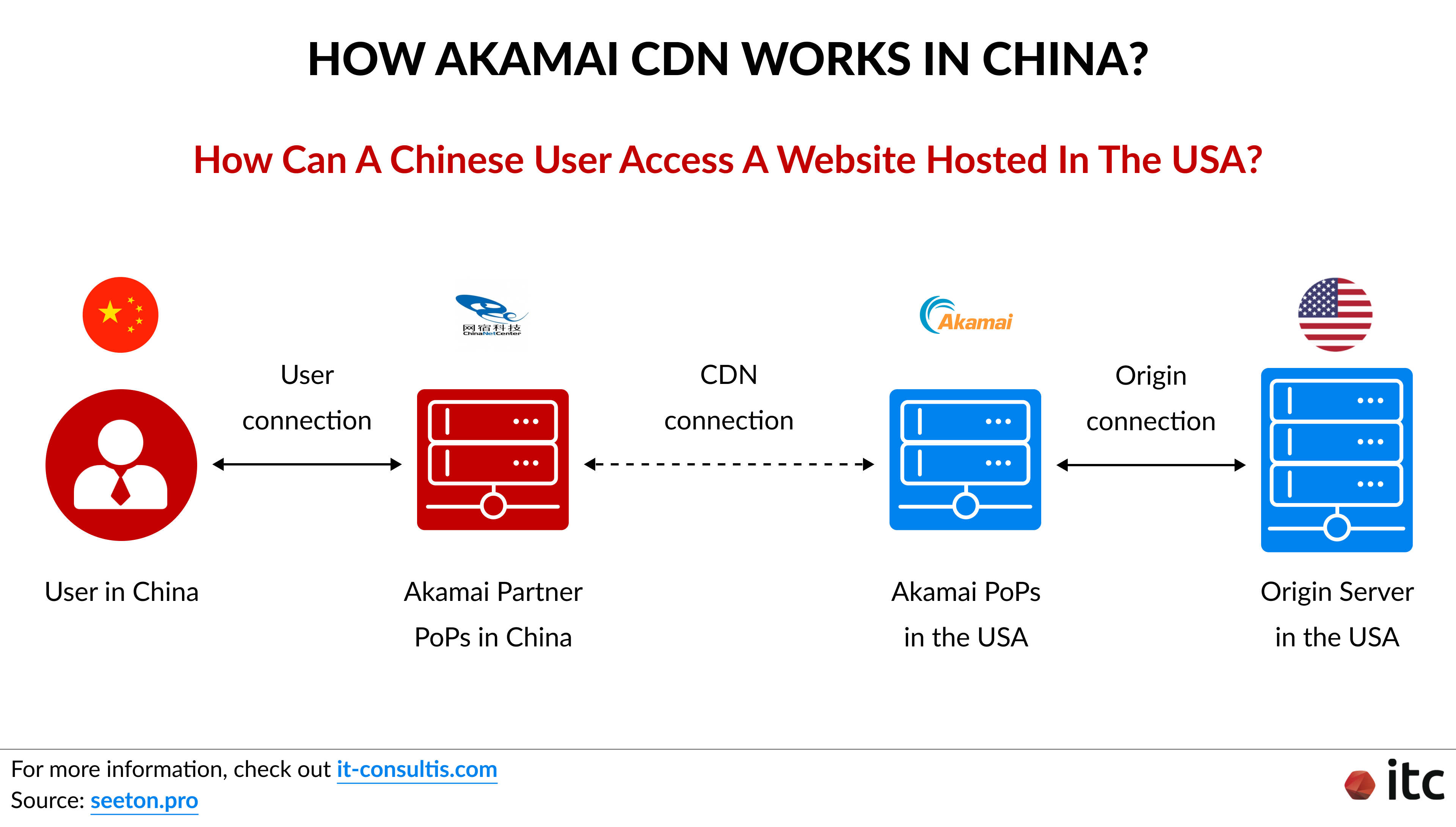
Alibaba Cloud’s Content Delivery Network overview is a useful reference for understanding how local delivery reach affects performance inside China. Tencent Cloud’s CDN documentation offers another helpful view of how mainland coverage can be approached in practice.
If you are currently using Akamai CDN to optimize performance for Chinese users on your eCommerce platform, it is important to note that Akamai is exiting the Chinese market. Check out this guide on what Akamai’s exit means for brands operating in China and the strategic next steps to consider.
Dependency Risk
Frontend resources, third-party scripts, global analytics tools, and external services that are routine in other markets may not behave reliably in China.
Ecosystem Fit
Magento in China often needs to work smoothly with local payments, Chinese websites, WeChat Mini Programs, and China-specific operational workflows rather than simply replicate the global stack.
Ownership and Governance
Hosting decisions in China are also closely tied to data handling, support ownership, deployment processes, and long-term operating model choices.
That is why a China-facing Magento setup is not just a DevOps topic. It is a business-critical decision shaped by compliance planning, performance realities, local integrations, and operational control.
What Happens When Magento Is Hosted Outside Mainland China
Many global brands begin by pointing Chinese traffic to an existing offshore Adobe Commerce setup. In practice, the structural constraints above usually show up as user-facing and operational problems.
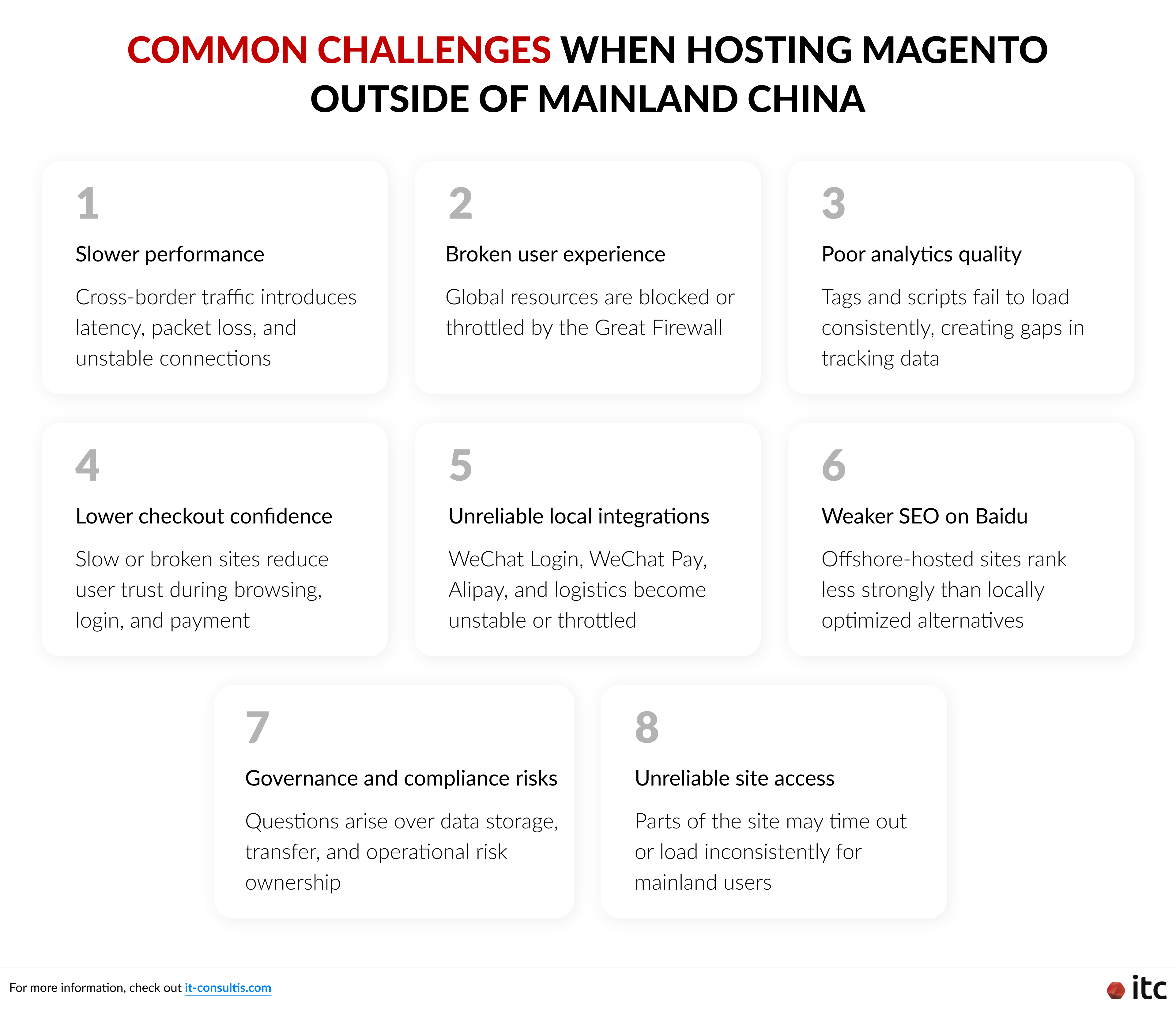
The most visible issue is slower and less stable performance. Pages can load unevenly because traffic has to move across borders and depends on network conditions that the global team does not fully control.
Cross-border traffic is often routed through limited gateways, which can introduce latency, packet loss, and unstable connections even when the site is technically still online.
This is one reason local content delivery matters so much in China. Without strong mainland coverage, even well-built storefronts can feel slower and less stable than teams expect from their global benchmarks.
The second issue is a broken or incomplete user experience. Many global resources are blocked or throttled by the Great Firewall of China (GFW). That includes tools such as Google Fonts, Google Analytics, certain JavaScript libraries, images, and other third-party scripts.
That can lead to missing assets, broken functionality, slow page rendering, and frustrated users who abandon the site.
Analytics quality can also suffer. When tags, scripts, or supporting services do not load consistently, teams may end up with weaker visibility into traffic, behavior, and conversion performance.
GFW interference can also create meaningful gaps in analytics and tracking data over time.
Checkout confidence can drop as well. If the site feels slow, inconsistent, or partially broken, users are less likely to trust the experience during product browsing, login, and payment steps.
Local integrations may also become less reliable.WeChat Login, WeChat Pay, Alipay, Mini Programs, and logistics integrations can become slower, unstable, or throttled when important requests depend on offshore infrastructure.
In practice, this can lead to failed payments, degraded user journeys, and higher abandonment rates.
SEO and visibility can weaken, too. Offshore-hosted sites may rank less strongly on Baidu than faster, more locally optimized alternatives.
There is also a governance consequence. Depending on the business model and data flows, offshore hosting can make teams think more carefully about how customer data moves, where it is stored, and who owns the resulting operational risk.
For some businesses, it can also raise compliance and legal questions about whether customer data is being stored and transferred in the right way for the Chinese market.
In more severe cases, access itself can become unreliable. During heavier filtering or unstable cross-border delivery conditions, parts of the site may load inconsistently or time out for mainland users.
For teams working on broader China digital readiness, this challenge is closely related to Chinese website localization. A storefront may be reachable, but that does not mean it is truly localized or commercially effective.
A Magento site can be technically reachable from mainland China and still perform poorly enough to hurt conversion, trust, and brand perception.
The Main Magento Hosting Model for China
For teams evaluating Adobe Commerce specifically, it is also important to note that Adobe Commerce Cloud is not a default mainland China solution.
Adobe’s public documentation shows that China is handled through on-premises deployment rather than standard cloud-region availability, which is one reason many brands need a more tailored Magento / Adobe Commerce architecture for the China-facing experience.
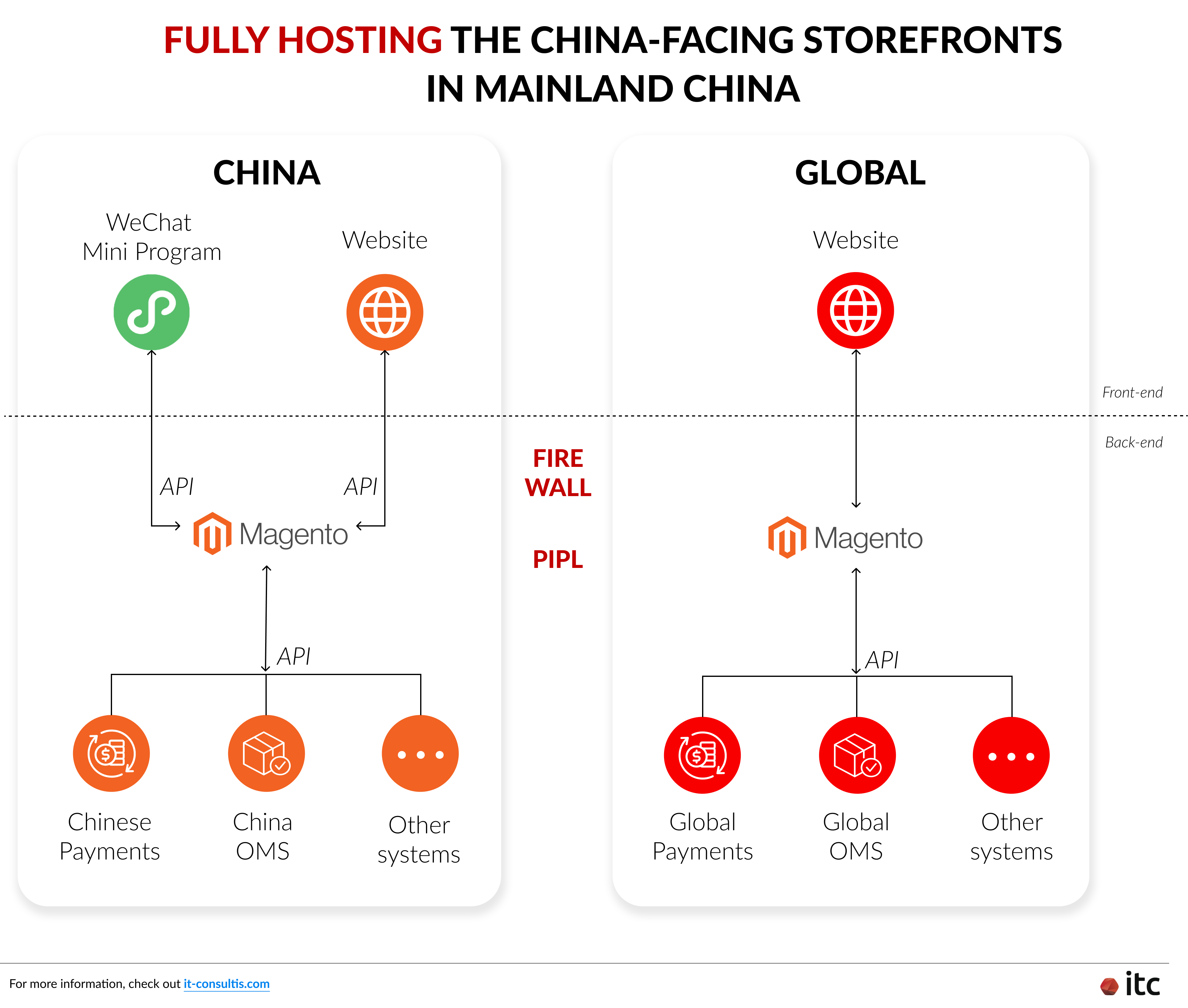
This model places the China-facing Magento environment on mainland infrastructure. It is usually the strongest option when a brand wants the best possible mainland performance and a more localized user experience across the Chinese website and WeChat Mini Program ecosystem.
For brands that are serious about performance, compliance, and long-term operations in China, the real decision is how localized the architecture needs to be to support the intended China business model.
Projects such as Brandy Melville’s China eCommerce app and Havaianas’ WeChat Mini Program help show how Magento can support a more localized China commerce setup when the architecture is built around local performance, local integrations, and China-specific user journeys.
In practice, that often means a dedicated China setup connected to global systems, rather than stretching a standard offshore setup beyond what it can realistically support.
The trade-off is preparation. Brands need to plan for entity structure, ICP compliance for China, operational ownership, and long-term maintenance much earlier.
What Adobe Commerce And Magento Setups Still Need to Be Localized Beyond Hosting In China
One of the most common mistakes is assuming that local hosting alone will solve the China challenge. In reality, hosting is only one part of the solution.
Hosting improves delivery, but a China-ready Magento-powered website or Mini Program experience also depends on localizing dependencies, integrations, data flows, and ongoing operations.
In many cases, this also means making practical technical changes for China: improving local content delivery, replacing blocked or unreliable global services, and adapting the experience more heavily instead of reusing the global storefront unchanged.
- Frontend Dependencies: Review fonts, scripts, maps, video embeds, tag managers, and analytics tools to make sure they do not rely on blocked or unreliable services.
- CDN and Asset Delivery: Optimize image delivery, caching logic, and asset routing so the storefront feels fast for mainland users, not just globally acceptable.
- Payments and Ecosystem Integrations: Plan WeChat, Alipay, Mini Program journeys, local logistics, and other China-specific touchpoints as part of the core architecture rather than as late add-ons.
- Analytics and Data Governance: Check how data is collected, stored, transferred, and reported so the setup supports both business visibility and local compliance expectations.
- Operational Governance: Review releases, plugin choices, new scripts, and third-party tools continuously because a China-ready site can drift out of alignment over time.
If these questions are becoming more central to the project, check out ITC’s China data governance and compliance consulting service for more information.
How To Evaluate The Right Magento / Adobe Commerce Hosting Architecture For China
Before choosing a hosting approach, brands should frame the decision as a business question, not just a technical one.
The right architecture depends on launch readiness, operating-model preferences, long-term ownership, and the commercial role China plays in growth plans.
Start With What the China-Facing Experience Must Deliver
A product showcase, a transactional storefront, and a fully localized omnichannel journey do not require the same architecture. The wrong choice here can limit commercial potential.
Then Weigh Launch Speed Against Long-Term Stability
Some teams prioritize speed to launch, while others prioritize long-term control, stronger localization, and lower operational risk. The right answer depends on how central China is to growth and how much local adaptation the experience truly needs.
Ownership Is Often Overlooked but Critical
Infrastructure, deployment, compliance support, and performance monitoring all need clear accountability. Without it, even a strong architecture can become difficult to operate effectively over time.
Data and Integration Dependencies Deserve Early Attention
Depending on the operating model, some flows can remain global while others are better localized for performance, compliance, or customer-experience reasons. It is better to map these early, before architecture decisions become difficult to reverse.
Finally, Trace Every Decision Back to Commercial Impact
A slow or unstable storefront can become a significant commercial issue. It affects revenue, customer confidence, and long-term growth.
If Magento must connect with multiple channels and systems, working with an experienced eCommerce agency in China becomes essential for execution planning.
Conclusion
Magento can be an excellent foundation for Chinese eCommerce when the setup is properly localized.
The brands that perform best are not the ones that simply extend a global environment, but the ones that build a China-ready architecture around local performance, local systems, and local operating realities.
That applies not only to the Chinese website, but also to connected experiences such as the WeChat Mini Program, local payments, and the wider China-facing ecosystem.
Magento in China is not a compromise. It can be a competitive advantage when the architecture is designed that way.
IT Consultis is an award-winning Magento agency in China, helping global brands build China-ready digital architectures that connect Magento / Adobe Commerce, local platforms, and the wider China ecosystem in a practical way.


