
For many content-heavy websites where Drupal powers the content layer, search is one of the most important and most underused parts of the customer journey.
When users land on your site, they already have a goal in mind: a family weekend getaway, a kid‑friendly buffet, a beginner’s guide to running shoes, or a how‑to article.
In just a few seconds, your search either understands that intent, or it doesn’t, and that gap directly affects conversion, content engagement, and campaign performance.
The problem is that, even with a solid content management system (CMS) like Drupal, search is often implemented as a simple database query rather than as a more flexible discovery layer using tools like Drupal’s Search API.
In this article, we’ll show how a semantic search architecture using Drupal, Elasticsearch, and a lightweight Go (Gin) API layer can transform how users find content on a global or Chinese Drupal website.
This is especially relevant for brands managing a Drupal website in China, where search often needs to support localized content, mobile-first user behavior, and channels like WeChat Mini Program, while still fitting broader global website strategies.
We’ll also show how the same approach can be applied to other backends, such as WordPress and Magento.
Executive Summary:
1. Most Drupal website search still behaves like a basic keyword lookup, missing intent and context, and leading to irrelevant results and user drop‑off.
2. Semantic search – powered by Drupal as the content hub, Elasticsearch as the relevance engine, and a lightweight Go (Gin) API – interprets meaning, handles synonyms and typos, and serves fast, consistent results across web and WeChat Mini Program channels.
3. This architecture enables a low‑risk, phased modernization: teams can upgrade search first, then unify content and structured data, and later iterate with analytics‑driven tuning and personalization.
4. In a real use case example, re‑architecting around Drupal + Elasticsearch cut search latency by roughly 30–40% while making results more forgiving and aligned with how users actually search.
5. The outcome is higher conversion, stronger content engagement, better campaign ROI, and a practical path that ITC can help design, implement, and optimize step‑by‑step.
Table of Contents
- Why Drupal Website Search Needs an Upgrade
- What We Mean by Semantic Search for Drupal Websites in China and Global Markets
- How Drupal and Elasticsearch Work Together to Power Semantic Website Search
- Applying Semantic Search to Other Backends: Magento E-Commerce, WordPress CMS, and More
- Business Impact for Drupal and E-Commerce Teams
- When Semantic Search Makes Sense for Drupal Websites in China & Global Markets
- How IT Consultis (ITC) Can Help
Why Drupal Website Search Needs an Upgrade
Open any successful website today, from content‑rich brand hubs to E-Commerce platforms, and you’ll notice the same thing: search is no longer a side feature.
Whether you run a resort website, a media hub, or a corporate content and knowledge platform, your visitors expect to type just a few words, even vague ones like “family weekend spa” or “roadshow ideas in Shanghai” – and instantly see:
- Relevant content and pages
- Helpful filters and facets
- Suggestions that feel almost one step ahead of what they were going to search next
Yet many Drupal (and non‑Drupal) platforms are still limited by old, monolithic CMS architectures and database‑driven search that only matches exact keywords and struggles with typos and synonyms.
It also doesn’t adapt to real user behavior.
For digital and e-Commerce teams, that translates into high zero‑result searches and users bouncing to competitors or other sources after just a few failed attempts. Campaigns also underperform when visitors cannot quickly find what they saw on the landing page or website as they continue their journey.
This becomes even more important for a Drupal website or WeChat Mini Program in China, where users expect fast, relevant discovery across localized content journeys and mobile-heavy digital touchpoints.
At this stage, the problem is less “we need more filters” and more “we need a smarter way to connect what people ask for with the content and offers we actually provide.”
What We Mean by Semantic Search for Drupal Websites in China and Global Markets
Semantic search understands the meaning behind the query – not just the words – and connects it to content, product attributes, and real user actions across your website, WeChat Mini Program, or app.
For many teams running a Drupal website in China or across global markets, semantic search is one of the most effective ways to modernize a Drupal website search without a full replatform.
You can expect your search functionality to:
- Interpret natural language queries like “family‑friendly brunch this weekend” instead of relying on exact matches.
- Handle synonyms, typos, and partial inputs gracefully, especially on mobile.
- Combine signals such as topic, date, location, and audience in a single, flexible query.
This is where pairing Drupal + Elasticsearch + a Go (Gin) API layer makes a difference.
How Drupal and Elasticsearch Work Together to Power Semantic Website Search
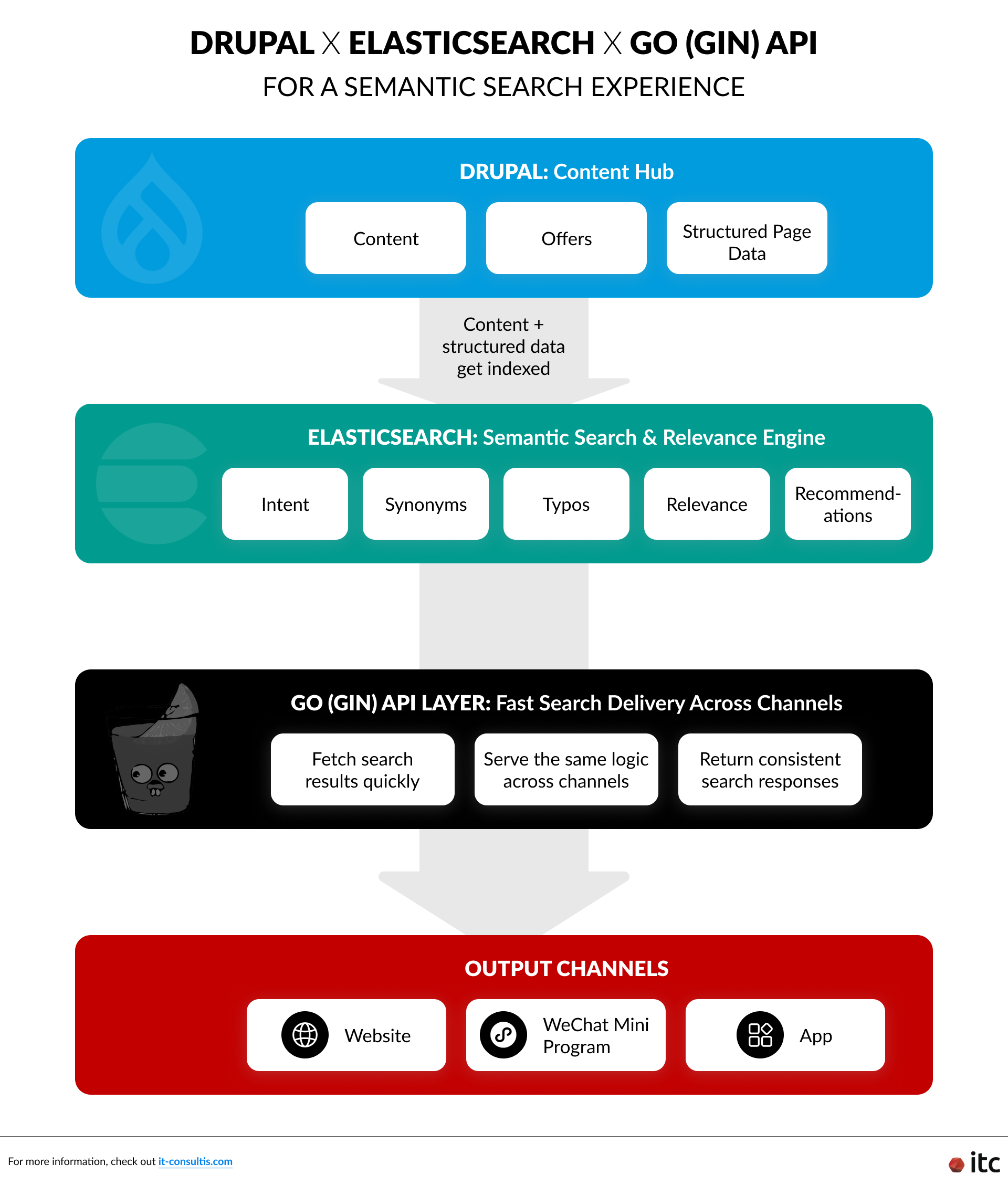
We modernize your stack around a three‑layer architecture where:
- Drupal centralizes rich content and the structured data that powers search experiences.
- Elasticsearch turns that content into a semantic search and recommendation engine.
- A lightweight Go (Gin) API layer delivers fast results to your website and WeChat Mini Program.
This way, you can upgrade search and discovery without a risky “big‑bang” rebuild.
From a business perspective, this gives you a more consistent content and search layer across channels. It also sets you up with a platform that’s ready for future personalization and experimentation.
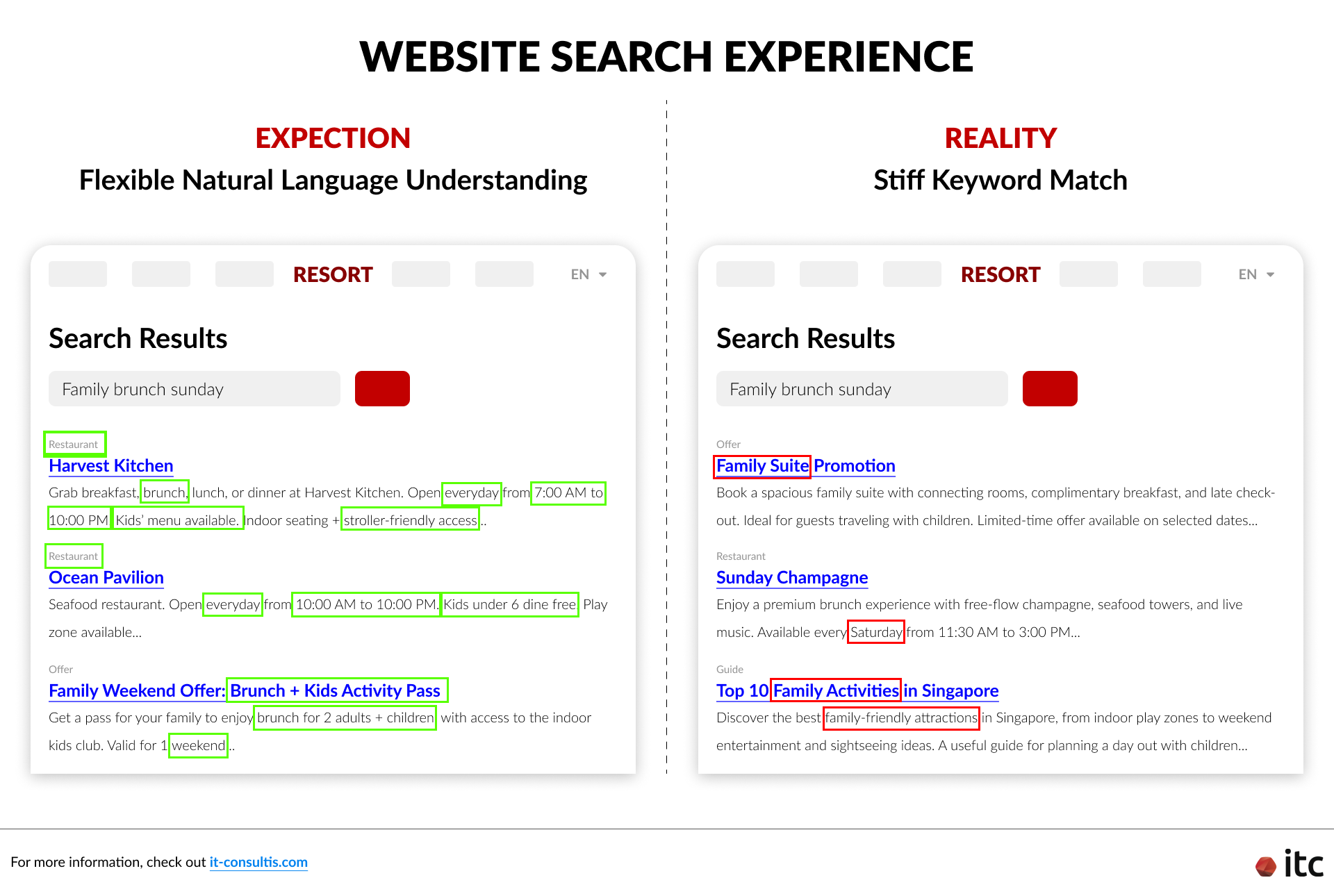
Let’s walk through an example: in one project for a resort destination in Asia, search was a clear bottleneck.
Guests relied on it to find stays, restaurants, and activities, but it often returned incomplete or noisy results, didn’t understand flexible queries like “family‑friendly brunch,” and slowed down during peak demand, such as holidays or big events.
By re‑architecting around Drupal + Elasticsearch, with a shared API across the Drupal website and WeChat Mini Program, we were able to:
- Cut search response times by roughly 30–40%
- Make results more forgiving and relevant, even with typos or vague wording
- Build a consistent search experience across the website and WeChat Mini Program, with the same principles guiding relevance, filtering, and discovery in each channel
For example, a query like “family‑friendly brunch” now returns a short list of brunch‑friendly restaurants with kids’ menus, nearby family activities, and relevant weekend stay packages – instead of a long, noisy list of anything tagged “family” or “brunch”.
This search approach can work beyond one resort or one Drupal site. If your structured product data and content are managed separately, search can still bring them together into a clearer discovery experience.
Applying Semantic Search to Other Backends: Magento E-Commerce, WordPress CMS, and More
Even though this architecture is built on Drupal + Elasticsearch, the same search approach can work with other stacks, such as Magento E-Commerce, WordPress, or custom Laravel platforms.
As long as your backend can expose structured data through APIs, the same search approach can be applied. That means you can use Elasticsearch or OpenSearch to improve result relevance, handle broader query types, and create a more consistent search experience across your website, app, and WeChat Mini Program.
For example, a Magento-powered E-Commerce site could use the same approach to improve search by helping shoppers find the right products faster, alongside relevant content and promotions.
This architecture turns fragmented catalog and content silos into a single, fast, relevance‑driven search experience that helps users quickly find the most useful products, articles, and campaigns from a single place rather than jumping between separate pages.
Business Impact for Drupal and E-Commerce Teams
Better search isn’t just nicer UX; it’s one of the most direct levers for conversion, content engagement, and campaign performance.
Once search behaves more like a smart assistant than a database query, you typically see impact in four areas:
1. Higher Conversion
- Users find relevant products or content faster, even from vague or imperfect queries.
- Fewer zero‑result pages, fewer frustrated exits.
- Search becomes a reliable path to purchase or to key content, not a last resort.
2. Higher Average Order Value and Engagement
- Related items, bundles, and upsells can appear naturally inside search results.
- Faceting and recommendations help users refine, compare, and add more to the cart – or dive deeper into your content.
3. Stronger Campaign ROI
- Campaign landing pages and key offers are properly indexed and optimized for search engines.
- Visitors coming from ads or social media can actually find what the campaign promised.
- Marketing and product/content teams can coordinate around the same search insights.
4. Foundation for Personalization
- Once the architecture is in place, you can introduce personalized ranking and recommendations by segment, behavior, or location.
- Experiments (A/B tests on ranking rules, layouts, filters) become easier to run and measure.
When Semantic Search Makes Sense for Drupal Websites in China & Global Markets
Teams managing a Drupal website China rollout or a global Drupal platform often see search show up as a recurring pain point in analytics, NPS, or support tickets.
This Drupal + Elasticsearch (often searched as “elastic search”) + Go (Gin) stack is a good fit if you:
- Rely on search as one of the main ways users discover your products and content.
- Feel that basic keyword search is no longer sufficient for relevance and UX.
- Run multiple channels (website, WeChat Mini Program, mobile app) and want one shared search engine across all of them.
- Prefer a phased Drupal modernization instead of a big-bang replatform.
- Find that your current E-Commerce or CMS platform has become a bottleneck for search improvements — making it harder to deliver more relevant results, improve ranking, or offer better filtering.
Typical first phases look like this:
- Start with search – Introduce Elasticsearch and the API layer while keeping your current frontend.
- Unify content & data – Consolidate editorial content and the structured data that powers search in Drupal as the central hub.
- Iterate and personalize – Use search analytics to tune relevance, then gradually add personalization and scenario‑specific journeys.
How IT Consultis (ITC) Can Help
IT Consultis (ITC) helps brands modernize Drupal websites in China and globally,improving the search experiences and designing scalable, user-centric content platforms.
In practice, we typically help teams:
- Design and build end-to-end Drupal websites — from UX/UI design and frontend/backend development to scalable content architecture.
- Integrate Drupal with existing systems such as CRM, PIM, ERP, E-Commerce, analytics, and other business platforms.
- Modernize and upgrade Drupal platforms through maintenance, version upgrades, performance improvements, and ongoing technical evolution.
- Improve search and discovery experiences with pragmatic architectures built around Drupal, Elasticsearch, and lightweight API layers.
- Roll out enhancements in phases — starting with the most impactful journeys, then refining relevance, personalization, and experimentation over time.


