
Drupal vs WordPress remains a consequential content management system (CMS) decision because both platforms can support serious brand websites. However, they create very different operating models once governance, localization, integrations, and regional complexity start to scale.
This comparison is most useful for brands managing multi-market websites, governance, and localization complexity, especially where China changes the architecture decision.
For global brands, China is one of the clearest pressure tests for that choice. It exposes whether the platform can hold up when hosting strategy, ICP requirements, blocked dependencies, lead capture, data handling, and WeChat-linked customer journeys become commercially material rather than technical side notes.
In this article, we compare Drupal and WordPress across the criteria that matter most in practice: governance, multilingual scale, security, SEO, performance, cost, and e-commerce. We then examine how China-specific requirements can change the decision when the website becomes part of a broader market-entry and customer journey.
Executive Summary
1. WordPress is the better default for marketing-led websites that value publishing speed, editor accessibility, and lower operating friction.
2. Drupal earns its place when multilingual structure, permissions, content modeling, and cross-market governance are strategic requirements rather than nice-to-haves.
3. For e-commerce, WooCommerce is typically the practical fit for lighter content-commerce programs, while Drupal Commerce becomes more compelling when workflow logic, permissions, and product-content relationships are more demanding.
4. The better CMS choice is usually determined less by feature lists than by the operating model behind the site: who publishes, how approvals work, how markets diverge, and how much structural consistency the business needs.
5. China is one of the clearest decision filters because it introduces architecture-level realities around hosting, ICP, data handling, blocked dependencies, lead capture, and WeChat-native customer journeys.
Table of Contents
- Drupal vs WordPress: The Short Answer
- Drupal vs WordPress at a Glance
- Drupal vs WordPress for Editorial Usability and Governance
- Drupal vs WordPress for Multilingual, Multisite, and Structured Content
- Drupal vs WordPress for E-Commerce
- Drupal vs WordPress for SEO
- Drupal vs WordPress for Security
- Drupal vs WordPress for Performance and Speed
- Drupal vs WordPress for Cost, Development, and Maintenance
- The Enterprise Breakpoints That Change the Answer
- How China Changes the CMS Decision in Practice
- A Practical Decision Matrix
- Conclusion: How to Choose the Right CMS
Drupal vs WordPress: The Short Answer
If you want the practical answer first:
- Choose WordPress when the website is primarily a marketing and publishing engine.
- Choose Drupal when the site is becoming a governed platform with stronger workflow, permissions, and cross-market structure.
- Use WooCommerce or Drupal Commerce selectively for lighter or more structured commerce needs.
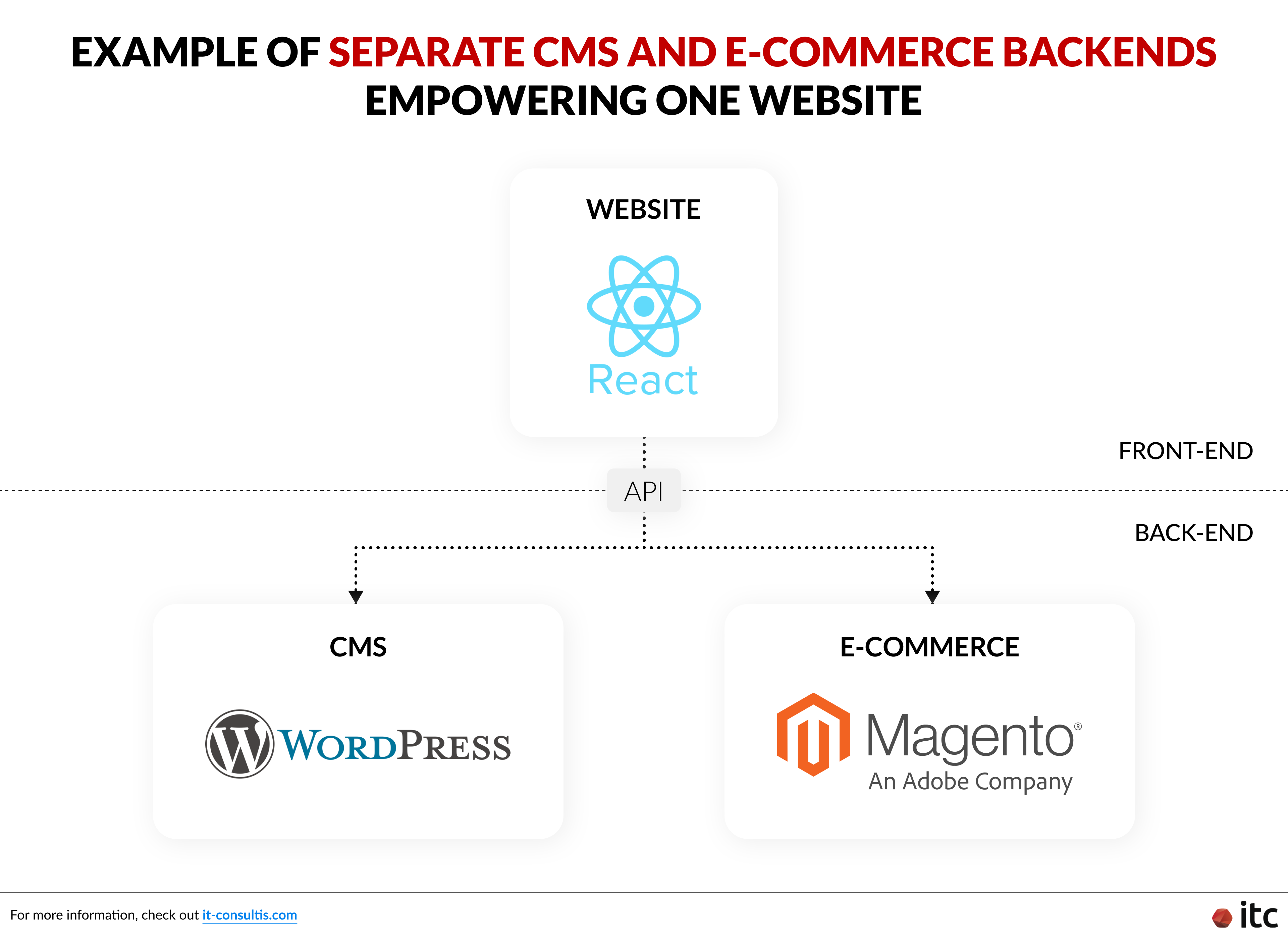
- Separate the commerce layer (e.g., using Drupal for CMS and Magento for e-Commerce) when payments, product logic, CRM or ERP sync, and channel-specific journeys become core to the business model.
That is the broad answer. The more useful answer is to understand where each platform creates leverage, where each one creates drag, and why China makes weak architectural assumptions surface faster.
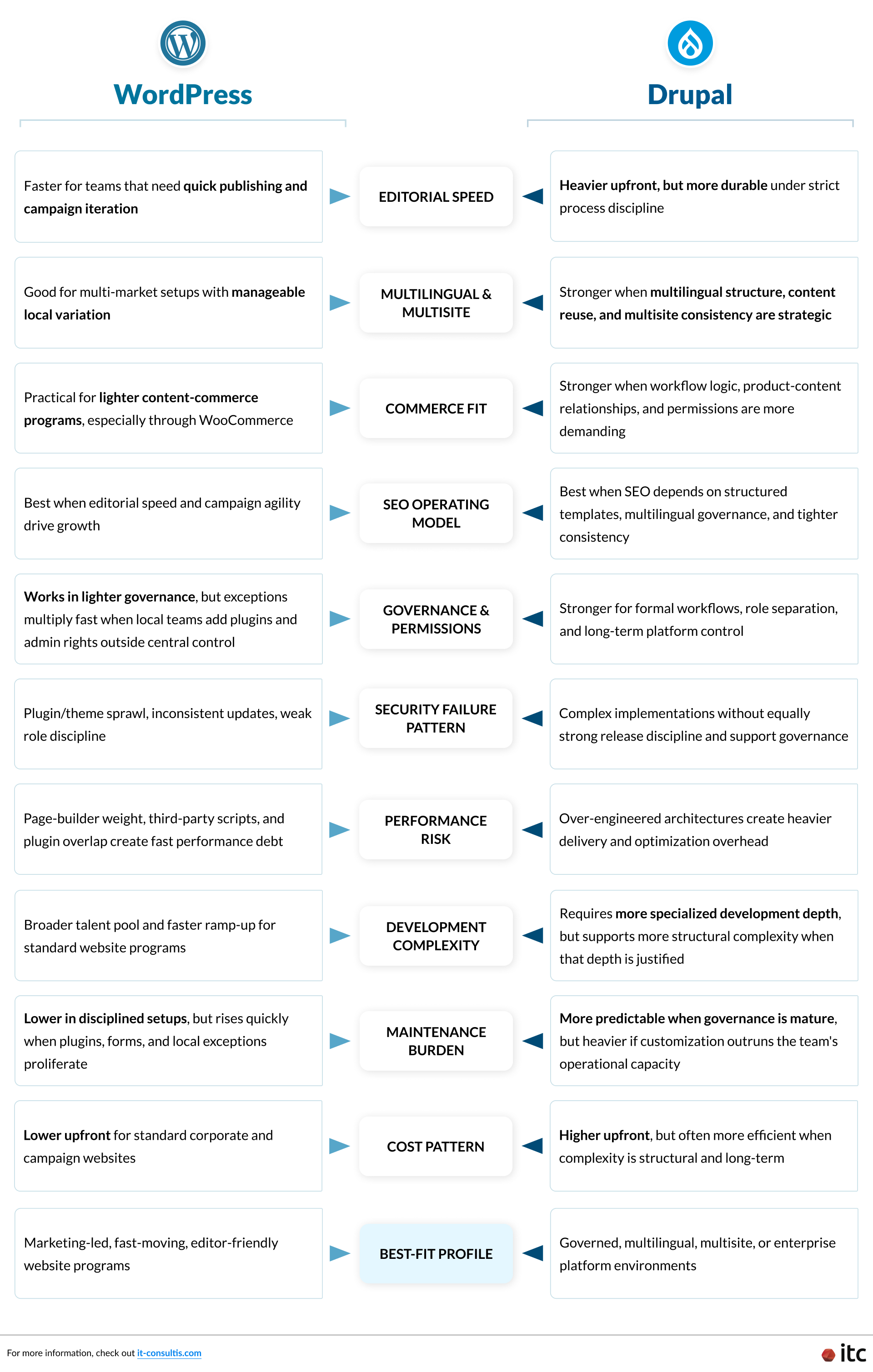
Drupal vs WordPress at a Glance
Drupal vs WordPress for Editorial Usability and Governance
WordPress is the default choice when the website must move quickly and stay easy for non-technical teams to run.
That makes it a strong fit for corporate sites, campaign landing pages, thought-leadership hubs, and lead-generation programs where publishing speed matters more than deep workflow logic.
Its real advantage is not feature count. It is reduced operating friction: faster publishing, simpler onboarding, and lighter day-to-day content operations.
Its most common enterprise failure pattern is governance drift.
In multinational WordPress environments, that drift usually starts when local teams need their own landing pages, forms, and plugins, then gradually demand separate permissions, template exceptions, and market-specific workarounds.
A good early warning sign is when central teams can no longer trust shared components, shared taxonomy rules, or approved publishing flows to behave consistently across markets.
Drupal is stronger when the business needs governance that survives scale.
That usually means formal approval paths, clearer role separation, reusable content relationships, stronger auditability, and less tolerance for local improvisation breaking central standards.
The trade-off is direct: WordPress reduces operating friction sooner; Drupal creates stronger control once content operations become a real platform-management problem.
Drupal vs WordPress for Multilingual, Multisite, and Structured Content
This is one of the clearest decision points.
If the business only needs a modest multilingual or multisite setup, such as a few regional sites with shared templates and limited local variation, WordPress can work very well.
The balance changes when the environment must support shared taxonomies, reusable structured blocks, controlled local deviations, multiple permission models, and a growing number of markets.
That is the point at which multilingual complexity stops being a content problem and becomes a platform-architecture problem.
In practice, one of the sharpest breakpoints is when teams are no longer debating translation quality, but arguing about who owns taxonomy governance, whether local markets can change page structures, and how much approval logic is needed before content goes live.
IT Consultis (ITC)’s own work shows both sides of that threshold:

In The Hour Glass, WordPress supported a multi-site, multi-language setup across eight APAC markets with region-specific permissions and shared governance from one backend.
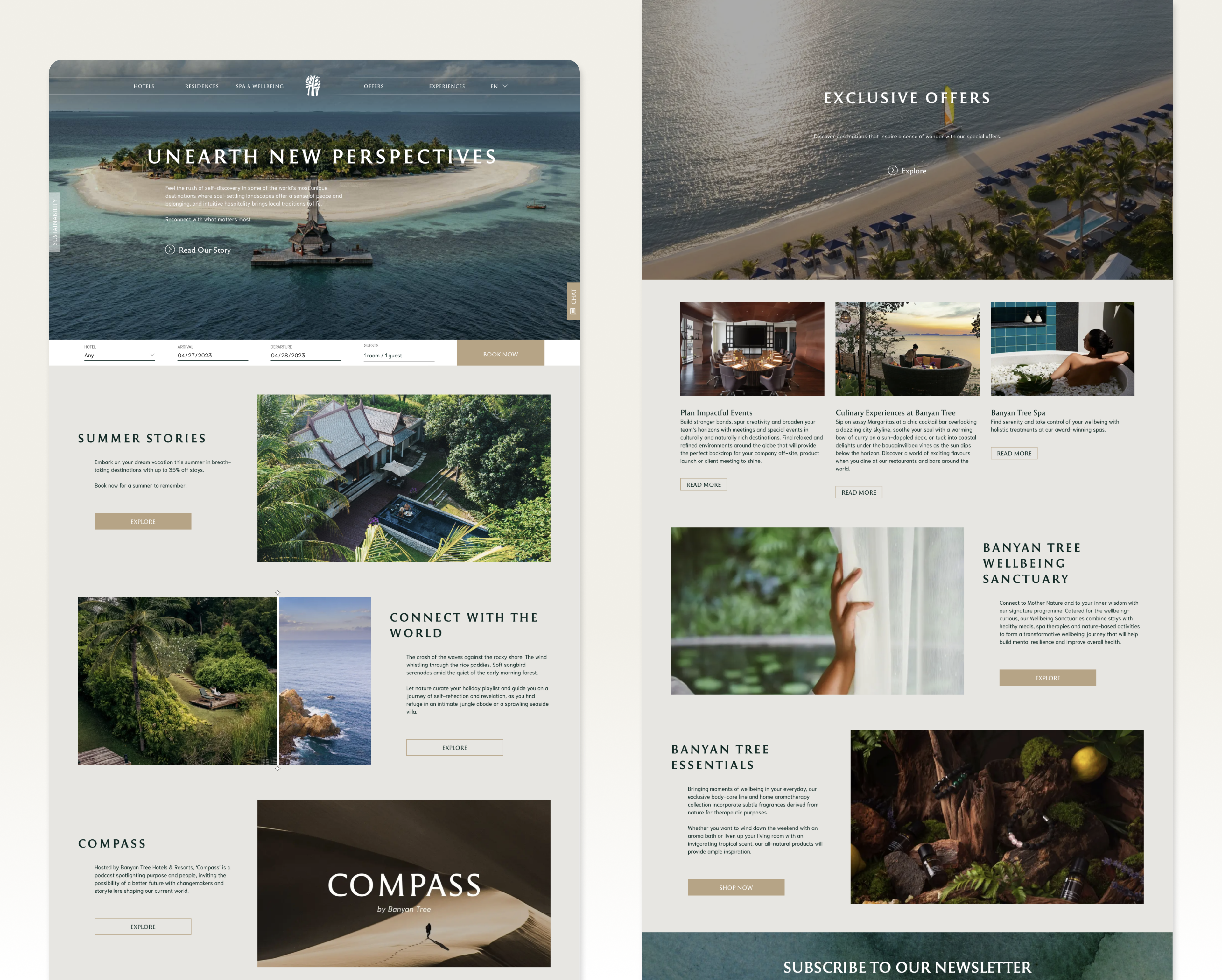
For Banyan Group, Drupal supported a far larger multilingual estate across brands (e.g., Banyan Tree, Angsana, Dhawa, Cassia), countries, and property-level websites, where stronger structure and component-based control mattered more.
Drupal is usually stronger there because multilingual structure is built into the platform logic rather than layered on as an operational workaround.
A practical rule:
– Use WordPress when multilingual or multisite remains mostly an editorial speed issue.
– Use Drupal when multilingual or multisite becomes a governance, reuse, and architecture issue.
Drupal vs WordPress for E-Commerce
For lighter content-commerce programs, both ecosystems can work well.
- WordPress + WooCommerce is usually the practical answer for lighter storefronts, content-led selling, and marketing-driven commerce programs that benefit from faster setup and broader plugin availability.
- Drupal Commerce is usually stronger when catalog logic, permissions, workflow control, structured content relationships, or more customized commerce behavior are materially more demanding.
The bigger breakpoint comes when commerce stops being a front-end website feature and becomes a systems problem.
That usually happens when product data, pricing logic, CRM or ERP handoffs, order orchestration, and customer-account logic are doing too much through the website layer.
When the CMS starts carrying responsibilities that really belong to the commerce and integration stack, operational drag rises quickly.
At that point, the stronger answer is often not to force the CMS to become the transaction engine. It is to let the CMS handle content, storytelling, SEO, and governance while a separate commerce layer (e.g., Magento or Adobe Commerce) handles payments, orders, catalog logic, and orchestration.
Drupal vs WordPress for SEO
There is no universal SEO winner because search performance usually reflects operating discipline more than the CMS label alone.
WordPress is strongest when SEO growth depends on editorial velocity: publishing quickly, launching landing pages fast, and giving marketing teams more autonomy to test and iterate.
Drupal pulls ahead when SEO depends on structural consistency across markets: controlled templates, multilingual URL logic, shared taxonomy, and reusable content models that keep local variation from degrading search performance over time.
A useful breakpoint is this: if each market is starting to invent its own metadata habits, URL structures, and template logic, the SEO problem is no longer a content-volume issue. It is a governance issue, and that is where Drupal usually creates more long-term control.
Drupal vs WordPress for Security
Both platforms can be secure. They fail differently.
In WordPress, the main security exposure rarely comes from the CMS core alone. It usually comes from the operating model around it:
- Plugin sprawl
- Inconsistent patching
- Loosely managed themes
- Duplicated functionality
- Admin rights that expand faster than governance
WordPress’s own security guidance emphasizes hardening through disciplined updates, plugin and theme management, and administrative controls.
In Drupal, the security advantage typically comes from tighter permissions, clearer content modeling, and a more disciplined governance model.
But that advantage only holds when release management is equally disciplined. Drupal’s security governance is built around supported versions, formal advisories, and coordinated release practices.
A highly customized Drupal stack with a weak deployment process is not inherently safer simply because it is Drupal.
To ensure optimal security for your Drupal site, make sure you are upgraded to Drupal 11.3.0.
So the sharper distinction is this:
– WordPress risk is broader third-party exposure and weaker role discipline.
– Drupal risk is carrying a more complex implementation without enough engineering and release rigor.
Drupal vs WordPress for Performance and Speed
Both WordPress and Drupal can be fast. Both can also accumulate performance debt quickly.
WordPress usually reaches an acceptable baseline faster, but it also degrades faster when page builders, trackers, heavy scripts, and overlapping plugins accumulate.
The failure signal is not simply lower Lighthouse scores. It is when routine campaign activity steadily makes the site heavier and harder to recover.
Drupal tends to carry the opposite risk. The performance issue is less about marketing sprawl and more about architectural overreach: overly complex content models, heavy integrations, and rendering logic that make optimization slower and more expensive later.
The real question is which type of debt your team is more likely to prevent: operational sprawl in WordPress or over-engineering in Drupal.
Drupal vs WordPress for Cost, Development, and Maintenance
Cost is one of the easiest areas to oversimplify.
WordPress is usually the lower-cost answer upfront for standard corporate, brand, and campaign websites. It is easier to staff, faster to launch, and lighter to operate when the environment stays within a disciplined publishing model.
Drupal costs more early because it needs more planning, stronger technical ownership, and more implementation rigor.
The more strategic cost question is not which platform is cheapest to launch. It is which one is cheaper to govern over three years.
If complexity is accidental, such as plugin sprawl, local exceptions, improvised approval logic, or duplicated functionality, WordPress becomes expensive through correction work.
If complexity is structural, such as cross-market governance, reusable content models, stricter permissions, and deeper architectural control, Drupal often becomes the more efficient long-term answer.
The Enterprise Breakpoints That Change the Answer
Teams often treat enterprise CMS selection as a matter of brand size. In practice, the answer changes when the website crosses a few operational breakpoints.
Drupal usually becomes easier to justify when several of these are true at once:
- The business needs shared governance across multiple markets, brands, or business units
- The content model depends on reusable structured components rather than page-by-page publishing
- Approvals, permissions, and auditability matter beyond a basic editorial workflow
- Forms, analytics, CRM handoffs, and localization logic must stay consistent across a complex environment
- The cost of drift is high because the website is becoming a durable platform, not a lighter marketing property
If those breakpoints are not present, WordPress often remains the more commercially efficient choice.
If they are present and growing, the lower-friction choice at the start can become the more expensive one to govern later.
How China Changes the CMS Decision in Practice
For global brands, the most important point is this: China does not simply add a localization layer to a normal Drupal vs WordPress discussion. It changes the architecture threshold.
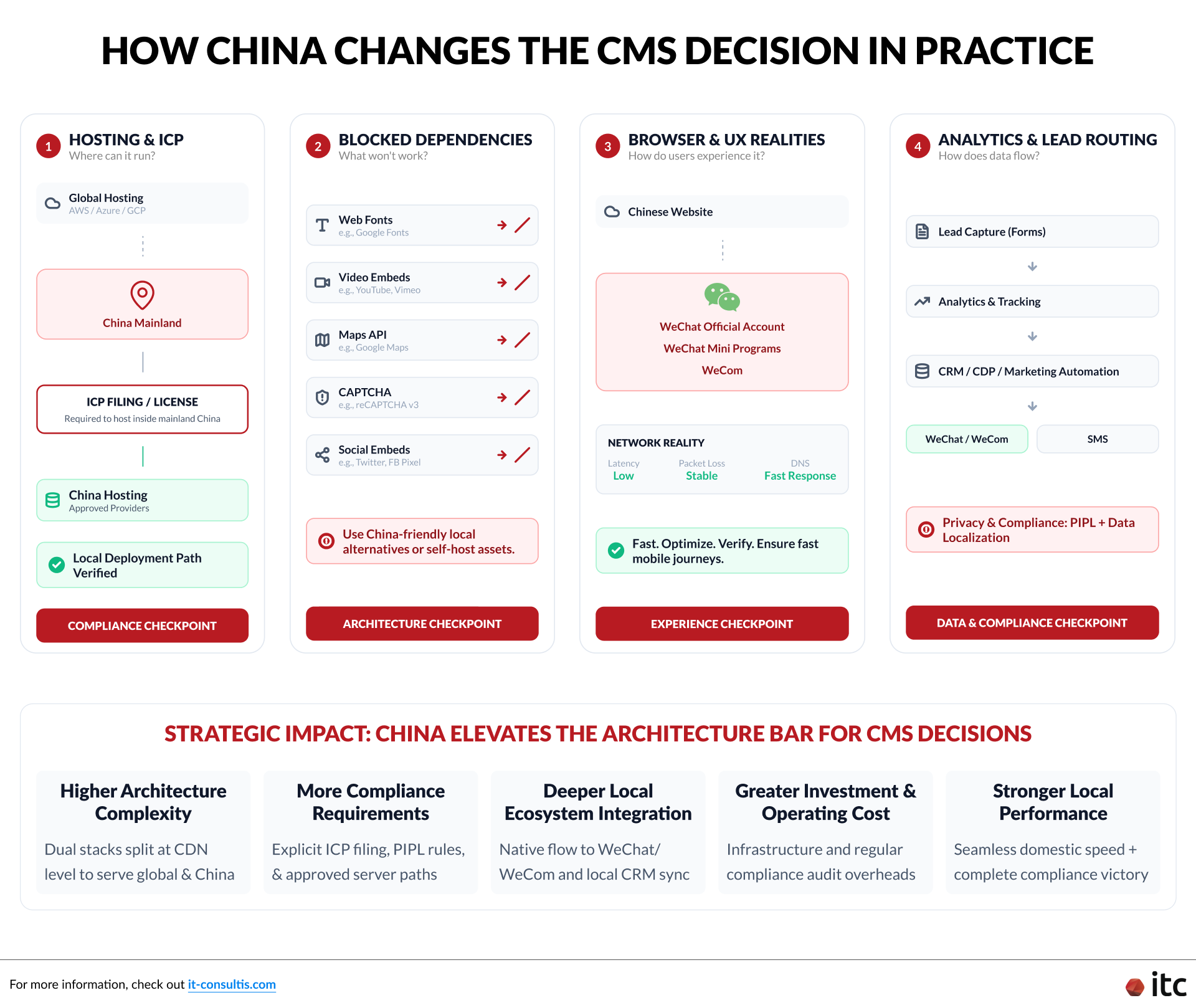
1. Hosting and ICP Change the Operating Model Early
If a site is hosted in mainland China, ICP filing becomes part of the operating model rather than a late infrastructure footnote.
Major infrastructure guidance for China hosting makes this explicit: websites and apps hosted on mainland servers must complete ICP filing before going live (Alibaba Cloud ICP filing overview).
That changes practical decisions around mainland hosting, offshore hosting plus acceleration, cache design, asset delivery, deployment governance, and how much local operational complexity the business is prepared to own.
2. Dependencies Become a Commercial Issue, Not a Technical Footnote
A site that relies on blocked or degraded services such as Google Fonts, YouTube, reCAPTCHA, Google Maps, or Western social embeds creates visible UX and conversion problems quickly.
WordPress is often more exposed because themes and plugins frequently pull those services in by default. Drupal is not automatically safe. It reaches the same problem through modules, embeds, and external services layered into the build over time.
3. China Browser and UX Realities Belong in the Platform Discussion
China localization is not just about translation and hosting.
China-facing websites also need to account for front-end and journey behavior that directly affects perceived quality and conversion:
- Font rendering and layout consistency across real local devices and browsers
- QR-code journeys that connect Official Accounts, landing pages, WeChat Mini Programs, and follow-up flows
- Real network testing under mainland conditions so page weight, third-party calls, and journey continuity are validated in practice
That is why a Chinese Website alone isn’t enough and how to localize it is fundamentally an architecture discussion, not a translation checklist.
4. Analytics, Forms, and Lead Routing Become Part of the CMS Decision
A China-facing site that loads but cannot capture, measure, and route leads reliably is still failing commercially.
That means the stack has to account for analytics choices, form logic, tag governance, CRM handoffs, sales follow-up routing, and when relevant, movement into WeChat or WeCom flows.
If the website collects personal data, the data-handling model also becomes part of the architecture decision.
China’s Personal Information Protection Law extends to personal-information processing involving individuals in China and sets expectations around consent, processor obligations, and cross-border transfer controls.
A Practical Decision Matrix
Pick WordPress If Most of These Are True:
- Commerce is light or secondary.
- Marketing owns the website.
- Editors need low-friction publishing.
- The content model is not deeply structured.
- Multilingual needs are real but still manageable operationally.
- Speed to market matters more than workflow depth.
Pick Drupal If Most of These Are True:
- The site is part of a regional or global platform program.
- Several brands, countries, or business units must stay aligned.
- Structured content, taxonomies, and reuse matter a lot.
- Permissions and approvals are strategic requirements.
- Multilingual and multisite are platform decisions, not just editorial ones.
- Control matters more than editorial simplicity.
Separate the Commerce Layer If Most of These Are True:
- Transactions are strategically important.
- Product, order, and customer data must stay synchronized across systems.
- Local payments or channel-specific journeys matter commercially.
- WeChat or Mini Program journeys are part of the China customer path.
- The website should be the content layer, not the transaction engine.
Conclusion: How to Choose the Right CMS
WordPress is usually the better fit for publishing-led websites, while Drupal is stronger when governance, multilingual complexity, and multisite control become structural.
For global brands, the real question is not just which CMS is better, but which platform model can support the operating realities around it.
China is one of the clearest decision filters because it quickly exposes whether that model can hold up in practice.
Ask these three questions in order:
- Is this mainly a publishing engine or a governed platform?
- Will multilingual, multisite, workflow, or permissions complexity become structural?
- Will China-specific customer journeys or integrations turn the CMS decision into a broader architecture decision?
If the answer to the third question is yes, the wrong choice does not just create technical inconvenience. It creates governance drag, weaker China execution, and more expensive correction later.
IT Consultis (ITC) can help assess whether you need a lighter publishing CMS, a more governed multi-market platform, or a broader China-ready architecture that connects website, integrations, and local customer journeys more effectively.


