A website that performs well in Europe, North America, or Southeast Asia will not automatically perform well for users in mainland China.
That gap is not mainly about WordPress as a CMS. It is about where the site is hosted, how assets are delivered, which third-party services it depends on, and how important China performance is to the business.
Too many teams treat WordPress hosting in China as a narrow infrastructure question. In practice, it is usually a commercial architecture decision. The wrong model can weaken lead generation, campaign conversion, brand trust, and day-to-day usability for China-based visitors.
In this article, we explain how to evaluate WordPress hosting China options, when offshore hosting is still acceptable, when mainland hosting becomes necessary, and when a hybrid model is the smarter long-term answer.
Executive Summary:
1. WordPress hosting in China works well only when the full website setup is China-aware. Hosting location matters, but so do front-end weight, asset delivery, and third-party dependencies.
2. Offshore hosting can still be acceptable for lower-stakes informational websites, but it becomes weak when China traffic needs to convert reliably.
3. Mainland hosting becomes more compelling when China is a serious operating market and website speed, form completion, or campaign performance directly affect revenue.
4. Hybrid models are often the strongest choice for brands that need a strong China experience without sacrificing global visibility and governance.
5. The best WordPress hosting China decision depends on business role, not just server location. The more commercially important China becomes, the less forgiving a generic global setup is.
Table of Contents
- Why WordPress Hosting in China Is Different
- Can WordPress Work Well in China?
- The Main WordPress Hosting Models for China
- How to Choose the Right WordPress Hosting China Setup
- Where Offshore WordPress Hosting Starts to Fail in Practice for China
- ICP and Operating Requirements
- Common Mistakes to Avoid
- What a Strong China-Ready WordPress Setup Looks Like
- Conclusion
Why WordPress Hosting in China Is Different
The core issue is not simply whether WordPress can run in China. The real issue is whether the full website experience remains fast, reliable, and conversion-friendly under China access conditions.
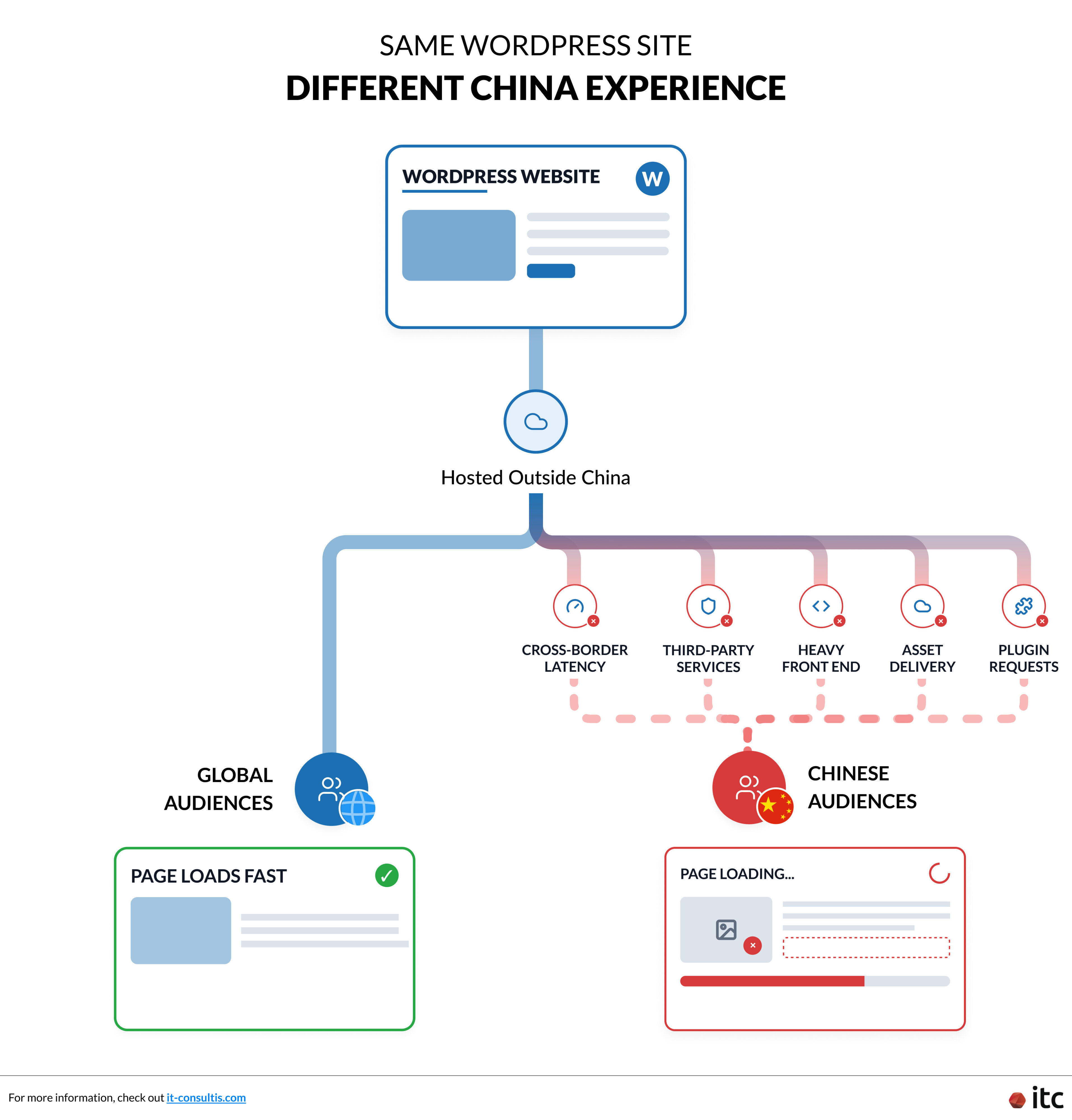
That is where many global websites fall short. A site may load reasonably well in a headquarters market, yet become uneven for users in China because of:
- Cross-border latency
- Blocked or degraded third-party services
- Heavy front-end execution
- Poor asset-delivery decisions
- Plugin behavior that depends on offshore requests behind the scenes
This is why WordPress hosting in China should be framed as a business decision, not just a DevOps decision.
If the website plays a role in lead generation, distributor support, campaign traffic, partner evaluation, or brand credibility, performance problems quickly become commercial problems.
So the real question is not whether WordPress can exist in China, but whether it can perform well enough to support business goals there.
Can WordPress Work Well in China?
Yes. WordPress can work well in China when it is deployed with the right architecture and operating model.
At the platform level, WordPress has a defined technical baseline, including server and software requirements documented in its official requirements. That baseline is not the difficult part.
The China-specific challenge begins with how the site is hosted, how assets are delivered, and which third-party services the front end depends on.
A disciplined WordPress setup can support corporate websites, localized content publishing, lead-generation journeys, and campaign landing pages for China audiences.
But WordPress is not forgiving when the website is overloaded with offshore dependencies, plugin sprawl, or global design choices that were never adapted for China.
In other words, WordPress is not the problem. More often, the issue is a weak website localization strategy for China.
The Main WordPress Hosting Models for China
There is no single best model for every company.
The right choice depends on how important China is to the business, how sensitive the site is to performance loss, and how much local operational complexity the organization is prepared to manage.
1. Offshore Hosting Optimized for China Users
This is often the most practical starting point. If China is relevant but not yet business-critical, an offshore setup may still be viable.
This is especially true when the site is primarily informational, traffic volumes are moderate, and the business is not yet relying on the website as a major conversion engine in China.
However, offshore hosting only works when the site is deliberately optimized. Without that discipline, teams often assume the model is acceptable because the homepage loads eventually, while key user journeys are already underperforming.
Offshore WordPress hosting becomes commercially weak when users in China are expected to:
- Submit lead forms during campaigns
- Open landing pages from paid traffic or QR codes
- Watch embedded videos as part of product education
- Interact with map, store-locator, or event components
- Use plugin-heavy front ends that trigger multiple offshore calls before the page becomes usable
If those journeys matter, an offshore model should be treated as a temporary answer, not a strategic one.
2. Mainland China WordPress Hosting
This is often the strongest option when China performance is commercially important every day.
When the website supports active lead generation, localized campaigns, distributor engagement, or ongoing business development in China, mainland hosting gives teams more control over local delivery conditions.
It can materially improve perceived speed, consistency, and reliability for users inside mainland China.
This model typically becomes more attractive when:
- China is a revenue-bearing market
- The website supports regular inquiries or conversions
- Local teams need dependable campaign and landing-page performance
- The business is ready to manage a more formal China operating model
The trade-off is not subtle. Mainland hosting can improve local performance, but it also raises the bar on preparation, governance, compliance, and ownership.
3. Hybrid or Regionalized Hosting
For many international brands, this is the most strategic WordPress hosting China model.
A hybrid approach is often the right answer when China is highly important, but the website still needs to remain usable and visible outside China for headquarters, investors, hiring, partners, or regional teams.
This model is especially valuable when the business cannot accept a weak China experience, yet also cannot treat the site as an isolated local asset.
In that case, the goal is not to choose between global and China. The goal is to design a website architecture that gives China users the experience they need while preserving global governance and visibility.
How to Choose the Right WordPress Hosting China Setup
The real decision is not “Where should the server sit?”
The real decision is: How localized does the website need to become for China users to convert and engage with confidence?
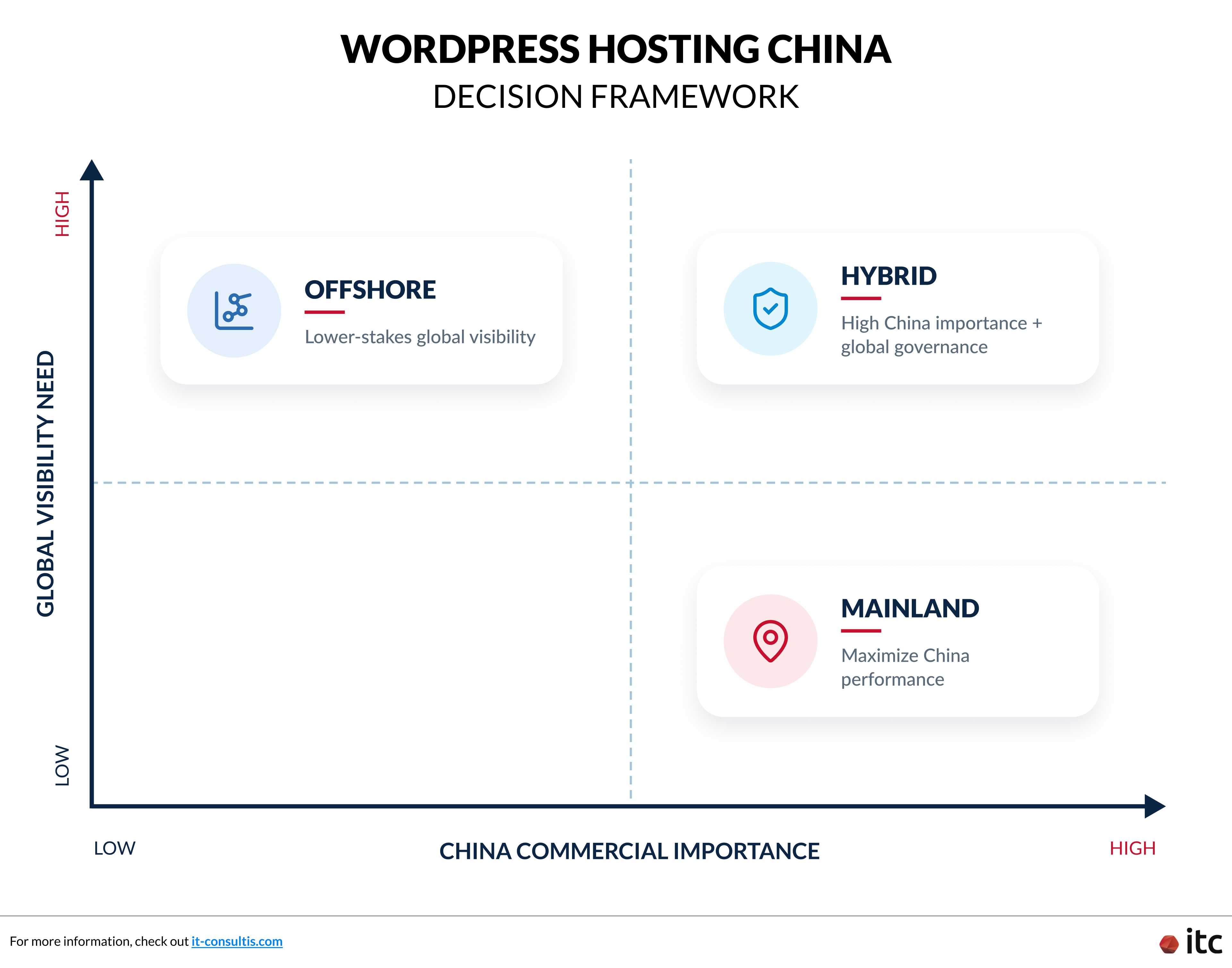
Choose Offshore First When China Is Still Secondary
An offshore model can still make sense when the China website is mostly for visibility, credibility, or light inbound traffic.
In that situation, the priority should be to simplify the site, control dependencies, and test whether the user experience is good enough before taking on local complexity.
Move Toward Mainland Hosting When China Performance Starts Affecting Revenue
If China traffic is tied to paid campaigns, partner recruitment, distributor enablement, or regular lead capture, weak performance stops being a technical inconvenience. It becomes a growth constraint.
This is usually the point where mainland hosting deserves serious evaluation.
Use Hybrid When China Is Primary but Global Visibility Still Matters
If China is central to the business but the website still needs to support global oversight or non-China audiences, a hybrid model is often the most resilient option. It avoids forcing a single infrastructure choice to serve two very different business needs badly.
Hosting is only one part of the decision. Businesses also need to select the right WordPress development partner to manage localization, dependencies, and long-term website governance
Four Practical Decision Signals
- Offshore is becoming risky when forms, landing pages, or campaign traffic in China start showing drop-off tied to speed or reliability.
- Mainland hosting becomes justified when China is an active operating market, and website performance directly affects pipeline, trust, or execution.
- Hybrid is the stronger strategic model when China needs a strong local experience, but the website still has a governance role outside China.
- Local complexity is worth absorbing when the commercial loss from weak China performance is higher than the cost of a more localized operating model.
Where Offshore WordPress Hosting Starts to Fail in Practice for China
The weakness of offshore hosting is not abstract. It shows up in specific commercial journeys.
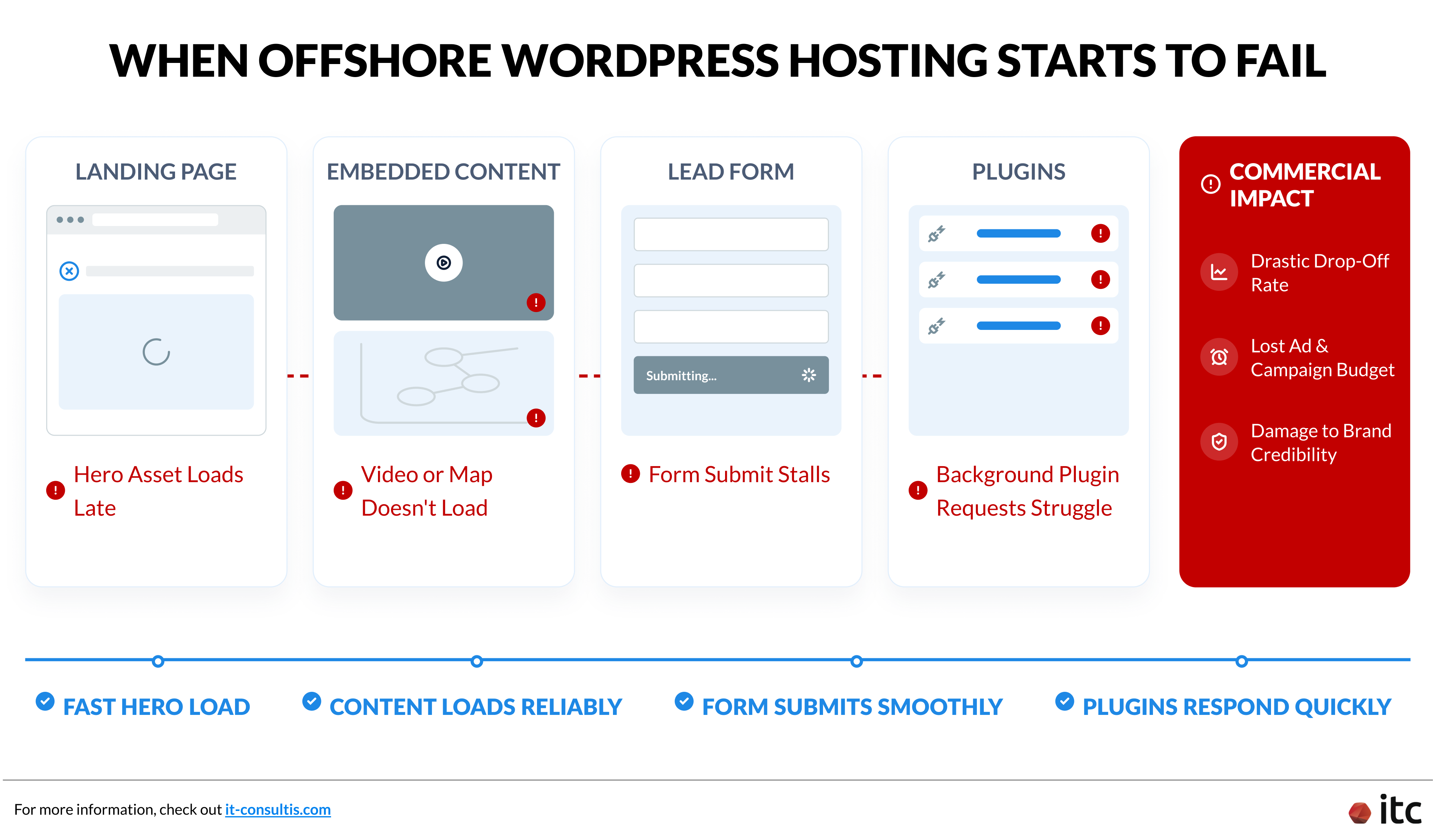
Lead Forms Stop Converting Reliably
A page may look acceptable, but if form scripts, validation logic, or anti-spam services depend on slow or degraded offshore calls, the user experience can become inconsistent at the most important moment.
Campaign Landing Pages Lose Momentum
Paid traffic and QR-code traffic are less forgiving than organic browsing. If the page loads slowly, key assets appear late, or the call to action stalls, the business loses media efficiency and conversion potential.
Embedded Components Break Trust First
Maps, videos, social embeds, or widget-driven components often fail before the rest of the page fully fails. The result is a website that technically loads but feels incomplete or unreliable.
Plugin-Dependent Front Ends Become Fragile
Many WordPress builds rely on plugins and third-party scripts that make offshore requests in the background.
As Google’s guidance on third-party JavaScript explains, these scripts can delay loading and user interaction. For China-facing websites, cross-border latency or degraded access to external services can compound that impact.
The result can be uneven rendering, delayed page interaction, broken modules, or hidden dependencies that only become visible when China traffic matters.
These are not edge cases. They are signs that WordPress hosting for China is being managed too narrowly — as a server decision rather than as a broader front-end, dependency, and delivery decision.
ICP and Operating Requirements
If a WordPress website is hosted in mainland China, ICP filing is part of the operating requirement. It should be planned early, not treated as a later administrative detail.
That matters because mainland hosting is not only an infrastructure choice. It is an operating-model decision involving questions such as:
- Which entity supports the local setup
- Who owns filing and launch readiness
- How deployments and updates are governed
- How forms, content, and ongoing operations are managed over time
The commercial case for mainland hosting can be strong, but the business should enter it deliberately.
Common Mistakes to Avoid
1. Treating WordPress Hosting China as a Server-Only Question
A faster server does not solve poor front-end decisions, weak asset delivery, or dependency risk.
2. Staying Offshore Too Long
Many businesses keep a global setup long after it has stopped being fit for China-facing traffic. By the time they act, campaigns, trust, and conversion quality have already suffered.
3. Assuming a Major Cloud Provider Fixes the Whole Problem
Using a strong provider helps, but provider choice alone does not fix architecture, usability, or governance issues.
4. Ignoring Global Stakeholders in a China-First Model
Some businesses optimize only for local access and then create problems for headquarters visibility, talent attraction, investor review, or regional coordination.
5. Letting Plugin Sprawl Accumulate
Every extra plugin, script, and exception increases the chance that a WordPress site becomes slower, harder to govern, and more fragile in China.
What a Strong China-Ready WordPress Setup Looks Like
A strong setup is defined less by its label and more by its discipline.
A credible WordPress hosting China setup usually includes:
- A hosting model aligned to China’s actual business role
- A lighter, more controlled front end
- Fewer risky third-party dependencies
- Cleaner asset-delivery choices
- Clear ownership for support and updates
- An explicit decision about how China performance and global visibility should coexist
That is the difference between a website that merely exists for China users and one that genuinely performs for them.
Conclusion
The right WordPress hosting China decision depends on how much business value the website needs to create inside China.
- Choose offshore hosting first when China is still a secondary market, and the website mainly supports visibility rather than high-stakes conversion.
- Move toward mainland hosting when speed, reliability, and form completion in China directly affect pipeline, trust, or campaign performance.
- Choose hybrid architecture when China needs a strong local experience, but the website still plays an important role for global stakeholders.
The strongest choice is not the one that sounds most local or most global. It is the one that matches the commercial role the website actually plays.
IT Consultis (ITC) helps brands evaluate WordPress hosting China options in business terms, balancing local performance, compliance requirements, website governance, and long-term scalability before infrastructure decisions become expensive to reverse.