
In China, RedNote (Xiaohongshu) shapes buying decisions long before conversion. Users rely on authentic reflections from other customers to compare options, validate brand claims, evaluate real-life experiences, and reduce purchase risk before taking action.
That is why a strong RedNote marketing strategy in China is not mainly a publishing plan. It is a search-and-evaluation system that answers buyer questions with the right content, the right creator role, and a community dynamic where people share opinions and experiences with others who are actively interested in the same topic.
That relevance does not stop at mainland China. It also matters for brands in Hong Kong/Macao, Singapore, and across APAC when Chinese discovery behavior influences regional consideration, travel, retail, hospitality, or service decisions.
In this article, we explain how winning brands build RedNote marketing strategies around search intent, useful proof, creator roles, community operations, and conversion design rather than around posting volume alone.
Executive Summary:
1. RedNote matters most in categories where buyers need comparison, reassurance, and real-use signals before they convert.
2. Strong performance starts with Chinese search behavior and buyer questions, not translated campaign messaging.
3. Owned notes, creator content, community management, and paid amplification each play different roles and should not be managed as one undifferentiated content stream.
4. KOLs, KOCs, and KOS accounts should be chosen based on the buyer friction that needs to be resolved at each stage of the journey.
5. Commercial impact depends on whether the post-discovery path is usable, compliant, and clearly owned across the teams that need to convert interest.
6. For brands with regional ambitions, RedNote can also support visibility outside mainland China: Hongkong/Macau, and Singapore; and demand capture when Chinese discovery behavior affects cross-market decision journeys.
Table of contents
- Why RedNote (Xiaohongshu) Matters for Brands in China
- What Makes a RedNote Marketing Strategy Different
- 1. Search Behavior Starts With Real Buying Questions
- 2. Useful Evidence Beats Translated Promotion
- 3. Organic Publishing, User-generated Content, and Paid Amplification Do Different Jobs
- 4. Different Creator Types Solve Different Decision Jobs
- 5. Comments, Saves, and Community Management Are Operating Signals
- 6. The Path From Discovery to Action Must Be Deliberately Designed
- How Xiaohongshu Influences Chinese Consumers Across APAC
- Is RedNote Right for Your Brand?
- The Operating Model Behind a Xiaohongshu Marketing Strategy That Works
- 1. Define the Commercial Objective First
- 2. Map Chinese Search Intent With Management Relevance
- 3. Build Content Families Around Evaluation, Not Just Visibility
- 4. Choose the Right Mix of KOLs, KOCs, and KOS Accounts
- 5. How Organic, Creator, and Paid Work Together
- 6. Run Community Operations and UGC Loops Deliberately
- 7. Lock Handoff Governance Before Scale
- A 90-day RedNote Marketing Strategy Rollout Plan
- Common Mistakes Brands Make on RedNote
- How Brands Should Measure Xiaohongshu Marketing Performance
- How IT Consultis (ITC) Helps Brands Build Xiaohongshu Marketing Strategies
- 1. When Buyer Questions Are Not Being Answered Clearly Enough
- 2. When the Creator Mix Is Generating Attention but Not Confidence
- 3. When the Next Step Exists, but the Handoff Is Too Weak to Convert Interest
- 4. When Teams Can Create Demand but Cannot Absorb It Reliably
- 5. When Reporting Overstates Activity and Understates Commercial Reality
- Conclusion
Why RedNote (Xiaohongshu) Matters for Brands in China
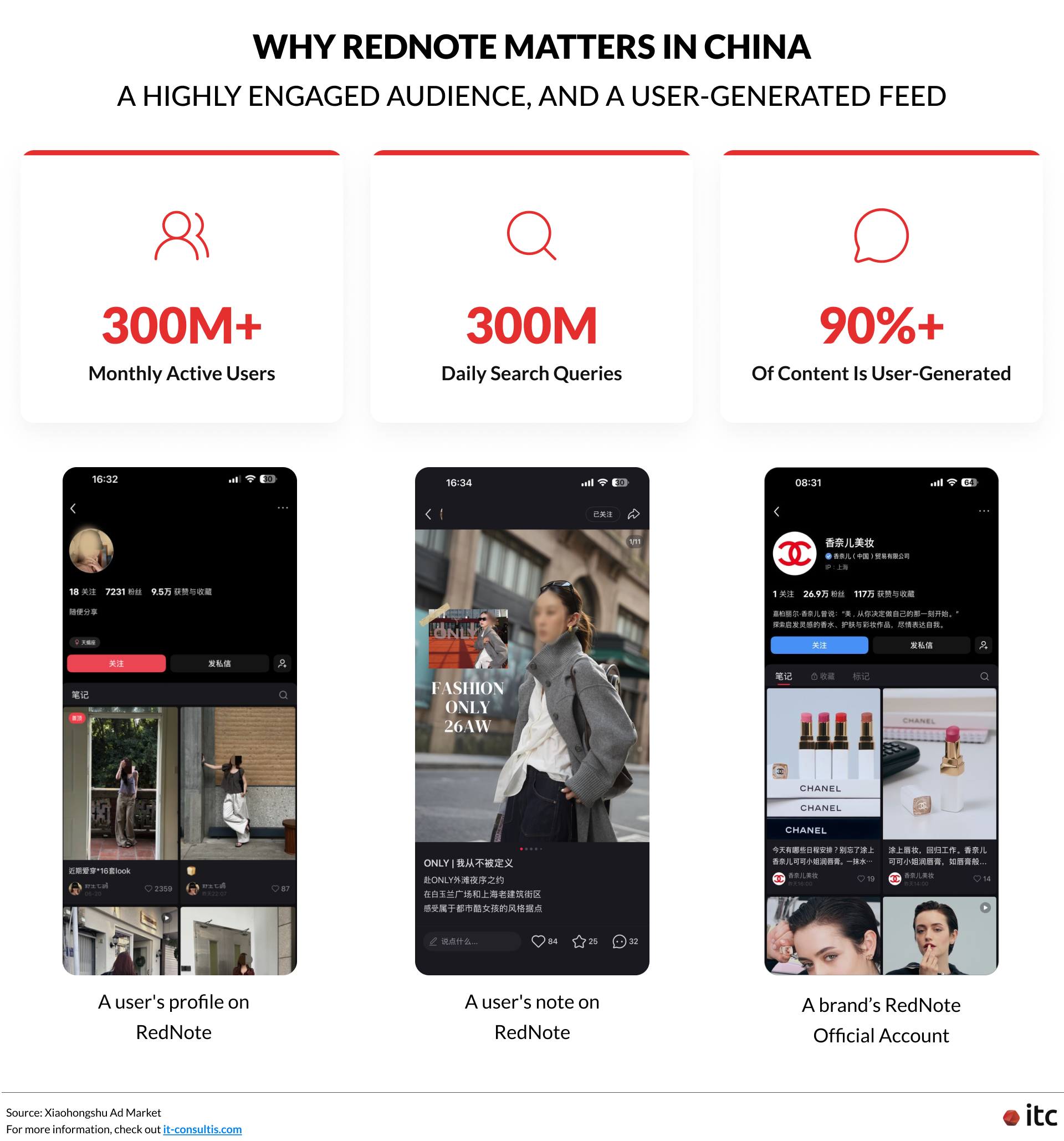
- Scale: Official RedNote business materials cite around 300 million monthly active users and 300 million daily search queries.
- Audience profile: RedNote is especially influential among younger, female-skewed audiences in China, particularly in categories where peer validation shapes purchase decisions.
- Platform dynamic: Official business materials also state that more than 90% of content is user-generated, which helps explain why discovery, evaluation, and influence sit so close together on the platform.
The implication is straightforward: RedNote influences shortlist formation, trust, and the quality of the next step toward conversion. That matters most in categories where buyers need reassurance on suitability, value, quality, or real-world experience before they move.
For some brands, that influence also carries into broader regional performance. When Chinese discovery behavior affects travel, cross-border shopping, hospitality, or service selection, RedNote can matter to Singapore, Hong Kong/Macao, and broader APAC commercial outcomes rather than to mainland China alone.
What Makes a RedNote Marketing Strategy Different
1. Search Behavior Starts With Real Buying Questions
Users on RedNote usually search with practical questions, comparisons, and suitability checks, not with the polished slogans brands use in campaign messaging.
This is where RedNote SEO starts. It is not about stuffing keywords into polished captions. It starts with matching real Chinese search behavior: the comparisons, hesitation points, suitability checks, and decision-stage questions people use when evaluating products, brands, and solutions.
The strongest search themes sit close to hesitation:
- How this compares
- Whether it suits me
- Whether it is worth the price
- Whether it solves my specific problem
- What could go wrong if I choose it
That means strong content should answer a decision question quickly through comparison, scenario, checklist, routine, or point of view. Notes that feel useful usually outperform copy that feels polished but generic.
2. Useful Evidence Beats Translated Promotion
A strong note names the user situation, surfaces the trade-off, explains suitability, and resolves hesitation. A weak one sounds like finished brand messaging before the buyer’s question has been answered.
On Xiaohongshu, content that improves understanding and helps users make more confident choices is usually more valuable than content that merely looks premium.
3. Organic Publishing, User-generated Content, and Paid Amplification Do Different Jobs
Owned notes help brands answer repeat buyer questions and build a searchable footprint around priority themes.
User-generated content (UGC) and creator content add realism, social proof, and category-specific reassurance that branded copy cannot provide alone.
Paid amplification has a role, but it should usually scale content logic that is already working rather than compensate for weak search alignment, weak proof, or weak handoff design.
On Xiaohongshu, adding budget to the wrong message often magnifies the mismatch instead of fixing it.
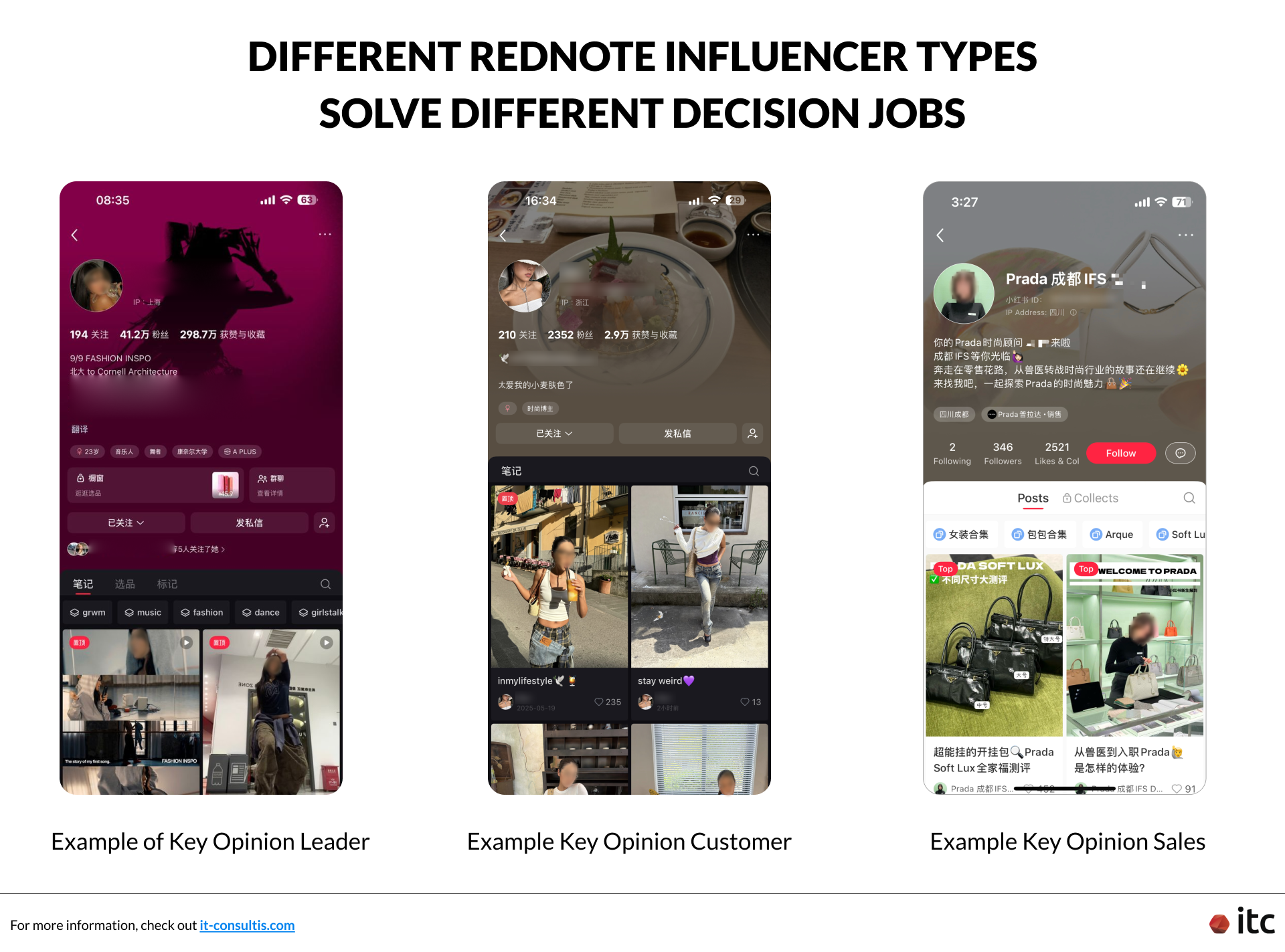
4. Different Creator Types Solve Different Decision Jobs
- KOLs can shape category understanding and build authority.
- KOCs can reduce perceived risk through realism, relatability, and peer-level reassurance.
- KOS accounts are brand-affiliated accounts that sit closer to sales than KOLs and KOCs, using content and conversation to help convert interested users.
The commercial question is not which creator tier is “best.” It is which type of creator is best suited to the buyer question at that stage of the journey.
If the main barrier is category understanding or trust transfer, a KOL may be the right lead voice.
If the barrier is realism, suitability, or “is this really for someone like me?”, KOCs usually do more to reduce hesitation.
If users are already asking detailed product, service, booking, or consultation questions, brand-affiliated KOS accounts are often the better conversion layer.
The smartest programs choose the mix based on friction, not follower count.
5. Comments, Saves, and Community Management Are Operating Signals
Saves often signal reference value. Repeat searches suggest the buyer is still evaluating. Detailed comments reveal the objection that is blocking action.
Community management should therefore do more than moderate replies. It should identify recurring questions, feed them back into note planning, improve creator briefs, and strengthen FAQs, landing paths, or store scripts.
UGC also needs to be cultivated, not left to chance. Brands that win on Xiaohongshu usually create more opportunities for customers, creators, store teams, or event participants to generate authentic proof, reactions, and scenario-based content that other users can evaluate.
6. The Path From Discovery to Action Must Be Deliberately Designed
The next step matters because Xiaohongshu is increasingly tied to commercial intent, not just inspiration.
Potential handoff paths include:
- A Xiaohongshu store or Xiaohongshu Mini Program
- Consultation through Xiaohongshu private messaging
- Store-visit invitations
- CRM capture or another approved conversion destination
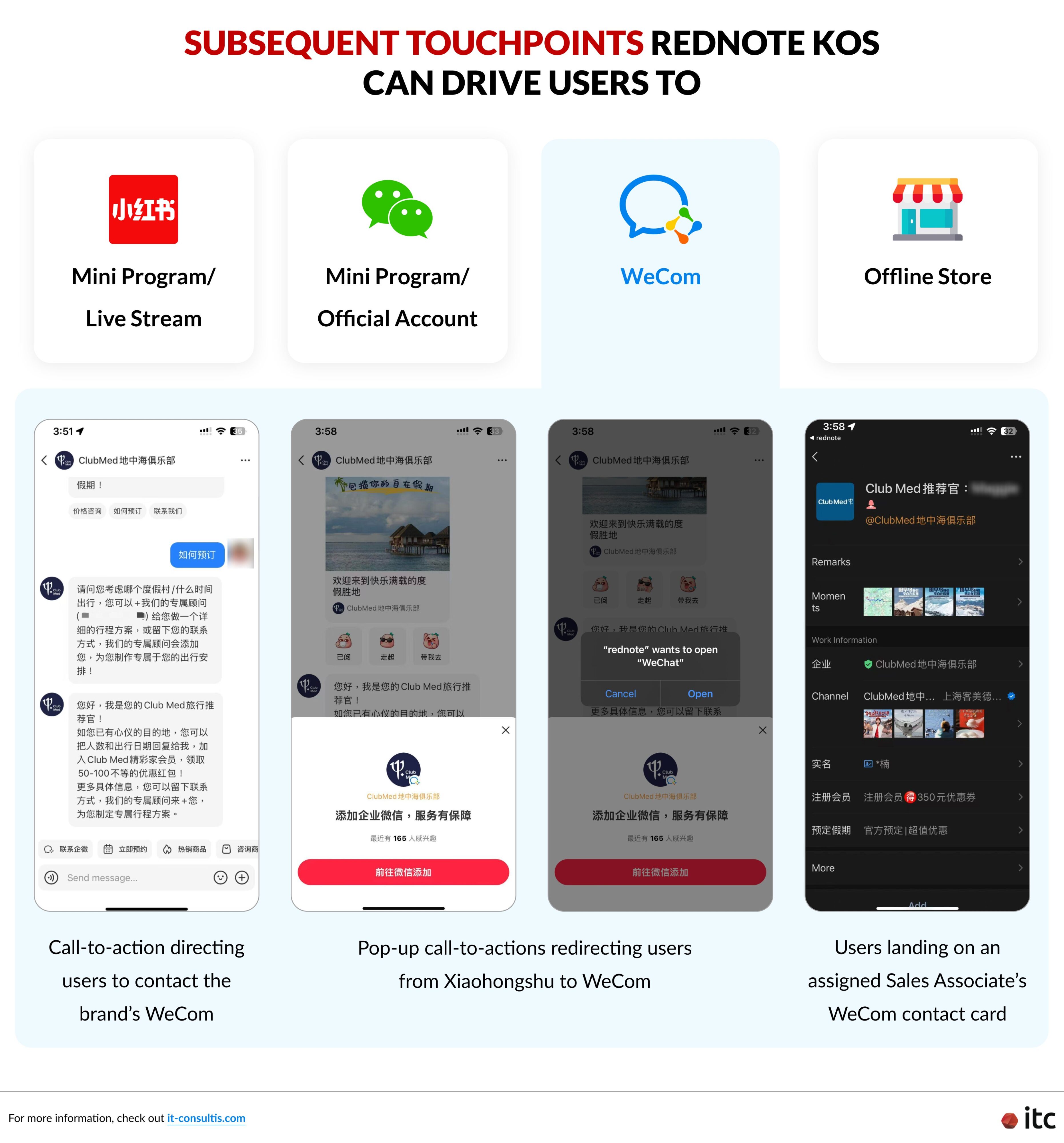
For many brands, RedNote is not the final conversion environment but the entry point into a broader ecosystem. Users may discover the brand on RedNote, then move into:
- WeCom for consultation
- WeChat Official Account for continued education and follow-up
- WeChat Mini Program for browsing, booking, registration, or purchase
The right route depends on the decision moment and how much reassurance or intent the user already has.
However, the handoff route is only as strong as its execution.
A direct messaging call to action fails when response ownership is unclear. A Mini Program route underperforms when the content creates intent, but the transaction path still creates doubt. A store-visit invitation stalls when staff cannot see source context or follow up with the right message.
Before scaling, any off-platform path should align consent capture, data minimization, and lead routing with China’s applicable legal requirements, such as the Personal Information Protection Law (PIPL).
How Xiaohongshu Influences Chinese Consumers Across APAC
Xiaohongshu matters beyond mainland China because Chinese users increasingly use it to decide what to buy, where to go, what to book, and which brands to trust across Hong Kong/Macao, Singapore, and broader APAC, especially in travel, hospitality, retail, luxury, wellness, and other experience-led categories.
Dragon Trail’s Spring 2025 survey found that 68% of planned outbound trips by Chinese travelers were within Asia, while the Singapore Tourism Board has already formalized cooperation with Xiaohongshu to understand these customer journeys better.
This is especially relevant for brands in Singapore, Hong Kong/Macao, and other APAC markets that depend on Chinese travelers, cross-border retail demand, or Chinese-speaking audiences during destination and purchase planning.
For brands, the takeaway is simple: success on Xiaohongshu in APAC depends on aligning with how Chinese users discover and decide.
- Search intent is scenario-led: users search around trips, value, convenience, and what is worth prioritizing.
- Content should reflect decision moments: destination, travel, and cross-border angles usually outperform abstract regional messaging.
- Follow-through must work in Chinese: if users cannot easily book, ask questions, or understand the next step, interest is unlikely to convert.
- This works best in experience-led categories: beauty, fashion, luxury, hospitality, wellness, dining, travel retail, and destination experiences.
Is RedNote Right for Your Brand?
RedNote is usually a stronger fit for B2C than B2B because the platform is primarily consumer-led and discovery-led.
Strong Fit
- Your category involves research, comparison, or reassurance before purchase.
- Consumers actively seek recommendations, reviews, or suitability guidance.
- You can sustain native Chinese content and timely community response.
- You have a credible next step after discovery, whether that is consultation, store visit, commerce, or qualified CRM capture.
- You also want your China-facing visibility to support broader demand in Hong Kong/Macao, Singapore, and APAC in general, or cross-market consideration where relevant.
Lower Fit
- Your product is bought almost entirely on impulse.
- Local content quality cannot be maintained.
- There is no Chinese-language response capability.
- There is no usable path from discovery to a business outcome, or the follow-up teams cannot absorb interest fast enough to convert it.
- Xiaohongshu may still help build awareness and attract relevant attention, but it is less likely to perform as a strong search-and-evaluation channel that drives meaningful conversion outcomes.
The strongest fits are usually categories where reassurance changes behavior: beauty, fashion, luxury, wellness, maternity and baby, travel, and lifestyle retail.
The Operating Model Behind a Xiaohongshu Marketing Strategy That Works
A practical RedNote marketing strategy translates business goals into repeatable operating decisions across content, creator roles, community response, conversion paths, and reporting.
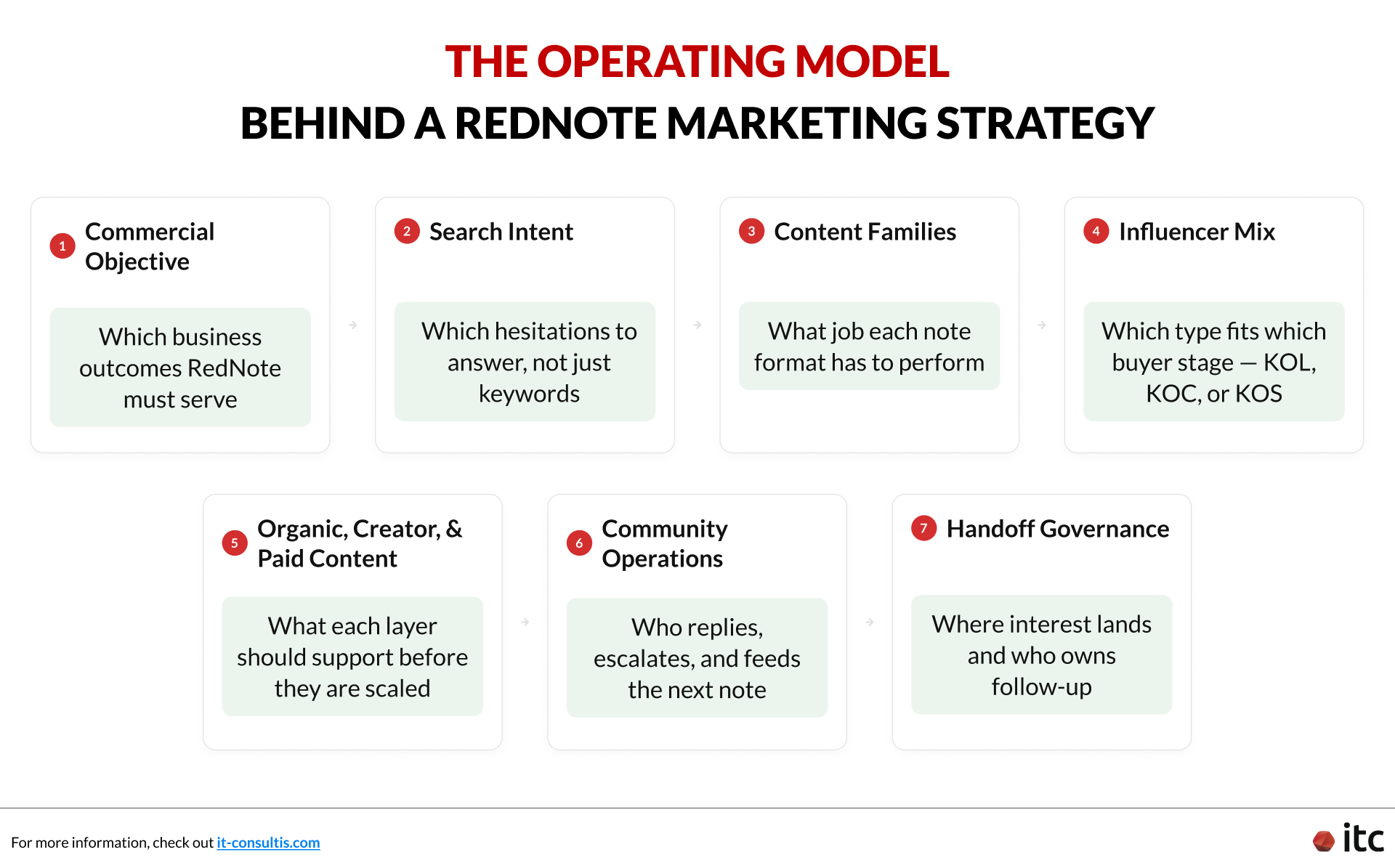
1. Define the Commercial Objective First
Clarify whether RedNote is meant to support education, launch visibility, trust building, qualified interest, commerce, store visits, consultation, or clienteling.
Then define four things clearly:
- The buyer question
- The evidence needed to resolve it
- The next step you want the user to take
- The team that owns that next step
2. Map Chinese Search Intent With Management Relevance
Organize category terms, comparisons, reviews, scenario-led questions, reputation concerns, and post-purchase anxieties.
Do not stop at broad product keywords. The more valuable clusters usually sit closer to hesitation: first-time-use anxiety, premium justification, giftability, maintenance concerns, booking readiness, or location-specific convenience.
3. Build Content Families Around Evaluation, Not Just Visibility
Different note formats should do different jobs:
- Education
- Awareness enhancement
- Comparison
- Objection handling
- Review and reassurance
- Inspiration
- Expert or brand credibility
A useful structure usually starts with the user situation, moves into evidence or comparison, and ends with a clear next step.
A beauty brand may need separate note families for ingredient reassurance, routine education, before-and-after proof, premium-value framing, and engagement.
A premium travel brand may need one stream for destination aspiration and another for itinerary confidence, service expectations, and booking readiness.
4. Choose the Right Mix of KOLs, KOCs, and KOS Accounts
Choose creators based on the kind of reassurance the buyer still needs.
- Use KOLs when the category needs framing, authority, or strong trust transfer.
- Use KOCs when buyers need realism, suitability reassurance, or peer-level proof.
- Use KOS accounts when high-intent users need product explanation, consultation handling, or conversion-oriented guidance.
The practical test is simple:
- If users are still asking “Why should I care?”, the content likely needs stronger framing.
- If they are asking “Will this work for me?”, the program probably needs more realism and scenario-based reassurance.
- If they are asking “How do I buy, book, or speak to someone next?”, the conversion layer needs strengthening.
5. How Organic, Creator, and Paid Work Together
Organic publishing, creator collaboration, and paid media should support different parts of the same system.
- Owned content creates the searchable knowledge base.
- Creator content provides outside validation and more varied proof.
- RedNote paid ads should help scale the themes, posts, or creator angles that already show strong saves, substantive comments, or better downstream progression.
Treating advertising as a shortcut around weak strategy usually wastes budget. The better approach is to prove the content logic first, then amplify what has already shown fit.
6. Run Community Operations and UGC Loops Deliberately
Community response should not be treated as a courtesy task after publishing. It should function as an operating input.
Teams should define:
- Who owns first-line replies
- What response speed matters for high-intent questions
- What must be escalated to product, legal, retail, or CRM owners
- Which recurring comment patterns should trigger a new note, creator brief, FAQ, or destination fix
This is also where stronger UGC strategies take shape. The recurring questions, objections, and proof gaps in the comments should guide what kind of authentic customer stories, creator briefs, store-level content, or event-driven proof the brand needs next.
7. Lock Handoff Governance Before Scale
Many Xiaohongshu programs underperform because interest is created faster than it is handled.
Before scale, define:
- Approved destinations
- Comment and message ownership
- Escalation rules
- Consent capture requirements
- Lead-routing logic
- Response-time and follow-up standards
- Reporting rules for what counts as value
Where advertising or promotional content is involved, controls should be explicit: ad identifiability, approved claims, approved destinations, and data-handling checks before off-platform capture.
For example, SAMR’s Internet Advertising Identifiability Enforcement Guidelines reinforce the importance of clearly identifiable advertising and the risks of misleading promotional presentation.
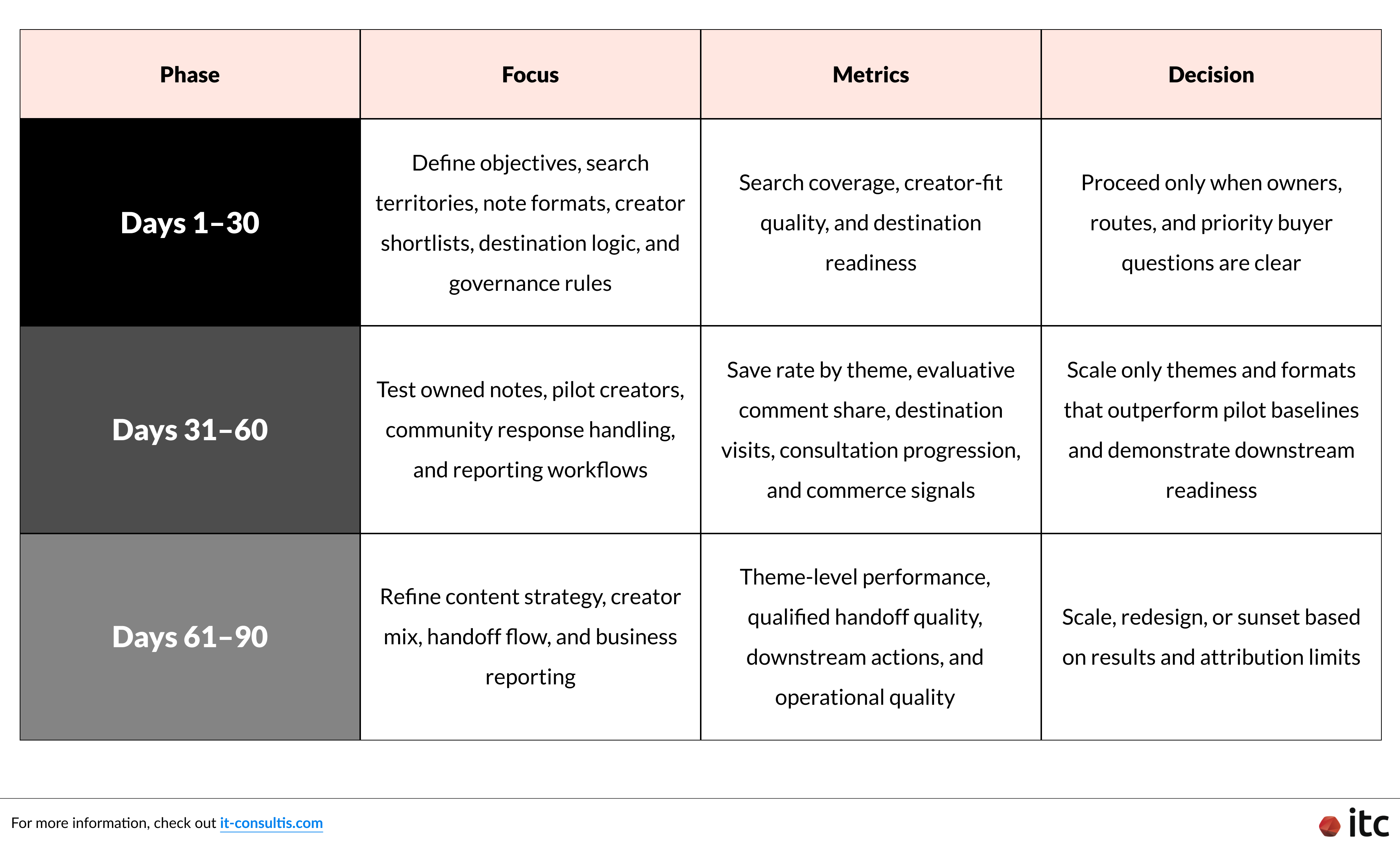
A 90-day RedNote Marketing Strategy Rollout Plan
Common Mistakes Brands Make on RedNote
- Treating RedNote like broadcast media instead of a research and evaluation environment.
- Translating HQ messaging directly instead of rewriting for Chinese decision intent.
- Choosing creators by reach alone instead of assigning them a specific role in the journey.
- Expecting paid support to rescue weak content logic instead of fixing the underlying search, proof, or handoff problem first.
- Treating comments as moderation work only instead of using them to improve content, UGC generation, and conversion design.
- Scaling activity before the next step is usable and owned across the teams that need to convert interest.
- Adding an APAC ambition to the narrative without defining what regional role RedNote is actually meant to play in the commercial model.
How Brands Should Measure Xiaohongshu Marketing Performance
Measure Xiaohongshu against the job it plays in the journey, not against engagement alone.
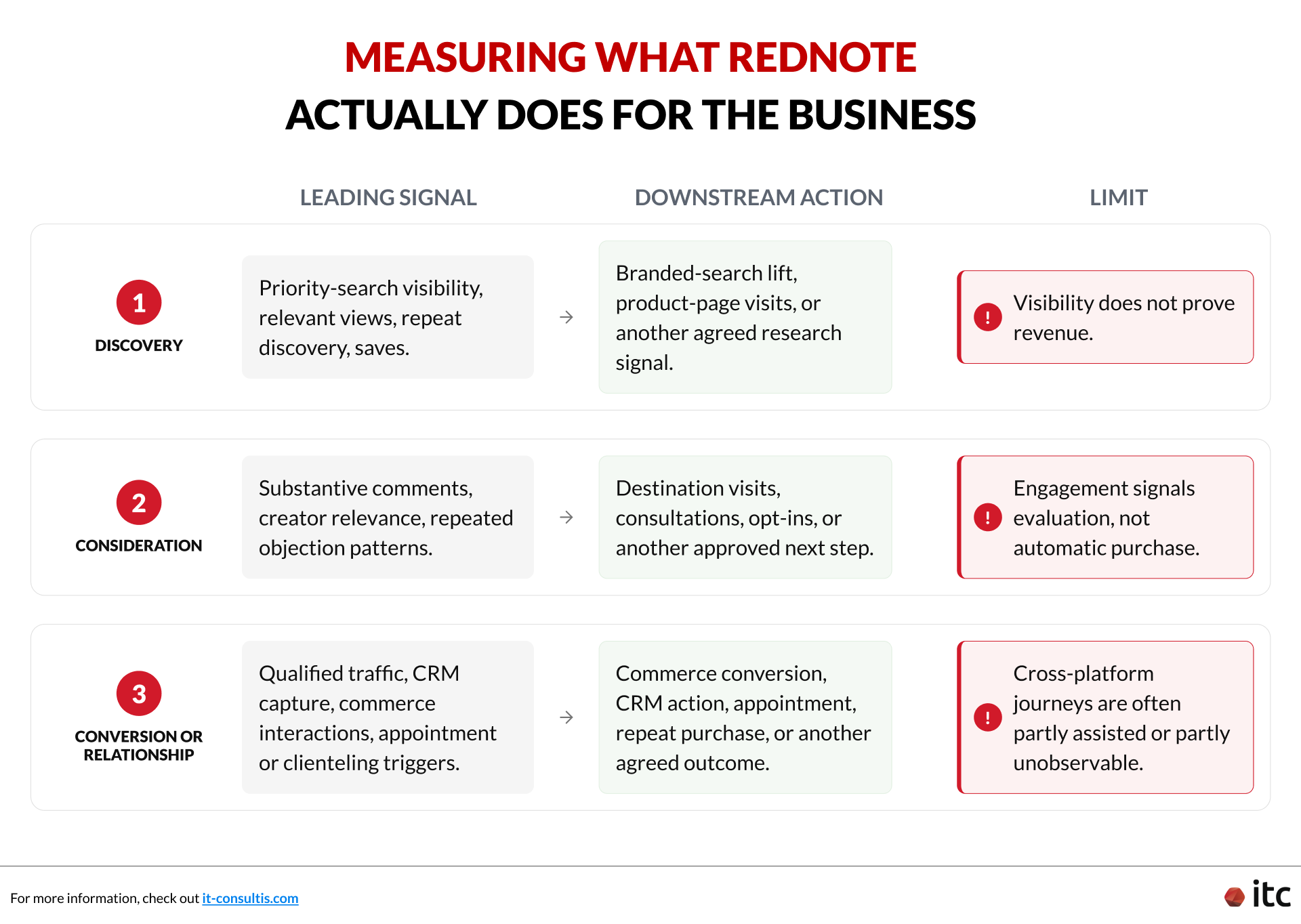
A useful RedNote report should answer four questions:
1. What objective does the platform support?
2. Which signal should improve first?
3. What downstream action proves value?
4. What can the data not prove on its own?
How IT Consultis (ITC) Helps Brands Build Xiaohongshu Marketing Strategies
IT Consultis (ITC) helps brands in China, Singapore, Hong Kong/Macao, and across APAC use Xiaohongshu to reach Chinese consumers and turn interest into measurable business action.
The value ITC adds is not generic channel management. It is fixing the breakdowns that stop Xiaohongshu interest from turning into qualified business action.
1. When Buyer Questions Are Not Being Answered Clearly Enough
Many brands publish attractive content but leave core decision friction unresolved. Comparison coverage is thin. Suitability concerns are handled too vaguely. Premium pricing is asserted rather than justified.
ITC helps identify which buyer questions are blocking movement and then reshape the content plan around those gaps. That often means clearer comparison themes, stronger scenario-led notes, sharper objection handling, and more useful proof tied to the actual buying moment.
2. When the Creator Mix Is Generating Attention but Not Confidence
A program can look active on the surface and still underperform because the creator role is wrong for the job. Authority-led creators may create awareness while peer-style reassurance is what the buyer still needs. In other cases, the missing piece is not reach but product explanation or conversion-oriented guidance.
ITC helps brands decide whether the gap sits in category framing, realism, suitability reassurance, or high-intent guidance, then adjusts creator roles and briefing accordingly.
3. When the Next Step Exists, but the Handoff Is Too Weak to Convert Interest
A brand may have a DM route, Mini Program, store appointment path, or CRM capture point in place, yet still lose momentum because the route does not match the user’s decision moment. Messages go unanswered, product exploration is clumsy, store teams lack context, or lead routing breaks after capture.
ITC helps brands redesign the path from Xiaohongshu into usable follow-through across Xiaohongshu private messaging, WeCom, Xiaohongshu Mini Programs, CRM capture, appointment journeys, and store operations.
4. When Teams Can Create Demand but Cannot Absorb It Reliably
One of the most common failure patterns is operational, not creative: social receives the question, CRM receives too little context, and retail or service teams respond too late for the interest to hold.
ITC helps define response ownership, escalation logic, qualified lead routing, compliant data capture, and the downstream systems needed to support consultations, opt-ins, store appointments, or other measurable actions.
5. When Reporting Overstates Activity and Understates Commercial Reality
Some programs celebrate views and engagement while missing the harder question: did Xiaohongshu create qualified visits, consultations, opt-ins, appointments, or attributable downstream movement?
ITC helps brands set measurement around the actions that matter for the business, while being explicit about attribution limits across multi-touch journeys.
Conclusion
A strong Xiaohongshu marketing strategy is not built by producing more content alone.
It works when buyer questions, creator roles, content design, community response, and the next step are aligned into one operating system.
Before increasing creator or media investment, brand leaders should do three things in order: identify the buyer questions that still block action, lock the handoff route that best fits the decision moment, and assign clear ownership for response and follow-through.
If those elements are weak, more activity usually scales leakage rather than results.