
Over the past few years, RedNote (or Xiaohongshu or Little Red Book) has evolved from a pure content-sharing community into one of China’s most influential decision-making platforms. Users no longer come only to be inspired — they come with concrete questions, intent, and purchase decisions to make.
In this context, KOS (Key Opinion Sales) has emerged as a core pillar of Xiaohongshu clienteling and a powerful bridge between content and conversion.
Instead of relying only on external influencers — Key Opinion Leaders (KOLs) or Key Opinion Consumers (KOCs), brands are building their own professional front-line accounts on Xiaohongshu to answer questions, give advice, and guide users through to purchase.
This article explains what a Key Opinion Sales is, how it differs from KOL and KOC, why it matters, and how brands can design an effective RedNote KOS strategy.
Executive Summary:
1. RedNote (Xiaohongshu) has evolved into a high-intent decision-making platform, where Key Opinion Sales (KOS) accounts bridge the gap between inspirational content and concrete purchase decisions.
2. KOS are brand‑affiliated, professionally trained accounts that combine content creation with 1‑on‑1 consultations, turning user questions into actions like product recommendations, bookings, and offline try‑ons, while building long‑term clienteling relationships.
3. Recent Xiaohongshu updates make it easier for brands to run structured, conversion‑oriented KOS programs.
4. Success should be measured beyond vanity metrics, with RedNote and WeCom clienteling investments balanced based on each brand’s assets.
Table of Contents
- What is Key Opinion Sales (KOS) Marketing?
- Key Advantages of RedNote Key Opinion Sales
- KOS Eligibility & Activation Requirements
- Latest Feature Updates for RedNote KOS
- Regulations & Compliance in RedNote Clienteling: What Brands Need to Watch
- Navigating Clienteling in China: WeCom vs Xiaohongshu Clienteling
What is Key Opinion Sales (KOS) Marketing?
KOS refers to brand-affiliated or professionally trained accounts on Xiaohongshu that combine content creation with direct sales responsibility.
A KOS account is not just here to “post and leave”. It is designed to answer questions, handle consultations, and help users move confidently toward a decision.
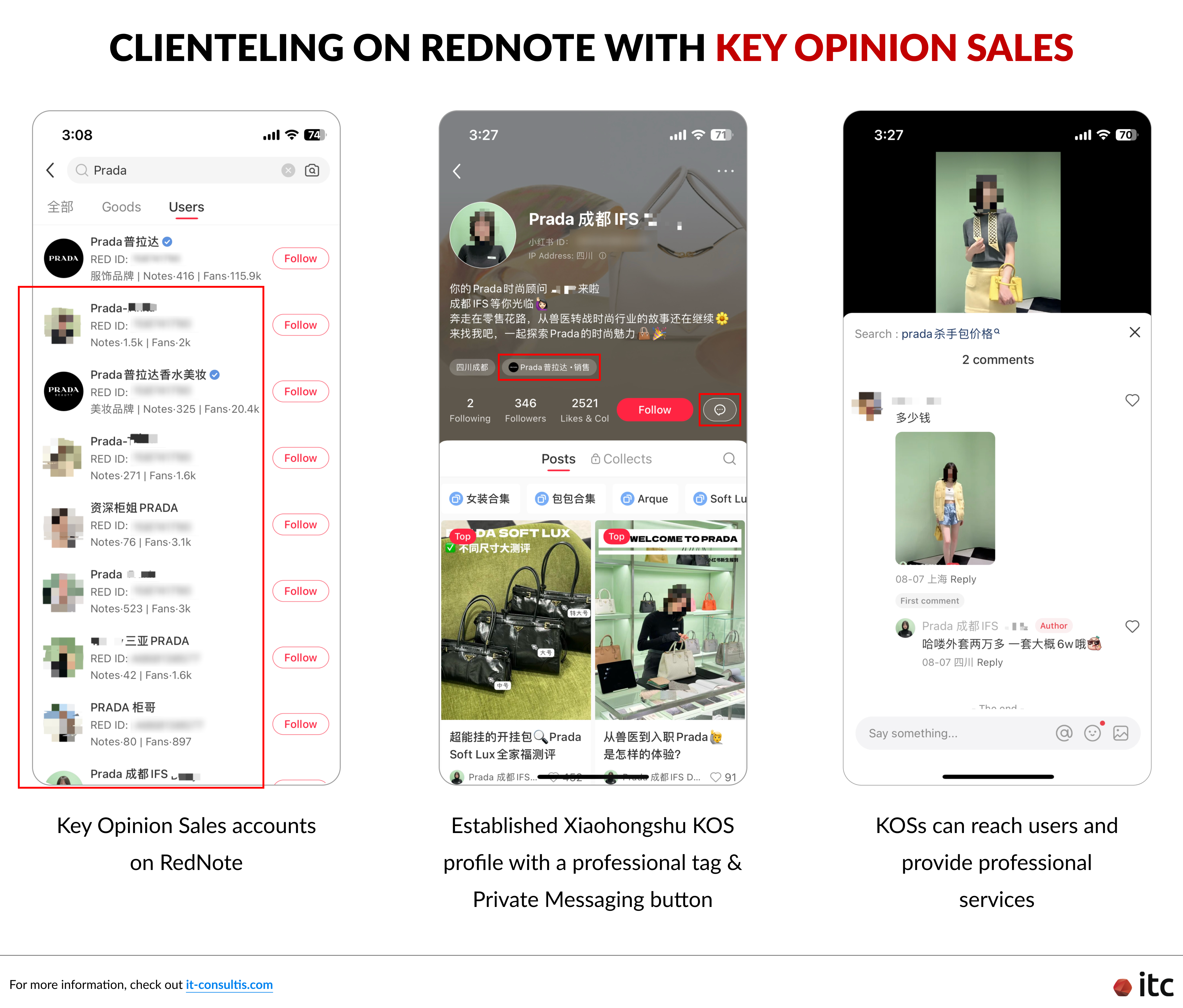
To understand where KOS sits, it’s useful to contrast it with other familiar roles:
- Primary role: reach and awareness
- Strength: mass exposure through large followings and high-impact content
- Typical use: product launches, big campaigns, and branding pushes
KOC (Key Opinion Consumer)
- Primary role: peer-level credibility and authenticity
- Strength: feels like advice from a friend or a real user
- Typical use: real customer reviews, user-generated content, and word-of-mouth
KOS (Key Opinion Sales)
- Primary role: guide and convert high-intent users
- Strength: combines professional knowledge, real-time interaction, and sales accountability
- Typical use: handling clienteling, answering detailed questions, nudging users from interest to action, and driving offline consultations or try-ons (O2O)
According to coverage of Xiaohongshu’s collaboration with Vogue Business, by 2024, the platform’s KOS ecosystem already includes over 100,000 business sales accounts and close to 2 million pieces of content, with a strong focus on luxury and high‑consideration categories.
Key Advantages of RedNote Key Opinion Sales
As RedNote (Xiaohongshu) matures, users expect more than inspirational content. They want professional, responsive, and credible engagement, especially when they’re close to a decision.
This is where RedNote clienteling through Key Opinion Sales becomes critical.
Shortening the Path from Discovery to Clienteling
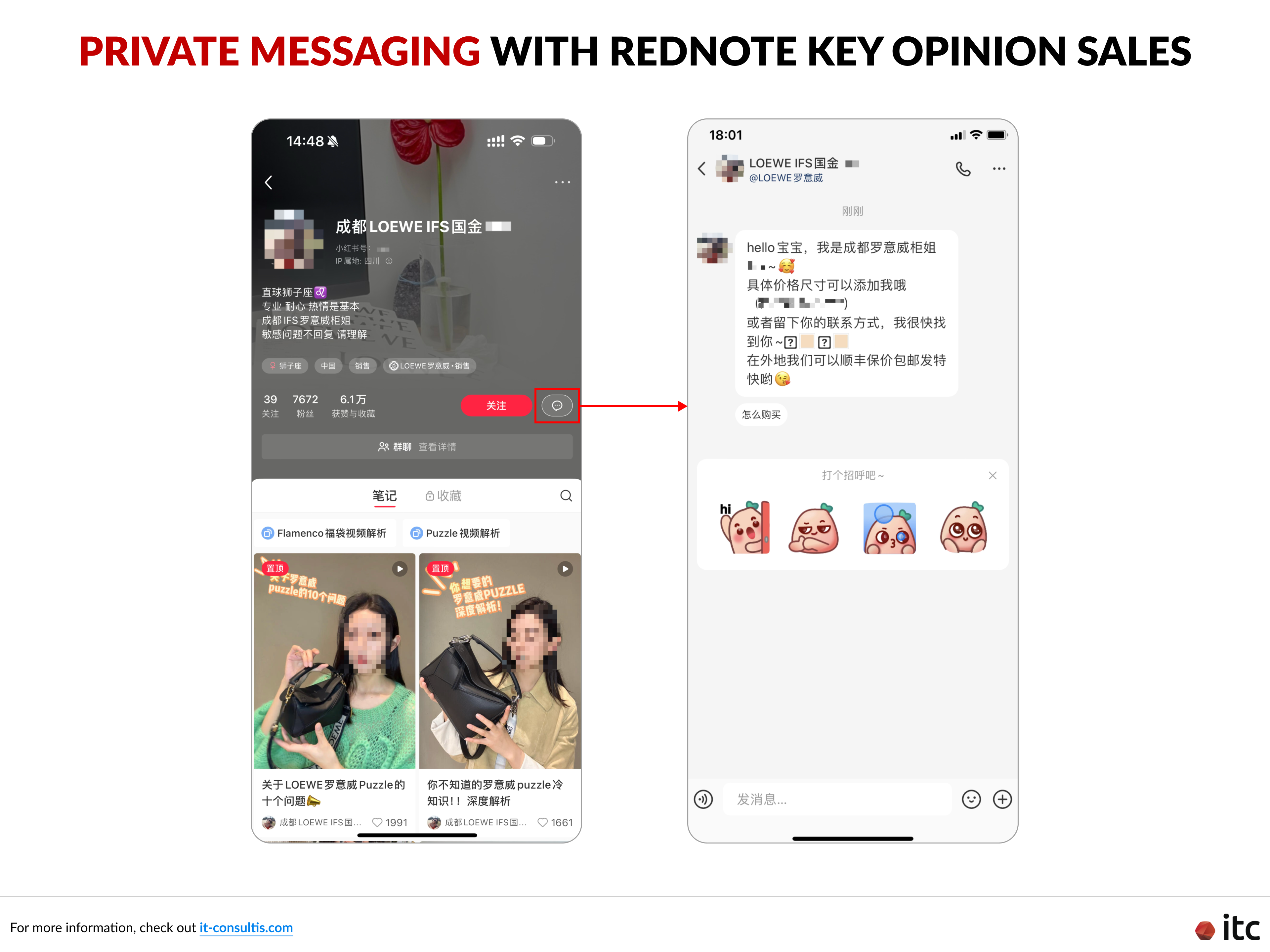
With KOS, users can go directly from a Note to a private 1‑on‑1 chat with a knowledgeable Sales Associate account, instead of leaving the platform to search elsewhere.
This keeps their decision journey inside RedNote and makes it easier to move from interest to consultation or booking.
Turning High‑Intent Questions into Concrete Actions
Many users have specific questions about usage, suitability, pricing, guarantees, or after‑sales service. KOS is designed to answer quickly and accurately, and can even encourage offline appointments for in‑person try‑ons and clienteling.
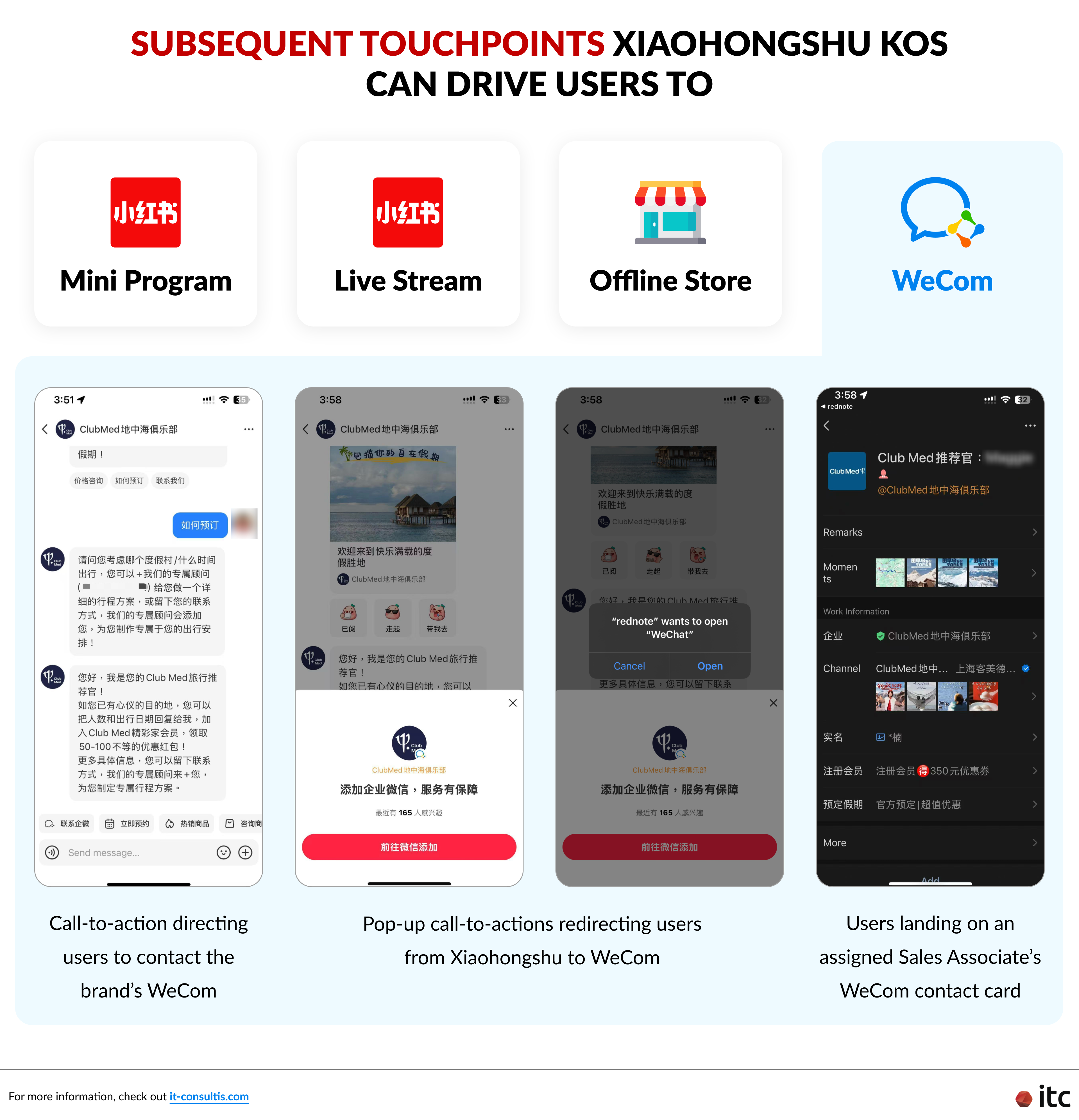
Brands can also integrate Xiaohongshu with WeCom, enabling KOS to smoothly redirect users for deeper clienteling, follow‑up, and long‑term relationship building.
Building Trusted, Brand‑Owned Clienteling Assets with Higher Credibility and Better ROI
KOS accounts are tied to real brands, stores, or professionals, not just individuals posting casually.
This makes them feel more official, trustworthy, and clienteling‑focused than generic influencer posts, and reassures users that they’re talking to someone who can actually help them buy, book, or sign up.
These KOS accounts can be:
- Managed internally by the brand or its agency
- Re‑assigned if staff change
- Scaled as a matrix of multiple accounts for different audiences, products, or cities
This means brands are not just “renting” reach from external influencers. They are building long‑term, owned clienteling relationships inside RedNote and a clearer conversion layer between marketing and sales — with more control, more measurable outcomes, and better overall ROI.
KOS Eligibility & Activation Requirements
To launch a RedNote KOS program, an enterprise must first complete official business verification on the platform.
Next, to activate a KOS account, brands then need to top up media budget via the RedNote platform, with two main options:
- Top up RMB 20,000 to obtain the KOS certification immediately.
- Top up RMB 2,000 and have this amount fully consumed within 30 days. Once the full deposit has been used as a traffic budget to promote content, the account can be upgraded to KOS.
Update on KOS employee account rules: For personal accounts to be directly bound as employee accounts, the account must have more than 5,000 followers.
This rule has been announced for 2026 but has not yet fully “landed” in practice, so brands should treat it as an emerging requirement and monitor official policy updates closely.
Currently, each verified enterprise can open up to 30 KOS accounts, although this quota remains subject to ongoing updates by the platform.
Within that cap, enterprises can select eligible Sales Associates based on their own criteria (e.g., store, region, performance, personality, etc.) when assigning KOS accounts.
Latest Feature Updates for RedNote KOS
RedNote has been strengthening its infrastructure to support KOS operations. Some key developments include:
1. Employee account recognition and account matrix management
Brands can formally recognize and manage multiple employee-operated or brand-operated accounts, making it easier to run a structured KOS matrix.
2. Enhanced private messaging and lead collection tools
Features for clienteling, enquiry forms, and lead capture support smoother follow-ups and integration with WeCom and CRM systems.
3. Integration with paid traffic
High‑performing KOS content can be scaled through paid information‑flow ads, extending reach while preserving a clear conversion path back to the Key Opinion Sales account.
By promoting the original KOS posts natively in the feed, brands amplify content that has already proven to have strong engagement and resonance with their target audience. This maintains the authenticity and storytelling that drive organic performance, while exposing the same content to a much larger audience.
Critically, paid traffic is directed back to the KOS account or original post, not a generic product page. Users can first explore more creator content, build trust through authentic recommendations, and then follow embedded purchase links. This creates a clearer content → trust → conversion journey.
This strategy offers several advantages:
- Higher credibility: Consumers perceive the content as creator‑driven recommendations rather than traditional brand advertising.
- Better conversion efficiency: Users arriving on the KOS page see multiple product experiences, which strengthens purchase intent before they click through to buy.
- Scalable performance: Brands can systematically identify top‑performing KOS posts and allocate paid budget to scale their reach and impact.
4. Improved data visibility
Brands have better access to engagement, lead, and conversion metrics, making it possible to evaluate KOS performance and optimize operations.
Taken together, these updates show a clear platform-level push toward structured, conversion-oriented content and accounts.
Regulations & Compliance in RedNote Clienteling: What Brands Need to Watch
As KOS grows, platform governance has tightened. Treating compliance as a core part of Xiaohongshu KOS operations — not an afterthought — is essential.
Key areas to pay attention to when implementing Xiaohongshu clienteling include:
- Clear identity disclosure and authenticity: KOS accounts should clearly represent who they are (brand, store, professional) and avoid misleading users.
- Industry qualifications in regulated sectors: Categories like finance, education, or healthcare often require specific licences or certifications. Brands and operators must ensure they meet Xiaohongshu’s qualification standards before promoting in these areas.
- Stricter review of promotional language: Exaggerated claims, indirect advertising tricks, and non-compliant wording are under increasing scrutiny.
- Follower threshold for upgrading to KOS: As mentioned above, for individual accounts that want to upgrade to a formal KOS account, a minimum of 5,000 followers is required.
Brands operating RedNote KOS at scale should build clear internal guidelines and checklists to avoid violations and protect both the account and the brand’s reputation.
Latest KOS Certification & Quota Policy Updates
Recent Xiaohongshu KOS policy updates have also adjusted both the cost structure and the scale at which brands can operate formal KOS programs. The key changes include:
- A RMB 600 certification fee per KOS account, with an additional annual renewal fee now required
- An increase in the maximum number of KOS accounts per company to 100, making it easier to build a larger, structured KOS matrix
- Removal of the previous consumption / ad‑spend requirement, lowering the barrier for brands that want to formalize their KOS operations
For brands, this means KOS is becoming a more regulated but also more scalable asset: there is now a clearer cost framework, but also significantly more room to roll out certified KOS accounts across different stores, categories, or cities.
Navigating Clienteling in China: WeCom vs Xiaohongshu Clienteling
Beyond RedNote KOS, clienteling in China also depends heavily on WeCom and the wider WeChat ecosystem.
In practice, the most effective set‑ups combine discovery and high‑intent engagement on Xiaohongshu with deeper 1‑to‑1 relationship management on WeCom.
While having a verified WeCom (WeChat Work) account is not a strict platform requirement, it is, in reality, a strong recommendation.
The core value of KOS lies in the “Contact WeCom” function — without WeCom, brands lose much of the benefit of turning public traffic into private contacts and connecting users directly with sales associates.
Ultimately, the right balance between RedNote and WeCom will depend on each brand’s audience, existing assets, and operational maturity.
For brands that are curious about how to navigate this balance and use RedNote strategically, IT Consultis (ITC) is helping brands unlock full-funnel growth in China by combining WeCom clienteling, RedNote KOS, WeChat and RedNote Mini Programs, and CRM into a coherent ecosystem.
If you’d like to review your current set‑up or explore what’s possible next, reach out to us to build your tailored roadmap.


