
For many brands in China, WeChat is no longer just a channel for publishing, engagement, and customer communication. It is also a discovery environment where users search for brands, articles, services, and next steps within a single connected ecosystem.
That creates a business risk. When discoverability is weak, brands lose visibility at the moment intent is highest, which can reduce qualified lead flow, weaken brand credibility, and limit how users progress toward the next step.
In this article, we explain how brands can improve WeChat SEO in China through stronger account setup, clearer keyword planning, more consistent content strategy, and better coordination across Official Accounts, WeChat Channels, and Mini Programs. We also show how stronger search engine optimization for WeChat can support broader digital performance in China.
Executive Summary:
1. WeChat SEO is about more than article optimization. It covers the full WeChat ecosystem. Search performance depends on account setup, content consistency, keyword use, homepage organization, and supporting WeChat assets across Official Accounts, Channels, and Mini Programs.
2. Clear thematic focus usually outperforms random publishing. Brands perform better when their Official Account is consistently associated with a defined set of topics instead of scattered, trend-driven content.
3. Account setup is a strategic decision first. For groups, schools, and multi-entity organizations, the decision to operate one Official Account or several is primarily a branding and governance decision, and SEO should support that structure once it is set.
4. Organic search optimization should come before heavy amplification. Brands need a strong keyword and content foundation before scaling paid promotion or experimenting seriously with GEO-related tactics.
5. AI-driven search is making WeChat visibility more important. GEO on WeChat is still early, but brands should prepare now by building clearer topic authority and stronger search relevance.
Table of contents
- Why WeChat Search Engine Optimization (SEO) Matters For Brands In China
- What WeChat SEO Includes
- What Influences Visibility Inside WeChat
- One Account vs. Multiple Accounts: A Strategic Choice
- How Brands Should Execute WeChat SEO
- How To Measure WeChat SEO Performance
- WeChat SEO vs WeChat Ads: When Paid WeChat Search Promotion Makes Sense
- Why Brands Should Start Watching WeChat GEO
- Conclusion
Why WeChat Search Engine Optimization (SEO) Matters For Brands In China
With over 1.4 billion monthly active users in 2025 and a vast ecosystem spanning communication, social networking, e-commerce, entertainment, and payments, WeChat has become an indispensable platform in Chinese consumers’ daily lives.
Unlike in Western markets, where websites serve as a brand’s primary digital presence, in China, WeChat Official Accounts, Mini Programs, and Channels function as the official “faces” for brands.
For brands operating in China, WeChat has become a key discovery environment where users search for companies, topics, services, articles, and broader digital entry points.
This is where WeChat Search comes in. It is the platform’s built-in search engine for finding topics, brands, articles, products, and touchpoints like chats, Official Accounts, Channels, and Mini Programs.
According to platform-wide data reported in 2022, WeChat Search contributed on average to:
- 27% increase in Official Account followers
- 20% boost in daily active users for Mini Programs
- 120% surge in WeChat Channels followers
That matters because search inside WeChat often reflects intent.
A user searching within the platform is usually not browsing passively, but trying to find something specific, whether that is a trusted source, a relevant article, a service provider, a program, or a brand account worth following.
If search becomes a stronger entry point, brands need to be more deliberate about how they appear, what themes they own, and which parts of their WeChat presence are expected to rank and convert.
That is why WeChat SEO deserves attention at the leadership level, especially in organizations where multiple teams, business lines, or local entities contribute to the same WeChat presence.
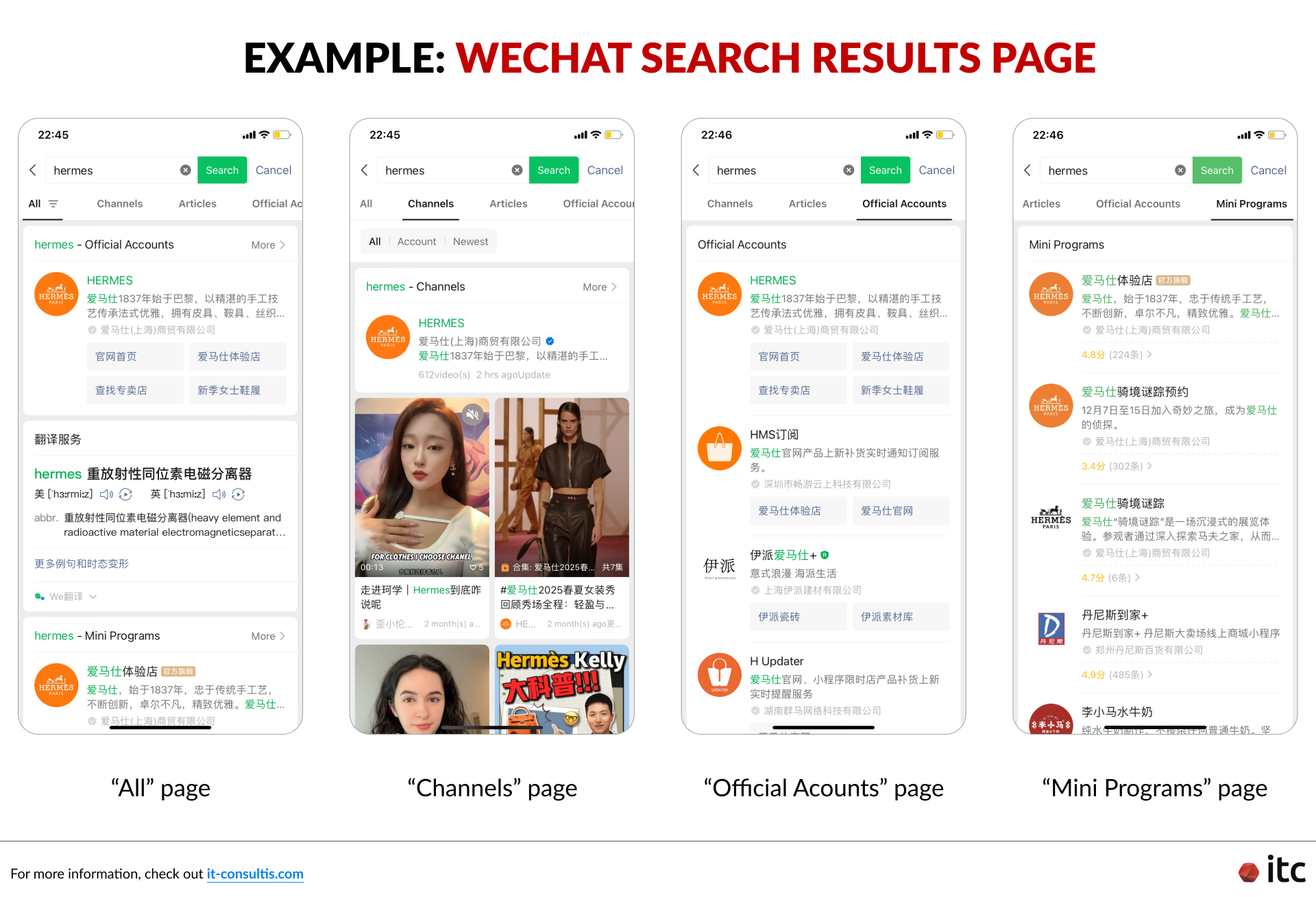
What WeChat SEO Includes
WeChat SEO is often misunderstood as a narrow WeChat Official Account (OA) article optimization exercise. In practice, it is broader than that.
It includes the visibility and relevance of:
- Account setup (name, description, verification, menu structure)
- Article content (titles, headings, keywords, readability)
- Account organization (homepage categorization, collections)
- Supporting WeChat assets (WeChat Channels, Mini Programs)
For most brands, the Official Account remains the core foundation because it combines brand presentation, searchable content, and user follow-up potential. But it should be understood as part of a wider WeChat presence rather than as an isolated publishing asset.
WeChat Search also makes it clear that search is increasingly designed to connect users with multiple types of content and services inside WeChat.
What Influences Visibility Inside WeChat
WeChat Search visibility depends less on external backlink authority than Baidu or Google SEO. It depends more on in-platform relevance, account clarity, keyword use, content structure, and what users encounter after the tap.
Effective WeChat Search optimization starts with stronger account clarity, tighter keyword alignment, and more structured user pathways after the search click.
Topical Consistency Builds Account Credibility
One of the strongest signals a brand can send is thematic clarity. Focused topic ownership outperforms scattered publishing because it makes the account easier for users and the platform to understand.
In practical terms, that means a brand should not publish trend-chasing, topically scattered content just to increase volume. A stronger approach is to define a clear content territory and reinforce it steadily over time.
A strong WeChat content strategy should align topic ownership, keyword focus, and publishing consistency so the account builds relevance over time rather than chasing isolated trends.
For B2B brands, that usually means building repeated visibility around a defined set of sector questions, solution themes, and business challenges rather than chasing unrelated topics for volume.
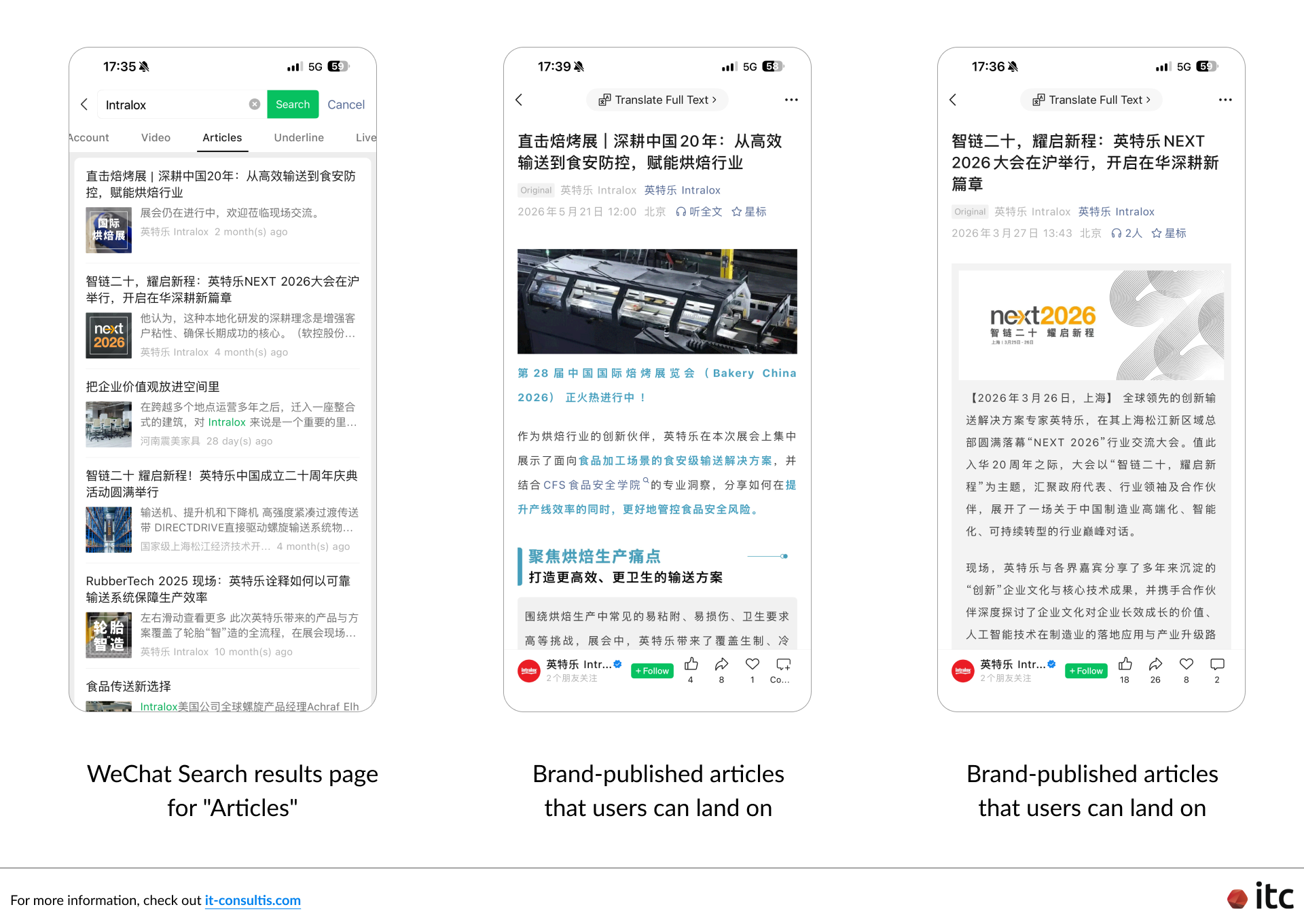
Keyword Relevance Matters, But Intent Matters More
Brands need evergreen long-tail keywords linked to their identity, offer, or recurring solution themes, and they also need thematic keywords tied to timely topics, news developments, current concerns, or seasonal opportunity areas.
That distinction matters because the goal is not repetitive keyword stuffing. The goal is to combine stable topic ownership with fresh relevance.
Tencent’s WeChat Index can support directional topic research here, especially when comparing related phrases and assessing attention patterns.
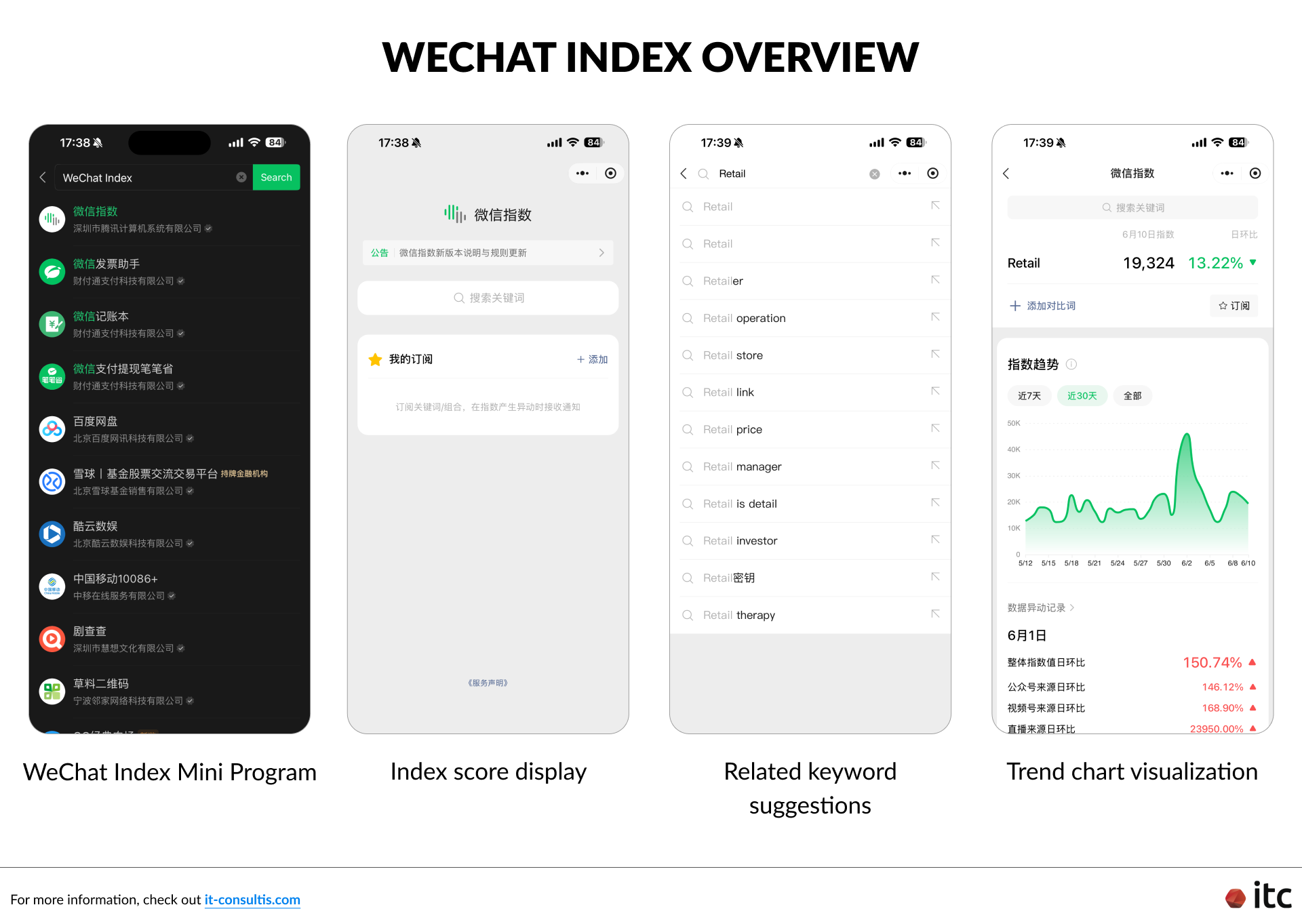
Need help analyzing your WeChat visibility? ITC helps brands assess their search performance, keyword positioning, and content discoverability inside WeChat. Get in touch for a tailored review.
Search-Friendly Content Structure Still Matters
Articles should make their subject immediately clear through precise titles, logical headings, and readable formatting.
Titles should reflect the real subject clearly, and headings should make the article easy to scan on mobile.
Because WeChat allows only limited post-publication edits, brands should treat clarity and structure as part of pre-publication optimization.
Content Organization Shapes The Post-Search Experience
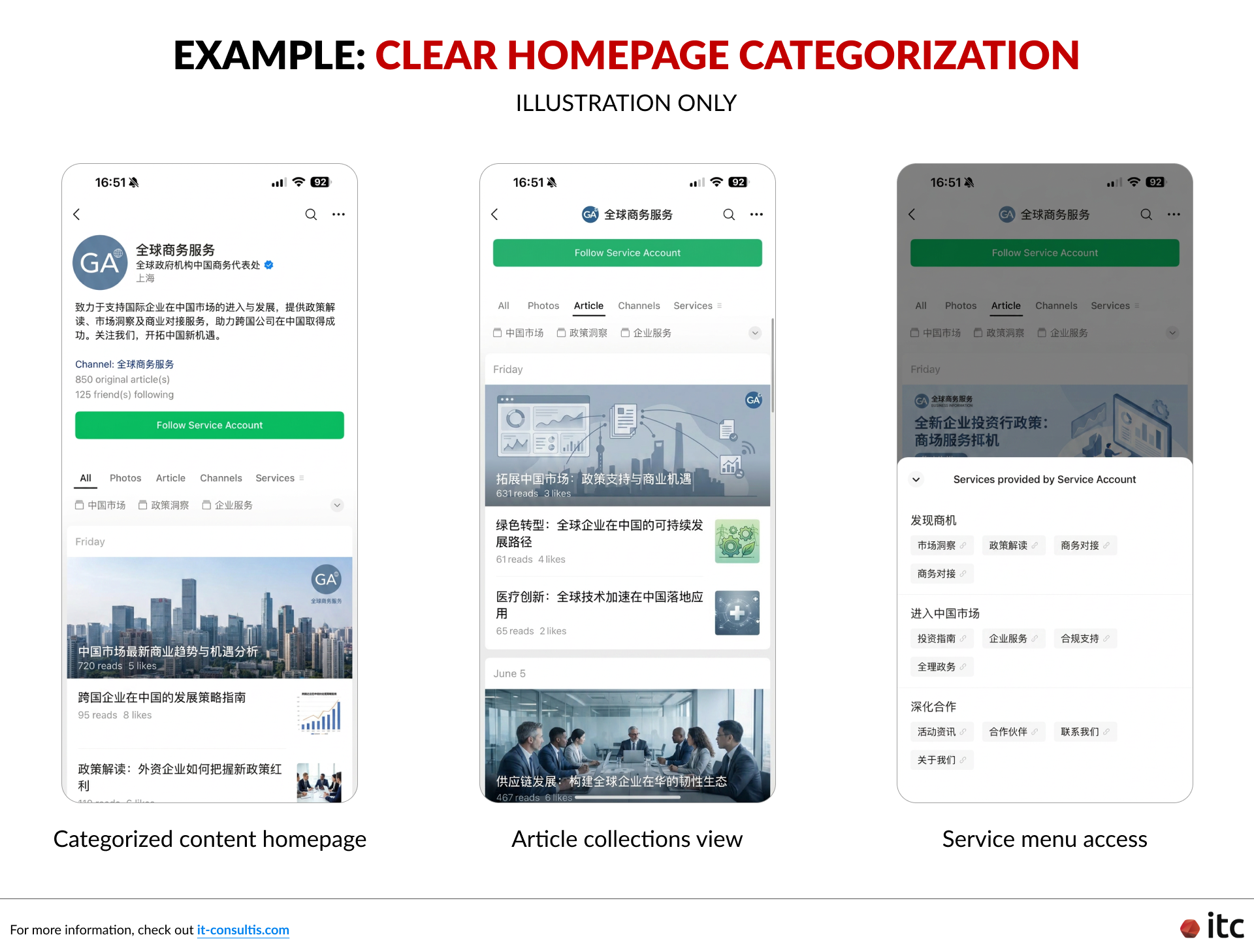
Clear homepage categorization, article collections, and better in-account pathways within the WeChat OA setup help previously published content continue to create value, while also making the account feel more coherent and navigable after discovery.
For example, in one government agency project, their WeChat search visibility improved not through a single SEO tactic, but through a combination of stronger account positioning, clearer keyword use, better homepage content organization, and more practical KPI tracking.
That is a more realistic model for WeChat SEO: not isolated optimization, but coordinated improvements across the full discovery journey.
One Account vs. Multiple Accounts: A Strategic Choice
For some organizations, the biggest SEO question is not simply how to optimize one WeChat Official Account. It is whether one account is even the right setup in the first place.
This is especially relevant for school groups, multi-campus education brands, and organizations with multiple business units, geographies, or audience layers.
In these cases, the choice between one OA and several is usually not an SEO decision first. It is a branding, governance, and audience-management decision, and SEO should support that setup once it has been chosen.
This logic can be seen in our work with Dulwich College International, which has one group-level Official Account and multiple for its individual schools in China.
At the group level, the objective was to strengthen institutional visibility and direct prospective students and parents toward the right school-level entry points. You can read more about this approach in our Dulwich College International Social CRM case study.
At the school level, the priority was more localized discovery and clearer progression toward admission inquiry and engagement, as detailed in our Dulwich College International student recruitment case study.
That more sophisticated setup contributed to stronger lead generation, better campaign engagement, and more sustained Official Account follower growth.
This is what makes the one-account-versus-multiple-accounts decision strategic rather than technical: the right structure depends on brand governance, audience segmentation, and how discovery should translate into action.
As WeChat Search becomes more important, this decision matters even more because brands need to think carefully about: (1) which account should rank for which topics and (2) how authority should be distributed across the wider WeChat presence.
How Brands Should Execute WeChat SEO
Once the main visibility drivers are clear, execution should follow a repeatable operating model. The goal is to make WeChat SEO manageable across setup, content, publishing, and review rather than treating it as a one-off optimization task.
1. Start with the Official Account Itself
Review the account name, description, verification status, and menu structure — all managed through the WeChat Official Account Admin Platform — before expanding content efforts.
For most brands, a WeChat Service Account is usually the more practical choice than a Subscription Account, because it is better suited to business communication, user visibility, and conversion-focused journeys:
- Service Accounts allow only 4 broadcasts per month, which encourages brands to prioritize stronger, higher-value content.
- They support richer QR code generation and tracking, making them more useful for campaigns and lead tracking.
- They are generally better suited to conversion-oriented features such as service flows, payments, and deeper user journeys.
For more details, check out the guide to WeChat Official Accounts.
2. Build Content Consistency Before Chasing Scale
Choose the main topics the account should consistently own, then publish against those themes instead of chasing unrelated volume.
3. Combine Evergreen and Timely Keywords
Pair stable, long-tail keywords that reflect your core offer with timely keywords tied to current topics or seasonal relevance. Tencent’s WeChat Index can help validate which terms are gaining traction.
4. Optimize Articles For Searchability And Mobile Readability
Use precise titles, clear headings, and concise paragraphing because WeChat allows only limited post-publication edits.
One practical pre-publication check is to use an AI tool like DeepSeek to evaluate your draft.
For example, you can prompt it to assess whether your title clearly reflects the article’s core topic, whether headings follow a logical keyword structure, and whether the content would likely surface for your target search terms inside WeChat.
This kind of AI-assisted review can help catch searchability gaps before the article goes live, when edits are still possible.
5. Connect Discovery to Useful Next Steps Across WeChat Assets
Ensure that when users find your content through search, they encounter clear pathways forward, whether through article collections, menus, WeChat Channels, or Mini Programs.
WeChat SEO performs best when the Official Account operates as part of a connected presence rather than a standalone publishing channel.
How To Measure WeChat SEO Performance
Because WeChat is a relatively closed environment, brands cannot rely on the same toolset they may use for Baidu or Google SEO. That makes it even more important to focus on a practical KPI set.
The most useful signals usually include:
- Search ranking for priority keywords
- Number of searchable articles under those keywords
- Page views from WeChat Search as a traffic source
- Follower growth or downstream actions influenced by search discovery
These metrics help brands answer two different questions:
- Are users finding the content?
- Does the content persuade them to stay engaged?
WeChat SEO vs WeChat Ads: When Paid WeChat Search Promotion Makes Sense
Paid WeChat Search placements can support visibility, but they should usually come after a brand has built a basic organic foundation.
An organic-first phase helps brands understand which topics, formats, and keyword approaches already create traction.
Once those patterns are clearer, paid search can be used more selectively to strengthen visibility around priority content or highly valuable commercial themes.
In other words, paid amplification works best when it builds on a clear organic logic rather than compensating for a weak one.
Why Brands Should Start Watching WeChat GEO
Brands should also keep an eye on the rise of Generative Engine Optimization (GEO) inside WeChat.
GEO refers to optimizing content so it can be surfaced and cited by AI-assisted search experiences, rather than ranked in traditional search results.
The rise of AI-powered search on WeChat is reshaping how users discover information. This matters because AI-assisted discovery is beginning to influence how users search, evaluate sources, and move from answers to brand-owned content.
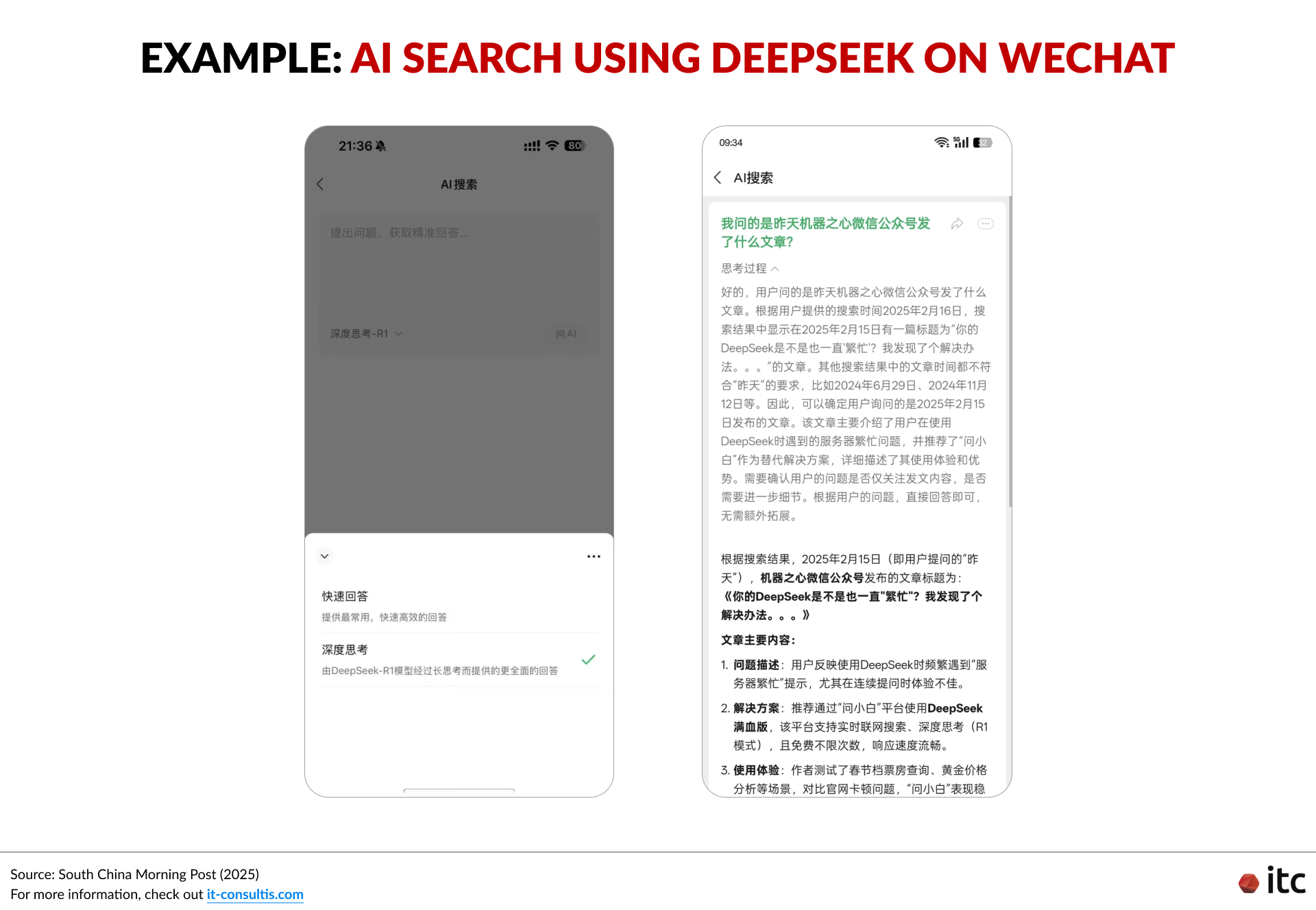
In early 2025, WeChat started testing its AI search feature with the DeepSeek-R1 model, moving beyond traditional keyword-based search toward direct answers that can draw from both web sources and Official Account content inside the WeChat ecosystem.
At this stage, however, there is still no developed toolset or structured operating model for GEO on WeChat, and most brands are only beginning to explore what is possible.
That means the most practical step today is not over-investment, but building a stronger content and search foundation that will remain useful as methods mature.
Conclusion
WeChat can be an excellent search and discovery environment for brands in China when the setup is properly optimized.
The brands that perform best on WeChat are not the ones that publish the most, but the ones that build a search-ready presence where account setup, content, structure, and user pathways work together to support discovery and conversion.
That is why WeChat SEO should be treated as part of a broader China digital growth strategy and a key driver of WeChat marketing performance, not just as a publishing task inside one channel.
IT Consultis (ITC) is an award-winning digital transformation consultancy guiding brands in building China-ready digital ecosystems that connect WeChat, WeCom, content strategy, social CRM, and local user journeys to drive stronger ROI.


